


A Typical Day on a Nepal Trek: From Breakfast to the Next Tea House

Five hours of walking, two plates of dal bhat, and an eight o’clock bedtime. Here’s what the hours in between actually look like.
The question I get most often from people planning a first trek isn’t about altitude, or training, or whether they really need a down jacket. It’s smaller than that, and usually a bit sheepish: what do you actually do all day?
Fair question. You’re not climbing anything. There’s no rope work, no summit push, no daily crisis to manage. You walk for five or six hours, and then you stop. Put like that, two weeks of it sounds like it could get dull.
It doesn’t, and the reason has less to do with scenery than people assume. It’s the shape of the day. Everything narrows down to four or five decisions, all of them small, all of them about food, warmth, or where to put your feet. So here’s one of those days, start to finish, from waking up cold to giving up and going to bed at eight.
Waking up, somewhere between 5:30 and 6:30
Nobody sleeps properly above 3,000 metres. Accept that early, and the rest is fine. You’ll surface three or four times in the night. Partly the altitude, partly the tea, mostly the fact that tea house walls are plywood and your neighbour has a cough.
The final wake-up is rarely your alarm. It’s someone’s boots on the floorboards above your head, at a volume suggesting they have never once considered that other people might be asleep underneath them.
In Dingboche one October I woke to frost on the inside of the window. Not a metaphor. Actual crystals, on the glass, in the room.
The hardest thing you’ll do all day is get out of the sleeping bag. Everything after that is downhill, emotionally speaking. One trick that genuinely works: put tomorrow’s base layer in the bag with you overnight, so you’re not dragging cold fabric over warm skin at six in the morning.
Don’t expect the dining room to be warm either. In most lodges the stove isn’t lit until late afternoon, because yak dung and firewood have to be carried or gathered and nobody’s burning them on breakfast.
You eat in your down jacket. Everyone does. A room full of grown adults in puffer jackets and beanies, hunched over porridge, saying almost nothing, is a completely normal Tuesday up there.
Breakfast
Most lodges want your dinner order and your breakfast order at the same time, the night before. That isn’t fussiness. There’s one stove, often one cook, and fifteen people who all want to be walking by half seven.
The menu is more or less fixed across the entire industry. Porridge with apple. Muesli, usually with hot milk made from powder. Tibetan bread, a deep-fried disc about the size of a dinner plate, better than that description suggests and considerably better with honey. Chapati and eggs. Somewhere in the Annapurnas you’ll be offered a pancake, and it will arrive looking nothing like a pancake.
Coffee is instant. Make peace with that now or carry your own.
What I order nearly every morning: porridge, two boiled eggs, a pot of lemon-ginger-honey. Not exciting. It’s warm, it’s mostly carbohydrate, and it doesn’t sit like a brick when you start climbing forty minutes later.
The classic first-timer mistake is a big greasy plate at 4,000 metres. Digestion slows down at altitude, and you’ll spend the first hour of the walk regretting your ambition.
Fill the thermos before you leave. A litre of hot water runs anywhere from 100 to 400 rupees depending on how high you are, and on a cold day it’s the best money you’ll spend all week.
Getting out the door, 7:00 to 8:00

The first hour involves more admin than you’d think. If you’ve got a porter, the big bag needs to be packed and downstairs by an agreed time, and genuinely closed rather than held together by optimism.
Everything you might want before evening goes in the daypack, because you will not see that duffel again until you arrive. People forget this constantly and spend the afternoon without their gloves.
In the daypack: two litres of treated water, snacks, a warm layer, a windproof, sunscreen, SPF lip balm, headlamp, basic first aid, permits. Rain shell from June through September and, frankly, the rest of the year too. Mountain weather doesn’t read the brochure.
Sunscreen is not optional. The UV at altitude is savage, and the classic Nepal tan line runs straight across the bridge of your nose in a way that shows up in every single photograph for the rest of the trip.
Then you walk, and the first twenty minutes are always bad. Cold legs, cold fingers, the pack heavier than it was yesterday, a flicker of resentment towards whoever suggested this.
It passes. It always passes. By the half-hour mark you’ve found the rhythm and stopped noticing.
The best two hours of the day
Morning is when Nepal shows off, and it isn’t close. The air is clearest before the valley heats up, which means the peaks are sharp and the light is doing something faintly ridiculous to the snowfields.
Cloud usually builds from late morning onward, so anything you want to see, you want to see now. If you only take one set of photos, take them before eleven.
You’ll share the trail. Mule trains and zopkyo, the yak-cow crossbreed that does most of the heavy lifting on the Everest side, move supplies up and down all day, and they do not give way.
One rule, and treat it as non-negotiable: when animals pass, step to the inside of the trail, against the hillside. Never the drop side. A loaded mule swinging a crate sideways has put people over ledges. Your guide will tell you once and then assume it stuck.
You’ll also pass porters carrying loads that make your eight-kilo daypack feel like a fashion accessory.
The trail greeting is namaste, offered to more or less everyone. Higher up, as the villages thin out, fewer people say it back. That isn’t rudeness. Above a certain altitude, everybody’s rationing breath.
Your pace, by the way, should feel too slow. Bistari, bistari. Slowly, slowly. If you can’t hold a conversation while walking, you’re going too fast, and going too fast is how a day falls apart at four in the afternoon.
Mid-morning tea, around 10:30
Somewhere along the way there’s a shack. Tin roof, three tables, a woman with a kettle, an elderly dog who has decided you look interesting.
Black tea, milk tea, sometimes a boiled potato with salt and chilli. It costs more than you expected, more than it did yesterday, and it’ll cost more again tomorrow.
That’s the price ladder, and it’s the most useful thing to understand about the economics of a trek. Everything you’re drinking arrived on someone’s back or a mule’s.
A Snickers at the trailhead is 150 rupees; at 4,500 metres it might be 600. That isn’t a tourist tax. That’s a man carrying a box of them uphill for two days.
Tip accordingly. Buy the second cup.
Lunch, and budget an hour for it
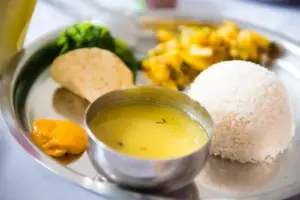
Dal bhat.
There’s a slogan on T-shirts in Thamel, dal bhat power, twenty-four hour, and it stopped being a joke roughly ten thousand trekkers ago.
Rice, lentil soup, a curried vegetable, pickle, sometimes greens, sometimes a papad. The critical detail is that refills are free and nobody is stingy about them. Someone comes round with the rice bucket and keeps going until you physically wave them off. Nothing else on the menu works like that.
There’s a food safety argument too. Dal bhat is what the kitchen cooks every day for its own family, so it’s fresh, cooked through, and turning over fast. The pizza, the lasagne, the yak steak get ordered maybe twice a week, and you’re gambling on how long those ingredients have been sitting in a room with no refrigeration.
Order what the kitchen actually makes. Your stomach will thank you around day nine.
Expect to wait forty-five minutes, sometimes longer. One stove, one pot, everyone arriving at once.
Put a layer on before you sit down, because this is exactly where people get cold: you turn up sweaty, sit still in a shaded room, and by the time the food lands you’re shivering.
Fleece on, immediately, every time.
The afternoon, which is the honest part

Here’s what the brochures skip. Afternoons are harder.
The cloud rolls in, the light goes flat, and the legs that felt great at nine feel like someone swapped them out at lunch.
With a cruelty that seems almost deliberate, the steepest climb of the day is usually the final thirty minutes, straight up to the village you’re sleeping in. Namche is the famous offender. Ghorepani does it too. Whoever chose these sites had strong legs and no sympathy.
You’ll also learn what Nepali flat means.
Your guide says the next section is flat. It is not flat. It’s a sequence of ups and downs that cancel out neatly on an elevation profile and do not cancel out at all in your quadriceps. This is delivered with total sincerity and a very small smile, and you have no recourse.
Afternoons are when you pay attention to yourself, too. A headache that won’t shift after water and rest, nausea, dizziness, breathlessness while sitting still: those get said out loud to your guide today, not tomorrow.
Altitude sickness gets worse quietly, and then all at once, and the only reliable treatment is descending. Everything else buys time.
Mostly, though, nothing dramatic happens. You go slowly, you drink more water than feels reasonable, and eventually you round a corner, and there are prayer flags and a tin roof.
Arriving, 2:30 to 4:00

Rooms are cheap, occasionally free, and the reason is simple. The lodge makes its money on food, and the understanding is that you eat there. Don’t try to be clever about it. Eat where you sleep.
Spend thirty seconds choosing the room if you have the choice. Away from the toilet block. Not directly above the kitchen, which sounds cosy and is in practice a five a.m. alarm clock made of saucepans.
A window is nice. A window that shuts is better.
Then the ritual, which never varies. Unroll the sleeping bag straight away so it has hours to loft up before you climb in. Get out of damp socks. Wash the pair you walked in, knowing full well they won’t dry but will at least be less offensive. Lay out tomorrow’s layers.
A hot shower, where one exists, runs 400 to 800 rupees and is a gamble. Gas is hot. Solar is hot if the day was sunny and glacial if it wasn’t, and whoever went in before you has usually taken all of it.
Wash early, while there’s still sun on the pipes and enough daylight left to warm back up.
Charging is separate money, normally 200 to 400 rupees an hour, and higher up it’s coming off a generator or a panel. A power bank pays for itself in three days. So does sleeping with your phone in your bag, because cold flattens a battery far faster than use does.
If there’s anything left in your legs, walk uphill for half an hour and come back down. It helps you acclimatise, and it buys you the view without the pack.
The dining room, which is the real social life of a trek
Around five, the stove gets lit, and the entire building migrates into one room.
This is the best hour of the day, and nobody photographs it. Everyone’s clean-ish, warm for the first time since breakfast, slightly punch-drunk.
Cards come out. Someone is two-thirds through a paperback and will not stop telling you about it. There’s a retired couple who’ve walked this route three times, two extremely serious Germans with immaculate equipment, a guide quietly charging four phones at once, and a group in the corner already deep into a hand of something with money on it.
You’ll notice the menus are identical. Not similar. Identical. Same laminated pages, same layout, same hopeful photograph of a pizza. Someone in Kathmandu printed the lot, and they’ve been carried up every valley in the country.
Dinner lands around half six. Garlic soup first, which is half tradition and half sincere belief that it helps with altitude, and which tastes good enough that the argument is academic.
Then dal bhat, or fried rice, or momos if you’re feeling brave.
Alcohol is a poor idea above 3,000 metres; it dehydrates you and masks the symptoms you’re meant to be watching for. Save it for the descent, where a tongba or a Khukuri rum beside the stove becomes one of the genuine rewards of the trip.
Your bill is being written in a notebook the entire time. Nobody’s tracking it but the owner, but the owner is tracking it perfectly.
Cash only, almost everywhere, and there’s no ATM above the roadhead.
Order breakfast. Go to your room.
Trekker’s midnight
By eight the dining room is thinning. By half eight most of the building is horizontal.
There’s one last trip outside, headlamp on, and this is the bit I’d keep if I could only keep one.
The cold hits you like a door. Then you look up, and there’s no electric light for forty kilometres in any direction, and the sky is not so much beautiful as absurd. So many stars it stops reading as a sky and starts reading as an error.
Then into the bag wearing most of your wardrobe, an alarm set that you won’t need, listening to somebody in the next room rearranging plastic bags at extraordinary length.
That’s the day. It repeats with small variations for a fortnight, and somewhere around the fourth or fifth one it stops feeling repetitive and starts feeling like the entire point.
Four decisions: when to leave, what to eat, when to stop, when to sleep.
The trail handles everything else.
People come home talking about the mountains, and the mountains deserve it. But what tends to stay with them, in my experience, is how simple a day turned out to be, and how long it takes to remember that once you’re back somewhere complicated.


How to book a trip?

make free inquiry

confirm the trip
