


Mera Peak Climbing


Destination
Mera Peak Climbing
Difficulty
Easy
Meals
- Breakfast
- Lunch
- Dinner
Overview of Mera Peak Climbing
A Complete Guide to the Highest Trekking Peak in Nepal
Introduction
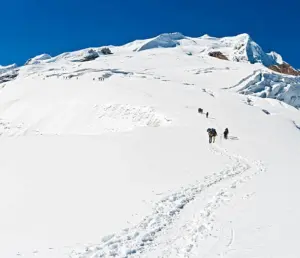
Mera Peak climbing is one of the most rewarding trekking peak expeditions in Nepal. Among the many peaks scattered across the Himalayas, Mera Peak (6,476 m) holds a special reputation. It is often described as the highest trekking peak in Nepal, a mountain that sits quietly in the Everest region yet rewards climbers with one of the most dramatic panoramic views in the entire Himalaya. For many mountaineers, Mera Peak climbing represents the perfect bridge between trekking and true Himalayan mountaineering. It’s high, remote, and glaciated, but technically straightforward compared to the giants surrounding it. That balance is exactly why climbers from around the world arrive in Nepal each season hoping to climb Mera Peak.
What makes the experience memorable isn’t just the summit. It’s the journey through the hidden Hinku Valley, far from the busier Everest Base Camp trail. The trek winds through quiet rhododendron forests, remote Sherpa villages, and high alpine valleys where yak caravans slowly move beneath towering ridgelines. Along the trail, you’ll notice small details that make the Himalaya feel alive with colorful prayer flags fluttering above mountain passes, stone mani walls carved with Buddhist mantras, and tiny teahouses where trekkers gather around warm stoves in the evening.
By the time climbers reach the small settlement of Khare, the last village before the glacier, the mountains suddenly feel enormous. The real Mera Peak expedition begins here.
Location and Geography of Mera Peak
Mera Peak rises in the Mahalangur Himal, the same subrange that holds some of the world’s tallest mountains. The peak sits southeast of Mount Everest in the remote Hinku Valley, a region that feels noticeably quieter than the famous Everest Base Camp route. The valley itself is wild and beautiful. Long glacial rivers carve through broad alpine landscapes, while towering peaks dominate the skyline in every direction.
Despite its relatively modest fame compared to Everest or Ama Dablam, Mera Peak stands at 6,476 meters (21,247 feet). That elevation alone places it above many mountains around the world that are considered major expeditions.
Geographically, the mountain has three main summits:
-
Mera North (6,476 m) – the highest and most climbed
-
Mera Central (6,461 m)
-
Mera South (6,065 m)
Most climbers aim for Mera North, which is accessible via a glacier route that is challenging but manageable for fit trekkers with basic mountaineering skills. Because of its location, the summit offers an almost unbelievable Himalayan panorama. On a clear morning, climbers can see five of the world’s six highest mountains.
Why Climbers Choose Mera Peak
Many Himalayan expeditions require significant technical climbing skills. Mera Peak is different. What makes this mountain special is the combination of high altitude, moderate technical difficulty, and spectacular views. For climbers looking for their first Himalayan summit above 6,000 meters, Mera Peak climbing is often considered the ideal objective. But the appeal goes far beyond that.
A Remote and Quiet Route
Unlike the busy Everest Base Camp trail, the route through the Hinku Valley remains relatively peaceful. Days can pass where trekkers encounter only a few groups along the trail. The silence of these valleys is striking. Sometimes the only sound is the distant rumble of avalanches echoing across the glaciers.
Khare Acclimatization and Climbing Training
Most expeditions spend several days in Khare (5,045 m) before the summit push. This small settlement sits beneath the massive slopes of Mera Peak and acts as a natural acclimatization point.
During this time, guides often provide basic mountaineering instruction:
-
Using crampons
-
Walking with an ice axe
-
Rope techniques
-
Glacier travel
It’s an important part of the Mera Peak expedition, especially for climbers new to high-altitude mountaineering.
Skiing on Mera Peak
In recent years, skiing in Mera Peak has also gained popularity among experienced ski mountaineers. The broad glaciated slopes provide rare opportunities for high-altitude skiing with massive Himalayan backdrops.
Although skiing from the summit requires advanced skills and perfect snow conditions, it has added another adventurous dimension to the climb.
The Summit Views
Reaching the summit is the ultimate reward of Mera Peak climbing in the Himalayas. The summit panorama is arguably the greatest reward of the entire expedition. Standing there, surrounded by the tallest mountains on Earth, the scale of the Himalaya becomes almost overwhelming.
From the top of Mera Peak, climbers can see:
-
Mount Everest (8,848 m)
-
Lhotse (8,516 m)
-
Makalu (8,485 m)
-
Cho Oyu (8,188 m)
-
Kanchenjunga (8,586 m) in the far distance
The Summit Experience
The final steps toward the summit of Mera Peak often happen just as the sky begins to glow with early morning light. After hours of slow climbing across the glacier, the slope finally eases. A narrow ridge leads to a snow-covered summit marked by fluttering prayer flags. And suddenly the entire Himalaya unfolds around you. To the west rises Mount Everest, its dark pyramid towering above the Khumbu glaciers. Nearby stand Lhotse and Makalu, massive and silent.
Farther north, the broad summit of Cho Oyu gleams in the sunlight. On the distant eastern horizon, the giant silhouette of Kanchenjunga rises like a dream. Up there, the wind carries the faint flutter of prayer flags.
For a moment, everything feels still. After weeks of trekking through forests, valleys, glaciers, and high camps, standing on the summit of Mera Peak feels less like conquering a mountain and more like being welcomed into the heart of the Himalaya. And that, more than anything else, is why climbers keep coming back. Many climbers also combine Mera Peak climbing with the Island Peak Climbing expedition.
|
|
|
 |
Mera Peak Climbing Difficulty
Although Mera Peak climbing is considered non-technical compared to many Himalayan mountains, it is still a serious high-altitude expedition.
Key challenges include:
-
High altitude (above 6,000 m)
-
Glacier travel
-
Cold temperatures
-
Long summit day
Basic mountaineering skills such as using crampons, ice axes, and fixed ropes are required. However, with proper training and guidance, many first-time climbers successfully summit.
Permits for Mera Peak Climbing
Climbers must obtain permits from the Nepal Mountaineering Association.
Required permits typically include:
-
Mera Peak climbing permit
-
Makalu Barun National Park entry permit
-
Local area permit
Most trekking agencies arrange these permits as part of their expedition packages.
Best Time for Mera Peak Climbing
The two main climbing seasons are:
Spring (March–May)
Stable weather and longer daylight hours make spring a popular season for Mera Peak expeditions.
Autumn (September–December)
Autumn offers the clearest skies and excellent mountain views after the monsoon season.
Winter climbs are possible but significantly colder.
Itinerary of Mera Peak Climbing
Day 1: Arrival in Kathmandu
Your Mera Peak expedition begins in Kathmandu, Nepal’s energetic and slightly chaotic capital. For many climbers, stepping into the city feels like entering a gateway to the Himalaya.
The streets around Thamel are packed with trekking shops, prayer-flag stalls, and cozy cafes where climbers compare routes and expedition plans.
If you arrive early enough, it’s worth wandering through the narrow streets where incense drifts out of small temples and prayer wheels spin quietly along monastery walls.
In the evening, most expedition teams gather for a briefing with their guide.
Equipment is checked carefully, including:
-
Crampons
-
Harnesses
-
Boots
-
Warm clothing
Guides explain the upcoming itinerary, discuss altitude safety, and answer questions about the climb.

Max Altitude
1400mDay 2: Fly to Lukla, Trek to Paiya
Early in the morning, climbers head to the airport for one of the most famous flights in the world. A short but unforgettable journey into the mountains. About 30 minutes later, the plane lands on the steep mountain runway at Lukla, the gateway to many Everest region adventures. Unlike trekkers heading toward Everest Base Camp, the Mera Peak route quickly turns away from the main trail toward the Hinku Valley.
By late afternoon, trekkers arrive at Paiya, a small mountain village with simple teahouses.
Max Altitude
2729mDay 3: Paiya to Panggom
The morning begins with a gradual climb along narrow trails carved into steep hillsides. During spring, the surrounding rhododendron forests burst into color, painting the slopes with red and pink blossoms.
What makes this section of the trek special is its peaceful atmosphere. Unlike the busier Everest routes, only a handful of trekking groups pass through these trails. Along the way, you’ll notice small Buddhist shrines, fluttering prayer flags, and mani stones carved with sacred Tibetan mantras.
Occasionally, the silence is broken by the deep bells of yak caravans slowly making their way along the trail, transporting supplies to the higher valleys.
By afternoon, the trail reaches Panggom, a traditional Sherpa village surrounded by terraced fields and green hills.
Max Altitude
2845mDay 4: Panggom to Ningsow
Leaving Panggom behind, the trail climbs steadily toward the Panggom La Pass. Fromthetopof thepass, trekkers get their first distant glimpses of higher Himalayan ridges. Beyond the pass, the path drops into thick forests filled with bamboo, moss-covered trees, and small mountain streams.
The landscape here feels almost tropical compared to the stark alpine environments higher up. Birds call through the forest, and in quieter moments, the only sound is the rustling of windthrough the leaves.
By late afternoon, the trail reaches the quiet settlement of Ningsow, perched on aridge overlooking deep valleys.
Max Altitude
2863mDay 5: Ningsow to Chhatra Khola
This day’s trek introduces a more rugged section of the route. The trail climbs along ridgelines before gradually descending through dense forests. Eventually the path drops into the valley of the Hinku River, marking the entrance to the wild and remote HinkuValley which is the heart of the MeraPeak route.
The scenery begins to change here. The valleys widen, forests thin out, and distant snowy peaks begin to rise above the horizon.
Trekkers spend the night at Chhatra Khola, a small settlement beside the rushing river.
Max Altitude
2799mDay 6: Chhatra Khola to Kothe
Today, the trail follows the Hinku River deeper into the valley. Tall pine and birch forests line the path while the sound of glacial water echoes through the canyon. As the day progresses, the landscape begins to open up.
The dense forests slowly give way to wider alpine terrain, and the first real views of high Himalayan peaks begin to appear.
After several hours of trekking, the route reaches Kothe, a small riverside settlement that serves as an important stop for trekkers heading toward Mera Peak. The teahouses here are simple but welcoming, and evenings are often spent around the dining room stove, sharing stories with fellow climbers.
Max Altitude
3579mDay 7: Kothe to Thaknak
From Kothe onward, the environment begins to feel more alpine. The trail gradually climbs above the tree line, revealing wide glacial valleys surrounded by rugged ridges. Yak pastures appear along the valley floor, and trekkers often stop for lunch beside grazing herds.
What makes this stretch memorable is the growing sense of scale. The mountains now dominate the skyline, and the air feels noticeably thinner.
By afternoon, trekkers reach Thaknak, a small seasonal settlement nestled beneath towering cliffs and glaciers.
Max Altitude
4358mDay 8: Thaknak to Khare
This is one of the most scenic days of the trek. The trail climbs steadily through rocky moraine terrain as the valley narrows and glaciers begin to appear along the surrounding slopes. By the time you reach Khare, the environment has transformed completely. Vegetation disappears, replaced by raw mountain landscapes of rock, ice, and snow. The enormous northern face of Mera Peak rises above the valley like a frozen wall.
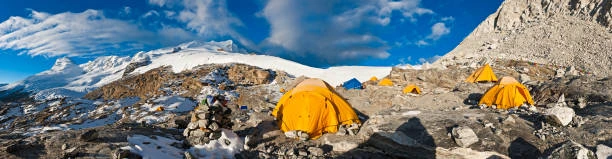
Khare serves as the main staging point for Mera Peak climbing, and climbers typically spend several nights here preparing for the ascent.
Max Altitude
5043mDay 9: Acclimatization Day in Khare
Day 10: Trek to Mera Base Camp
The real climbing phase begins today. Trekkers leave Khare and slowly ascend rocky terrain before reaching the lower sections of the Mera Glacier. Crampons are usually required here as the trail crosses sections of ice and snow.
The camp is set beneath towering ice formations and crevassed glacier walls. The atmosphere feels remote and dramatic, with nothing but snowfields and distant peaks stretching across the horizon.
Max Altitude
5348mDay 11: Move to High Camp
Climbers begin ascending the glacier using crampons, ropes, and harnesses. The climb is steady but not extremely steep, allowing climbers to move gradually while adjusting to the altitude. High Camp sits on a snowy ridge with breathtaking views of the Himalaya.
From here, climbers can see distant peaks glowing in the evening light. Sunset at High Camp is unforgettable as the sky turns deep orange while shadows stretch across the glacier.
Max Altitude
5779mDay 12: Summit Day
Summit day begins in the dark. Around 2–3 AM, climbers leave their tents and step onto the glacier under a sky filled with stars. Headlamps illuminate a slow procession of climbers moving quietly up the snow slopes. The climb itself is gradual but demanding due to the altitude. Each step requires patience and steady breathing.
As dawn approaches, the horizon begins to glow. One by one, the massive Himalayan giants appear above the clouds. The final section climbs a steeper ridge leading directly to the summit.
Reaching the top of Mera Peak (6,476 m) is an unforgettable moment. From here, climbers are surrounded by some of the highest mountains on Earth.
Max Altitude
6476mDay 13: Return to Khare
Day 14-17: Trek Back to Lukla
Day 18: Fly Back to Kathmandu
Trip Information - Good to Know
Accommodation and Food
During the trekking section, climbers stay in teahouses and lodges.
Typical meals include:
-
Dal bhat (rice and lentils)
-
Noodle soup
-
Fried rice
-
Pancakes and eggs
Higher up the mountain, particularly at High Camp, climbers stay in tents prepared by the expedition team. Meals become simpler but still warm and energizing.
Culture and Environment
The lower sections of the trek pass through Sherpa villages, where Tibetan Buddhist traditions remain deeply rooted in daily life.
Trekkers often pass:
-
Mani walls carved with sacred mantras
-
Spinning prayer wheels
-
Monasteries perched on hillsides
Respect for the mountains is deeply embedded in the culture here. Before many expeditions, Sherpa guides perform a puja ceremony, asking the mountain for safe passage.
Training and Preparation
To successfully climb Mera Peak in Nepal, climbers should prepare months in advance. Proper training is essential for successful Mera Peak climbing.
Recommended preparation includes:
-
Cardiovascular training (running, hiking, cycling)
-
Strength training for legs and core
-
Practice hikes with a loaded backpack
-
Basic mountaineering courses, if possible
Essential gear includes:
-
Mountaineering boots
-
Crampons
-
Ice axe
-
Down jacket
-
Glacier sunglasses
Safety and Altitude
Altitude sickness is the most serious risk during Everest region trekking peak expeditions.
Symptoms may include:
-
Headache
-
Nausea
-
Fatigue
-
Dizziness
Proper acclimatization, hydration, and slow ascent are essential. Good guides monitor climbers carefully and adjust the itinerary if needed.
Frequently Asked Questions
Is Mera Peak climbing difficult?
Mera Peak climbing is considered one of the easier Himalayan trekking peaks, but the high altitude of 6,476 meters still makes it physically demanding.
How long does Mera Peak climbing take?
Most expeditions take 17–18 days, including trekking through the Hinku Valley and acclimatization days.
Do you need experience for Mera Peak climbing?
Basic mountaineering skills such as using crampons and ice axes are recommended, but many beginners successfully climb Mera Peak with proper training.
Trip Reviews
 Write a Review








- Best Price Guarantee
- Secure & easy booking
- Easy trip date changes
- Discount for groups


How to book a trip?

make free inquiry

confirm the trip
