


EBC Gokyo Cho La Pass Trek

Trip Duration
18 Days Days
Group Sizes
2-16 People People
Transportation
Flight/Walk
Destination
EBC Gokyo Cho La Pass Trek
Max. Altitude
5420
Nature of Trip
Trekking
Best Season
Mar-May, Oct-Nov
Activities
- Trekking
- High Pass Crossing

Difficulty
Challenging
Meals
- Hotel/Teahouse Breakfast
- Teahouse Lunch
- Teahouse Dinner

Start & End Point
Kathmandu
Accommodation
- Teahouse
- Hotel
Overview of EBC Gokyo Cho La Pass Trek
 |
 |
The EBC via Gokyo Cho La Pass is the ultimate Khumbu trekking circuit, combining the sacred turquoise Gokyo Lakes, the legendary Cho La Pass (5,420m), Everest Base Camp, and the summit of Kala Patthar (5,545m) in one comprehensive 18-day journey. This route is Nepal’s most complete Everest region experience — crossing one of the highest trekking passes in the world, visiting both the Gokyo and Khumbu valleys, and reaching the foot of Everest itself.
Trip Overview
The Everest Base Camp via Gokyo Lakes and Cho La Pass Trek is the definitive Khumbu adventure — an 18-day circuit that combines the signature highlights of both the Gokyo and EBC routes into one epic Himalayan journey. You will stand atop Gokyo Ri for a four-peak panorama, cross the thrilling 5,420 m Cho La Pass through glacier and snow, reach Everest Base Camp at 5,364 m, and summit Kala Patthar (5,545 m) for the finest close-up view of Mount Everest available to non-climbers anywhere on Earth.
This is a Hard-rated trek. The Cho La Pass crossing involves steep, icy terrain and may require crampons. You will spend multiple nights above 5,000 m and walk some of the most remote and demanding terrain in the Khumbu. For experienced trekkers seeking their greatest Himalayan challenge, or for those who have completed either the EBC or Gokyo trek separately and want to experience both in one journey, this 18-day itinerary is unmatched anywhere in Nepal trekking.
The route begins with the classic ascent to Namche Bazaar, then diverges northwest up the Gokyo valley through Dole and Machhermo to the sacred turquoise Gokyo Lakes and the summit of Gokyo Ri. From Gokyo, the trail crosses the spectacular Cho La — a high glacier saddle linking the Gokyo and Khumbu valleys — before rejoining the EBC trail at Dzongla and Lobuche. The final days follow the world’s most famous trekking path to Everest Base Camp and Kala Patthar before the long descent back to Lukla.
Green Horizon’s experienced high-altitude guides are trained in glacier travel and emergency wilderness first aid, and carry all necessary safety equipment, including crampons, fixed ropes for the Cho La descent, and a Gamow bag. The itinerary is structured for maximum acclimatisation and safety, and our guides make real-time decisions about pace and rest based on each individual’s daily response to altitude. Only trekkers with demonstrated cardiovascular fitness and previous high-altitude experience above 4,000 m are recommended for this itinerary.
Learn more on our Everest Region page. Also see our Altitude Sickness Prevention and Trip Difficulty Grades guides.
There are a handful of trekking routes in the world that earn the word legendary, and the path linking Everest Base Camp, the turquoise lakes of Gokyo, and the high, ice-glazed crossing of Cho La Pass sits firmly among them. This itinerary takes the classic Everest Base Camp trek and weaves in arguably the most beautiful side valley in the entire Khumbu region, then connects the two with one of Nepal’s most dramatic high altitude pass crossings, all without resorting to the crowds and traffic jams that the standard EBC route has become known for in peak season.
Over eighteen days, the trail ascends from the lower Khumbu through Sherpa villages to the glacial heights above 4,500 meters, where yaks outnumber people. Experience stunning glacier-fed lakes, witness sunrise over four of the world’s six highest mountains from Gokyo Ri, navigate the frozen boulders of Cho La Pass at 5,420 meters, and reach Everest Base Camp before climbing Kala Patthar for unparalleled views of Everest’s summit.
This is not a casual walk. Combining Gokyo and Cho La Pass with Everest Base Camp makes for one of the more physically demanding teahouse treks in Nepal, both in terms of daily elevation gain and the technical difficulty of the pass crossing itself. But for trekkers with reasonable fitness, the right preparation and a sensible acclimatisation schedule, it remains entirely achievable without mountaineering experience or specialised climbing skills. What you get in return is, by most accounts, one of the very best multi-day trekking circuits the Khumbu has to offer.
Quick Facts
| Item | Details |
|---|---|
| Trip Duration | 18 Days, Kathmandu to Kathmandu |
| Trip Grade | Strenuous to Challenging |
| Maximum Altitude | 5,545m / 18,192ft (Kala Patthar) |
| Trek Region | Khumbu, Sagarmatha National Park, Nepal |
| Best Season | March to May, and late September to November |
| Group Size | 2 to 14 trekkers, private departures available |
| Start and End Point | Kathmandu, via flight to and from Lukla |
| Accommodation | Teahouses and lodges on the trail, 3-star hotel in Kathmandu |
| Meals | Full board on the trail, breakfast only in Kathmandu |
| Daily Walking Hours | 3 to 9 hours, depending on the stage |
| Total Trekking Distance | Approximately 130 to 150 kilometres round trip |
| Mode of Transport | On foot, plus a domestic flight between Kathmandu or Manthali and Lukla |
| Minimum Age Recommended | 12 years |
| Connectivity | WiFi and mobile networks are available in most villages for a fee |
Route at a Glance
A condensed look at the full circuit before the day-by-day detail below. Distances and timings are approximate and depend on weather, trail conditions, fitness, and how often the group pauses for photos, tea, or simply to take in the view.
| Day | Route | Altitude | Overnight |
|---|---|---|---|
| 1 | Fly Kathmandu to Lukla, Trek to Phakding (2,610m) | 2,610m | Teahouse |
| 2 | Phakding to Namche Bazaar (3,440m) | 3,440m | Teahouse |
| 3 | Acclimatisation Day in Namche Bazaar | 3,880m | Teahouse |
| 4 | Namche Bazaar to Dole (4,200m) | 4,200m | Teahouse |
| 5 | Dole to Machhermo (4,470m) | 4,470m | Teahouse |
| 6 | Machhermo to Gokyo (4,790m) | 4,790m | Teahouse |
| 7 | Acclimatisation Climb to Gokyo Ri (5,360m) | 5,360m | Teahouse |
| 8 | Gokyo to Thangnak, the Cho La Base (4,800m) | 4,800m | Teahouse |
| 9 | Cross Cho La Pass (5,420m), Descend to Dzongla (4,830m) | 5,420m | Teahouse |
| 10 | Dzongla to Lobuche (4,940m) | 4,940m | Teahouse |
| 11 | Lobuche to Everest Base Camp (5,364m) via Gorak Shep | 5,364m | Teahouse |
| 12 | Kala Patthar (5,545m) and Descend to Pheriche (4,280m) | 5,545m | Teahouse |
| 13 | Pheriche to Namche Bazaar (3,440m) | 3,440m | Teahouse |
| 14 | Namche Bazaar to Lukla (2,840m) | 2,840m | Teahouse |
| 15 | Fly Lukla to Kathmandu | 1,400m | Hotel |
| 16 | Buffer Day in Kathmandu | 1,400m | Hotel |
| 17 | Buffer Day Two in Kathmandu | 1,400m | Hotel |
| 18 | Final Departure | 1,400m | N/A |
Ready for the Trail
The combination of Everest Base Camp, the Gokyo Lakes, and Cho La Pass is, by most measures, the finest extended circuit the Khumbu has to offer—demanding in places, occasionally humbling, but consistently rewarding in a way that’s hard to put into words until you’re standing on Gokyo Ri watching the sun catch Everest’s summit, or crossing the wind-scoured boulders of Cho La with prayer flags snapping overhead. Eighteen days is enough time to do the route properly, with the acclimatisation built in to keep things safe and the buffer days built in to keep things stress-free.
Good preparation, realistic expectations, and a willingness to go slow when the altitude asks you to are really all that’s required beyond reasonable fitness. The mountains, the lakes, and the villages along the way take care of the rest.
For a professionally guided and well-organised trekking experience, consider booking your adventure with Green Horizon Tours Nepal. Their experienced local guides, carefully planned itineraries, and commitment to safety help ensure you get the most out of this remarkable Himalayan journey. For more information about the EBC Gokyo Cho La Pass Trek and other trekking adventures across Nepal, visit greenhorizontour.com.
- Cross the Cho La Pass (5,420m) — one of Nepal’s highest trekking passes
- Summit Gokyo Ri (5,360m) for four 8,000m peaks in one panorama
- Reach Everest Base Camp (5,364m) and Kala Patthar (5,545m)
- Walk beside the Ngozumpa Glacier and through the sacred Gokyo Lakes chain
- The complete Khumbu circuit — no other route covers more of this legendary region
- Three dedicated acclimatisation days for safe altitude progression
Itinerary of EBC Gokyo Cho La Pass Trek
Day 1: Fly Kathmandu to Lukla — Trek to Phakding (2,610m)
Your trek begins long before sunrise, weaving through Kathmandu’s quiet streets toward the domestic terminal for one of the most thrilling short flights anywhere in the world. The little Twin Otter banks low over forested ridgelines, and somewhere past Ramechhap, the first glimpse of snow-capped giants appears through the window, a preview of what’s coming. Landing at Tenzing Hillary Airport in Lukla, often described as one of the most extreme airports on earth, is an experience in itself. The runway tilts uphill at an angle that catches first-time visitors off guard, and the short, steep strip leaves little room for error, which is exactly why only the most experienced pilots are cleared to fly here.
After sorting gear and meeting the rest of the crew, you set off through Lukla’s narrow lane lined with gear shops and bakeries, then drop down toward the Dudh Kosi river. The trail rolls gently through Chaurikharka and a string of small Sherpa settlements, prayer wheels turning lazily in doorways, mani stones stacked along the path. Pine forest gives way to terraced fields, and the milky turquoise water of the Dudh Kosi keeps you company most of the afternoon. By the time you reach Phakding, a small riverside village at 2,610 meters, the legs are loosened up, and the appetite is sharp. It’s an easy first day on purpose, giving the body a gentle introduction before the climbing really starts tomorrow.

Duration
3-4 hrs
Activity
Trekking
Accommodation
Teahouse
Meals
L/D
Max Altitude
2610mDay 2: Phakding to Namche Bazaar (3,440m)
This is the day most trekkers remember as the real beginning of the climb. Leaving Phakding, the trail crosses and recrosses the Dudh Kosi on a series of swaying suspension bridges strung with thousands of fluttering prayer flags, the kind of image that ends up on every postcard from this region. Around Monjo, you register at the Sagarmatha National Park checkpoint, your first official step into the protected UNESCO World Heritage area surrounding Everest.
Past Jorsale, the valley narrows, pine and rhododendron press in close, and the river roars below as the path climbs steadily toward the confluence of the Dudh Kosi and Bhote Koshi. Then comes the famous ascent, a long, switchbacking climb up the forested hillside that gains nearly 600 meters in just a few hours. It’s tiring, no question, but there’s a reward built in. Where the trail flattens briefly, if the clouds cooperate, you catch your very first glimpse of Everest’s summit pyramid peeking out from behind Nuptse, framed perfectly between the ridgelines. Namche Bazaar itself, the unofficial capital of the Khumbu, appears suddenly around a bend, a horseshoe-shaped amphitheatre of stone houses, bakeries, gear shops, and guesthouses built into the hillside at 3,440 meters. After settling in, take it easy. Tomorrow is about letting your body catch up with the altitude.
Duration
5-6 hrs
Activity
Trekking
Accommodation
Teahouse
Meals
B/L/D
Max Altitude
3440mDay 3: Acclimatisation — Namche
Altitude doesn’t care how fit you are, which is why every well-planned itinerary on this route builds in a proper acclimatisation day here in Namche. The golden rule at high elevation is to climb high and sleep low, so rather than simply lounging around, most groups hike up toward the Everest View Hotel or the village of Khumjung, gaining several hundred meters before returning to sleep at Namche’s lower elevation.
The walk up to the Everest View Hotel, perched above 3,880 meters, rewards the effort with one of the most photographed panoramas in the Himalaya, Everest, Lhotse, Ama Dablam, and Thamserku lined up across the horizon on a clear morning. Many trekkers continue to Khumjung, a quieter, more traditional Sherpa village where the local monastery keeps what locals say is a yeti scalp on display, a curiosity worth a look even if you take the legend with a pinch of salt. Back in Namche by afternoon, there’s time to wander the Saturday market if your timing lines up, stock up on snacks, charge devices while the power is reliable, and rest properly. This is also a sensible moment for a final gear check before the trail splits toward the quieter Gokyo valley.
Duration
Acclimatisation
Activity
Rest/Hike
Accommodation
Teahouse
Meals
B/L/D
Max Altitude
3880mDay 4: Namche to Dole (4,200m)
From Namche, most Everest Base Camp groups head straight up the main Khumbu valley, but your route branches off toward Gokyo, a quieter and in many ways wilder trail. The path climbs out of Namche past Kyanjuma, where the views open up across the valley to Ama Dablam’s dramatic spire and the long ridge of Kangtega and Thamserku.
At Mong La, a small pass scattered with chortens and prayer flags, the trail offers a genuinely spectacular rest stop, arguably one of the best lunch spots on the entire circuit. From there, the path drops into pine and rhododendron forest before climbing again along the Dudh Kosi gorge, narrow in places and cut into the hillside above the river. Yaks plod past with bells clanking, and the air noticeably thins as you gain height through the afternoon. Dole, a tiny scattering of stone lodges at 4,200 meters surrounded by steep grazing slopes, marks your entry into proper high alpine territory. Evenings here turn cold fast once the sun drops behind the ridge, so a warm layer and a hot bowl of soup become the evening ritual.
Duration
5-6 hrs
Activity
Trekking
Accommodation
Teahouse
Meals
B/L/D
Max Altitude
4200mDay 5: Dole to Machhermo (4,470m)
The walk to Machhermo is mercifully short on paper, but altitude has a way of making every step feel a little heavier than the day before. Leaving Dole, the path traces the contour of the valley high above the Dudh Kosi, passing scattered summer settlements like Lhabarma and Luza that come alive with grazing yaks during the warmer months.
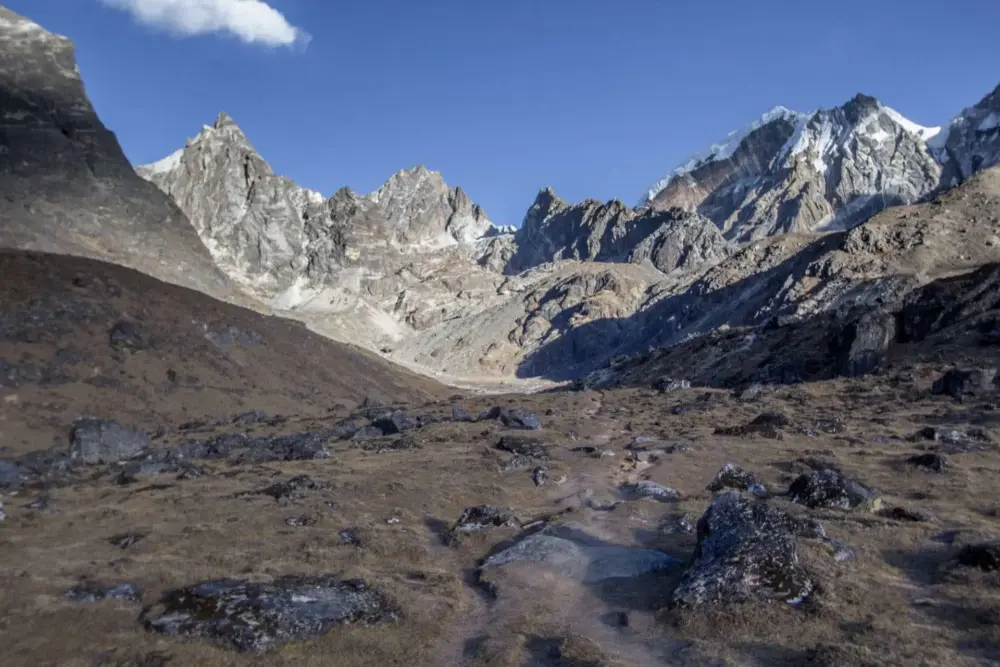
The landscape here turns properly alpine. Trees thin out almost entirely, replaced by dwarf juniper and windswept grass, and the views stretch open toward Cho Oyu, the sixth-highest mountain on earth, brooding at the head of the valley. Machhermo itself sits in a wide, exposed bowl at 4,470 meters, a cluster of lodges with a rather unusual claim to fame; this is reportedly where the first documented yeti sighting by a Western trekker took place back in 1974. True or not, it makes for good fireside conversation. With the body still adjusting, this is a good evening to drink plenty of water, eat well, and pay attention to how you’re feeling. Headaches and mild breathlessness are common at this stage. Anything more severe is worth mentioning to your guide right away.
Duration
3-4 hrs
Activity
Trekking
Accommodation
Teahouse
Meals
B/L/D
Max Altitude
4470mDay 6: Machhermo to Gokyo (4,790m)
Today brings one of the trek’s defining landscapes. The trail climbs out of Machhermo and soon runs alongside the Ngozumpa Glacier, the longest glacier in the Nepal Himalaya, its surface a chaotic jumble of grey rock and ice rubble that looks almost lunar against the white peaks behind it.
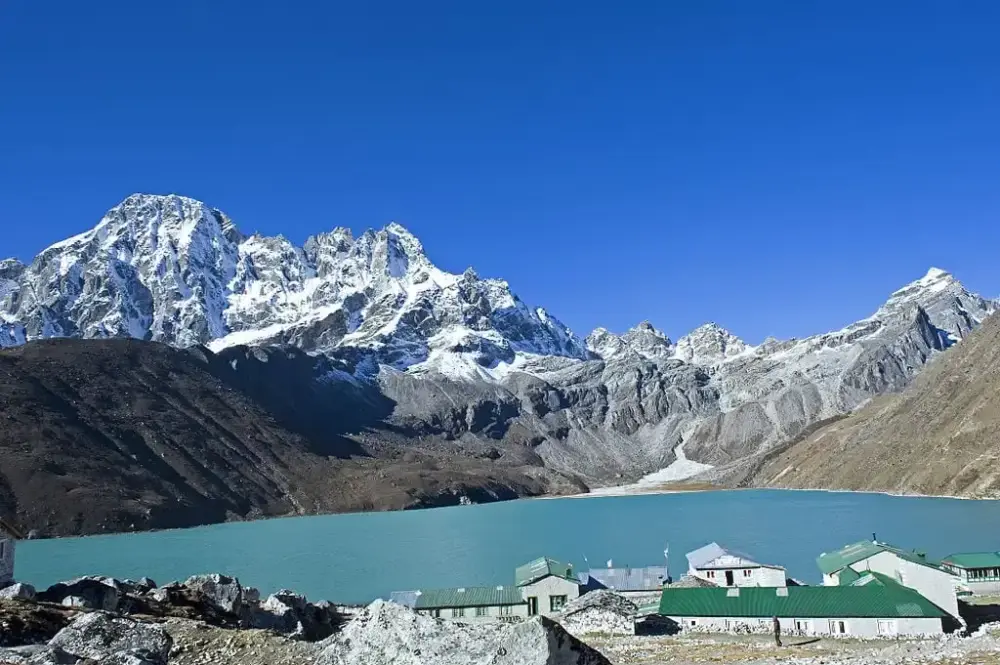
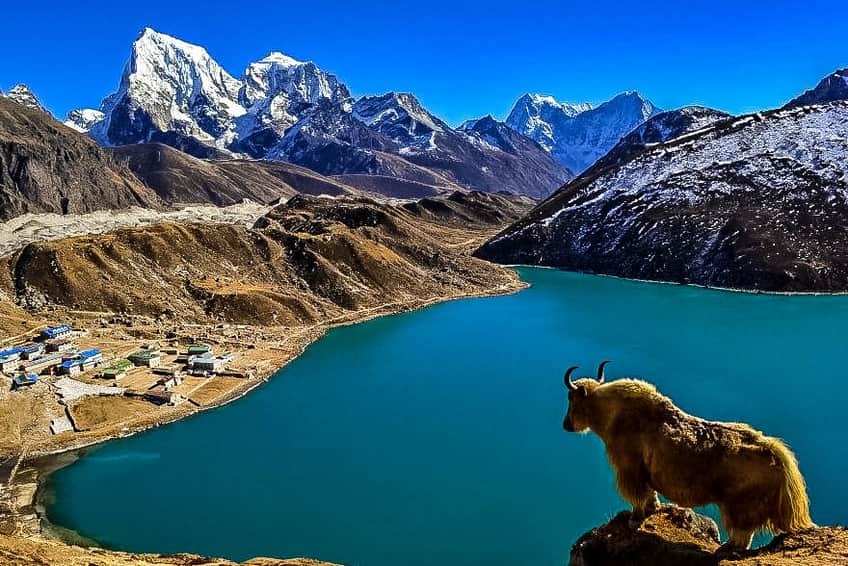
Before long, the first of the Gokyo lakes appears, a startling patch of turquoise water called Longpongo, followed not far after by the second lake, Taboche Tsho. The colour of these glacial lakes, somewhere between jade and electric blue depending on the light, never quite looks real in photographs. From the second lake, a final push along the glacier’s edge brings you to Gokyo village itself, strung along the shore of the third and largest lake, Dudh Pokhari, at 4,790 meters. Framed by Cho Oyu to the north and the towering wall of Cholatse and Tawache to the south, this is, by most accounts, one of the most beautiful settings of the entire trek. Settle into your lodge, rehydrate properly, and save your energy. Tomorrow’s predawn climb is one of the highlights of the whole journey.
Duration
4-5 hrs
Activity
Trekking
Accommodation
Teahouse
Meals
B/L/D
Max Altitude
4790mDay 7: Acclimatisation — Gokyo Ri (5,360m)
Set the alarm early, because today is built around catching first light from the summit of Gokyo Ri. The climb begins in darkness, headlamps bobbing up the steep, zigzagging trail above the lake, and it’s a proper effort, somewhere around two hours of steady uphill walking at an altitude where every breath works harder than it should.
The payoff at the top, 5,360 meters above sea level, is one of the most complete mountain panoramas available anywhere on foot in the Himalaya. Four of the world’s six highest peaks line up across the horizon, Everest, Lhotse, Makalu, and Cho Oyu, with the immense grey ribbon of the Ngozumpa Glacier unspooling directly below. Watching the first sunlight hit Everest’s summit while standing above the clouds is the kind of moment that tends to stay with people long after the trek ends. After soaking it in and warming frozen fingers around a flask of tea, descend back to Gokyo for a late breakfast. Energetic trekkers with strong acclimatisation sometimes add a side trip to the fourth and fifth lakes in the afternoon, though for most, today is simply about resting up before tomorrow’s crossing of Cho La.
Duration
8-9 hrs
Activity
Summit/Hike
Accommodation
Teahouse
Meals
B/L/D
Max Altitude
5360mDay 8: Gokyo to Cho La Base (4,800m)
This is officially a short day, and it’s worth treating it that way. The route leaves Gokyo and crosses back over a section of the Ngozumpa Glacier’s lateral moraine, a stretch of loose rock and ice that demands careful footing even though the distance covered is modest.
Thangnak, sometimes spelled Dragnag, sits at around 4,800 meters in a quiet side valley below the approach to Cho La, little more than a handful of lodges serving yak herders and trekkers preparing for the pass. With only three or four hours of walking, you’ll likely arrive by early afternoon, leaving plenty of time to rest, sort gear for tomorrow, and go over the route plan with your guide. Cho La has a reputation, deserved in part, as the most demanding stretch of the entire circuit, involving a steep boulder scramble followed by a crossing of glacial ice near the top. Use this evening well, lay out crampons or microspikes if your operator carries them, pack a headlamp within easy reach, and get to bed early. Tomorrow starts before dawn.
Duration
5-6 hrs
Activity
Trekking
Accommodation
Teahouse
Meals
B/L/D
Max Altitude
4800mDay 9: Cross Cho La Pass (5,420m) — Descend to Dzongla (4,830m)
Today is, for most people, the toughest and most memorable day of the whole trek. You’ll be moving before sunrise, partly to take advantage of firmer, frozen ground and partly because crossing exposed high terrain is always safer earlier in the day, before afternoon weather has a chance to roll in.
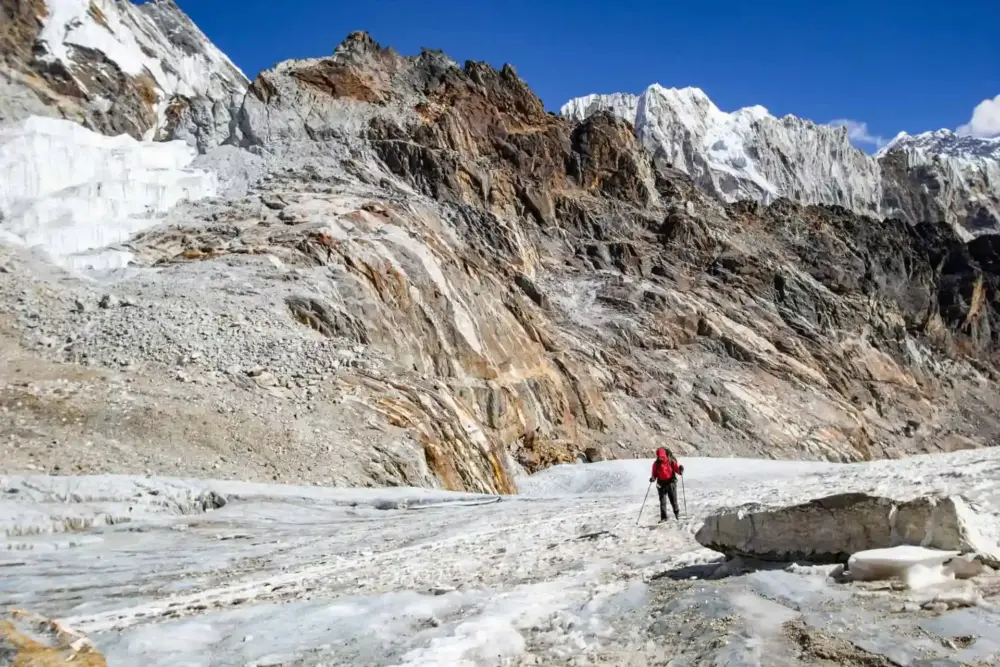
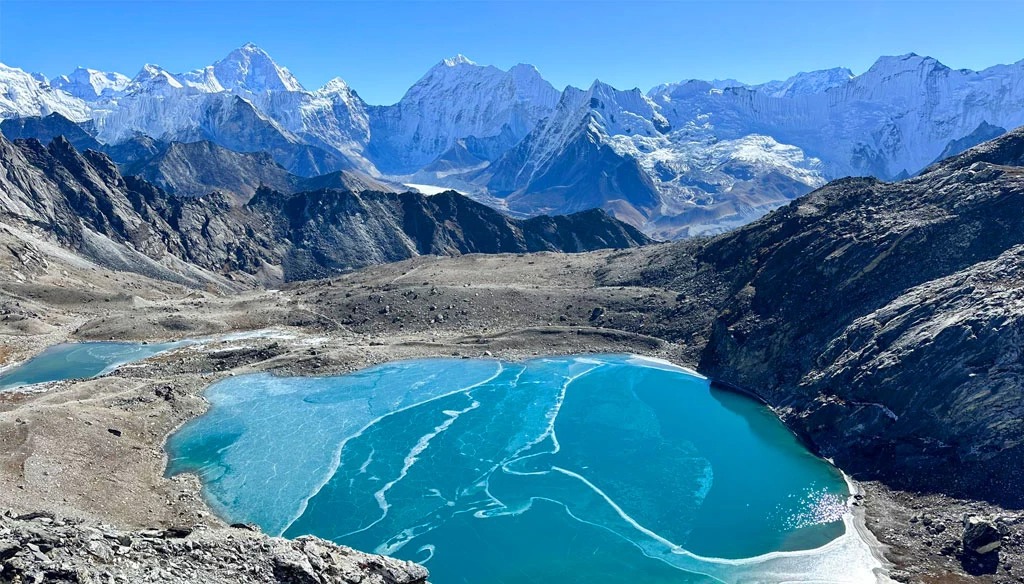
The climb to the pass winds through a boulder field that demands scrambling in places, hands as useful as feet on the steeper sections. Near the top, the trail crosses a stretch of glacial ice, where guides typically rope groups together or fit microspikes depending on conditions. Reaching the summit at 5,420 meters, marked by a tangle of weathered prayer flags snapping in the wind, brings a genuine sense of achievement, along with views across to Ama Dablam, Baruntse, and a sea of unnamed peaks stretching toward Tibet. The descent on the far side is steeper and, frankly, harder on the knees than the climb up, dropping over loose scree and rock to the glacier below before the trail eases toward Dzongla. This tiny outpost at 4,830 meters, tucked beneath the cliffs of Cholatse, offers little more than a few basic lodges, but after a day like this, a hot meal and a sleeping bag feel like genuine luxury.
Duration
6-8 hrs
Activity
Pass Crossing
Accommodation
Teahouse
Meals
B/L/D
Max Altitude
5420mDay 10: Dzongla to Lobuche (4,940m)
After yesterday’s effort, today feels almost gentle by comparison, though don’t let the shorter distance fool you into thinking it’s flat. The trail drops from Dzongla past the glacial lake of Chola Tsho, its surface often half frozen even outside the depths of winter, before climbing again to rejoin the main Everest Base Camp trail near Dughla.
At Dughla, take a moment at the memorial cairns built in honour of climbers and Sherpas who lost their lives on Everest and the surrounding peaks. It’s a sobering, quiet spot, strewn with stone monuments and faded prayer flags, and most groups pause here regardless of how much time pressure they’re under. From Dughla, a final climb up a rocky moraine slope brings you into Lobuche, a small collection of lodges at 4,940 meters with Nuptse’s sheer south face rising directly behind the village. The crowds thicken noticeably here, since this is now the standard route up to Everest Base Camp, a contrast after the relative solitude of the Gokyo valley. Eat well tonight, tomorrow is a long one.
Duration
3-4 hrs
Activity
Trekking
Accommodation
Teahouse
Meals
B/L/D
Max Altitude
4940mDay 11: Lobuche to EBC (5,364m) via Gorak Shep
This is the day most people have been picturing since they first booked the trip. The trail from Lobuche follows the lateral moraine of the Khumbu Glacier, undulating across loose rock with the icefall and a wall of surrounding peaks visible almost the entire way. After two to three hours, you reach Gorak Shep, a wind-scoured flat at 5,164 meters sitting on what was once a frozen lakebed, the last proper settlement before Base Camp itself.
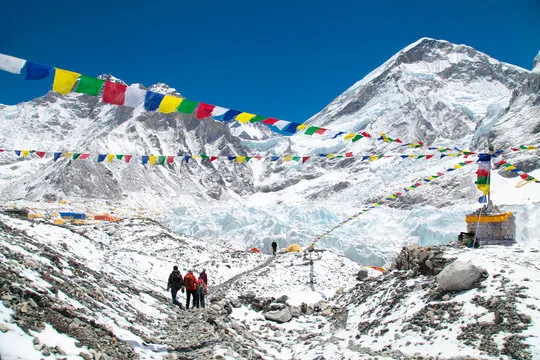
Drop your bags, grab a quick lunch, and continue toward Everest Base Camp, now only a few hours away across increasingly broken, rocky terrain. The approach winds between glacial pools and ice formations until the famous collection of expedition tents, prayer flag shrines, and the chaotic tumble of the Khumbu Icefall finally come into view. Standing at 5,364 meters at the literal foot of the world’s highest mountain is a strange, humbling kind of moment, often quieter and more understated than people expect, particularly outside spring climbing season when the camp itself is mostly empty. Photographs taken, you’ll retrace your steps back to Gorak Shep for the night, tired but unmistakably satisfied.
Duration
7-8 hrs
Activity
Trekking
Accommodation
Teahouse
Meals
B/L/D
Max Altitude
5364mDay 12: Kala Patthar (5,545m) — Descend to Pheriche (4,280m)
Set another early alarm. Kala Patthar, a rocky outcrop above Gorak Shep, offers what many consider the single best mountain view of the entire trek, a close, unobstructed look at Everest’s summit pyramid that’s actually impossible to see properly from Base Camp itself, since the mountain’s own bulk hides its summit from that angle.
The climb is steep and the air thin, gaining roughly 400 meters in under two hours, but arriving at the summit, 5,545 meters above sea level, as the first light catches Everest, Nuptse, and the surrounding wall of peaks is widely regarded as the emotional high point of the trip. After enough photographs and a while spent simply taking it in, descend to Gorak Shep for breakfast, then begin the long walk back down through Lobuche and Dughla toward Pheriche. The drop in elevation, over a thousand meters across the day, brings welcome relief, thicker air, warmer temperatures, and the first proper green moss and shrubs in days. Pheriche, set in a wide glacial valley at 4,280 meters, also hosts the Himalayan Rescue Association’s high altitude medical clinic, worth a quick visit if you’re curious how altitude affects the body, even if you’re feeling fine.
Duration
8-9 hrs
Activity
Trekking
Accommodation
Teahouse
Meals
B/L/D
Max Altitude
5545mDay 13: Pheriche to Namche (3,440m)
With the high points of the trek behind you, today is mostly about descending, and the body tends to respond gratefully to every meter lost. The trail retraces familiar ground through Pangboche, with its centuries-old monastery, and Tengboche, home to the largest and most significant Buddhist monastery in the Khumbu, perched on a ridge with Ama Dablam rising dramatically behind it.
If timing allows, a stop at Tengboche is worth building in, particularly around the late afternoon puja ceremony when monks gather to chant, the low resonant sound of horns and drums carrying out across the valley. From there, the trail drops steeply through rhododendron forest, crosses the Dudh Kosi once more, and climbs back into Namche Bazaar by evening. After days spent above 4,500 meters, Namche’s bakeries, hot showers, and reliable wifi feel almost decadent. Most trekkers treat this as something of a celebration night, the hardest physical and mental challenges of the trek now safely behind them.
Duration
6-7 hrs
Activity
Trekking
Accommodation
Teahouse
Meals
B/L/D
Max Altitude
3440mDay 14: Namche to Lukla (2,840m)
The final trekking day tends to arrive with mixed emotions. Legs are tired, somewhere between eager to finish and reluctant to see it end, and the trail itself, now familiar from the walk up nearly two weeks earlier, feels different in reverse. The path descends steeply from Namche down to the Dudh Kosi, crossing the long suspension bridges near Jorsale one final time before the gentler stretch back through Monjo, Benkar, and Chaurikharka.
It’s a long day, six to seven hours depending on pace, but the lower elevation means easier breathing and noticeably faster walking than anything experienced over the past two weeks. Reaching Lukla, perched at 2,840 meters, in the late afternoon brings a particular kind of satisfaction, equal parts achievement and exhaustion. Most groups mark the occasion with a proper celebratory dinner, sharing stories from the trail with the guides and porters who’ve made the whole journey possible. It’s worth setting aside cash this evening for tips, a meaningful gesture for the crew who’ve carried gear and watched over the group’s safety since day one.
Duration
6-7 hrs
Activity
Trekking
Accommodation
Teahouse
Meals
B/L/D
Max Altitude
2840mDay 15: Fly Lukla to Kathmandu
Lukla mornings move fast and on their own schedule, largely dictated by mountain weather rather than printed timetables. Flights typically depart early, while visibility through the valley is still clear, so expect a prompt start and a short wait at the airport before boarding.
The thirty-five-minute flight back to Kathmandu, or to Manthali during the high-season reroute, passes in something of a blur after two weeks on foot, the same ridgelines and river valleys that took days to walk through now sliding past the window in minutes. Landing back in Kathmandu’s noise, traffic, and warm air comes as a genuine sensory shock after the silence of the high mountains. Once settled into the hotel, most trekkers spend the rest of the day on simple pleasures, a long hot shower, laundry, a proper meal that isn’t dal bhat for once, and maybe a wander through Thamel’s markets in the evening, picking up last-minute souvenirs or simply enjoying being back at a comfortable altitude.
Duration
35 min flight
Activity
Travel
Accommodation
Hotel
Meals
B
Max Altitude
1400mDay 16: Buffer Day — Kathmandu
Two buffer days are built into this itinerary, and there’s a good reason for that, rather than it being padding for padding’s sake. Lukla’s airstrip is short, high altitude, and notoriously weather dependent, and flight delays or cancellations, sometimes stretching two or three days during poor weather, are common enough that any well-planned Everest Base Camp itinerary accounts for them.
If your flights run on schedule, which happens more often than not, this day becomes free time in Kathmandu rather than an emergency cushion. Many trekkers use it to explore the Kathmandu Valley’s UNESCO-listed sites, Boudhanath’s enormous stupa with its ring of prayer wheels and incense smoke, the ancient temples of Patan or Bhaktapur, or simply rest and recover with a massage and good food after two demanding weeks at altitude.
Duration
Buffer
Activity
Rest
Accommodation
Hotel
Meals
B
Max Altitude
1400mDay 17: Buffer Day 2 — Kathmandu
Should the first buffer day go unused because flights ran on time, this second day adds to your free time in the capital. Shopping for gear, gifts, or last-minute souvenirs in Thamel easily fills an afternoon, and Kathmandu’s restaurant scene offers a welcome change of pace after weeks of dal bhat and noodle soup.
If both buffer days end up needed for delayed flights instead, your guide and the local operations team will keep you updated and rebook seats as soon as a weather window opens, a fairly routine part of Everest region logistics that experienced operators handle calmly and often, rather than something to worry over.
Duration
Buffer
Activity
Rest
Accommodation
Hotel
Meals
B
Max Altitude
1400mDay 18: Final Departure
Your trip wraps up with a private transfer to Tribhuvan International Airport, timed around your international flight’s departure. Depending on what time you fly, there may be a few final hours free for breakfast, a last walk through Thamel, or simply repacking and reflecting on the past two and a half weeks.
It’s a strange feeling, going from the silence of Gokyo and the thin air above Kala Patthar back into ordinary life, and most people find it takes a few days for that to properly sink in. Whatever flight carries you home, you’ll be leaving with summit photos, sore legs, and very likely the beginnings of a plan for which Himalayan trail to walk next.
Duration
Departure
Activity
Transfer
Accommodation
Hotel
Meals
B
Max Altitude
1400mIncludes/Excludes
What's included?
- Airport and hotel transfers
- Kathmandu hotel (3 nights, 3-star, B&B)
- Domestic flights Kathmandu–Lukla–Kathmandu
- Teahouse accommodation on trek (15 nights)
- All meals on trek
- Licensed English-speaking trek leader
- Sherpa assistant guides (1:5 ratio)
- Crampons and fixed rope assistance for Cho La
- Porter service (1 per 2 trekkers)
- Sagarmatha National Park entry permit
- Khumbu Pasang Lhamu Rural Municipality permit
- First-aid kit, pulse oximeter, Gamow bag
- Green Horizon duffel bag and trekking map
- Completion certificate and farewell dinner
What's not included?
- International airfare and Nepal visa fees
- Travel and medical insurance (mandatory)
- Personal gear and clothing
- Tips for the guide and porter
- Beverages and personal snacks
- Helicopter evacuation insurance
- Personal trekking gear (sleeping bag, down jacket, poles)
- Personal snacks and bottled water
- Guide and porter tips
- Emergency evacuation costs
EBC Gokyo Cho La Pass Trek Altitude Chart
Trip Information - Good to Know
Best Time of Year
Two windows stand out on this route, and each has a slightly different character.
Autumn (Late September to November)
Autumn tends to bring the most stable weather of the year, with crisp mornings and the clearest mountain visibility. It is also the busiest season on the lower, classic Everest Base Camp sections of the trail.
Spring (March to May)
Spring runs a close second, offering milder temperatures, blooming rhododendron forests in the lower elevations, and slightly quieter trails through the Gokyo Valley even when Everest Base Camp itself becomes busy.
Winter (December to February)
Winter trekking is possible for well-prepared, cold-tolerant trekkers. However, temperatures at Cho La Pass and Gokyo can drop dramatically after dark, and heavy snowfall occasionally closes the pass altogether.
Monsoon (June to August)
The monsoon season is generally avoided. Persistent cloud cover obscures mountain views, lower trails become muddy and leech-prone, and Lukla flights become considerably less reliable. Cho La Pass is rarely attempted during this period because of the risk of crevasses hidden beneath fresh snow.
Permits and Documentation
Two local permits cover this entire route:
Sagarmatha National Park Entry Permit
- Cost: Approximately NPR 3,000 for foreign nationals (around USD 25–30)
- Available at:
- Nepal Tourism Board office in Kathmandu
- Park at the checkpoint in Monjo
Khumbu Pasang Lhamu Rural Municipality Entry Permit
- Cost: Approximately NPR 3,000 (around USD 20–25)
- Available at:
- Kathmandu
- Lukla
- Monjo
TIMS Card
The TIMS card is no longer a mandatory requirement for this region, as the municipality permit now serves a similar purpose. However, regulations can change, so it is advisable to confirm current requirements with your trekking operator before departure.
Additional Requirements
Both permits are arranged as part of a guided trekking package.
You will also require:
- A valid Nepal tourist visa
- Passport validity of at least six months
- A few passport-sized photographs for permits and administrative procedures
Physical Difficulty and Fitness Preparation
This is a strenuous itinerary that combines the elevation gain of the standard Everest Base Camp Trek with the additional demands of the Gokyo Valley and Cho La Pass crossing.
Several trekking days involve:
- 7 to 9 hours of walking
- Altitudes exceeding 4,500 metres
- Significant elevation gain and loss
Cho La Pass Challenge
The crossing of Cho La Pass is the most physically demanding section of the trek. While no technical climbing certification is required, trekkers should expect:
- Scrambling over loose rocks
- Crossing short sections of glacial ice
- Exposure to high-altitude conditions
Recommended Preparation
A good level of cardiovascular fitness significantly improves the trekking experience.
Preparation ideally includes:
- 2–3 months of regular hiking
- Running or stair climbing workouts
- Long hikes carrying a loaded daypack
- Practice on uneven terrain
Previous trekking experience is helpful but not essential.
Altitude Sickness and Acclimatisation
The itinerary includes two dedicated acclimatisation days:
- Namche Bazaar
- Gokyo
Both follow the proven principle of climb high, sleep low.
Common AMS Symptoms
Mild Acute Mountain Sickness (AMS) symptoms may include:
- Headache
- Nausea
- Dizziness
- Reduced appetite
- Disturbed sleep
These symptoms are common above 3,500 metres and often improve with rest, hydration, and a slower pace.
Serious Symptoms Requiring Immediate Descent
Seek immediate descent if any of the following occur:
- Persistent cough
- Severe breathlessness at rest
- Confusion
- Loss of coordination
These may indicate:
- High Altitude Pulmonary Oedema (HAPE)
- High Altitude Cerebral Oedema (HACE)
Prevention Tips
- Walk slowly and steadily
- Stay well hydrated
- Avoid alcohol at altitude
- Report symptoms honestly to your guide
Guides carry a pulse oximeter and monitor oxygen saturation daily.
Some trekkers use Diamox after consulting their doctor before travel.
Accommodation and Meals on the Trail
Accommodation
Teahouses along the route are simple but welcoming.
Typical facilities include:
- Twin-sharing rooms
- Mattress, pillow, and blanket
- Shared bathrooms
- Heated dining halls
Attached bathrooms become increasingly rare at higher elevations.
Most trekkers bring a sleeping bag for additional warmth and hygiene.
Meals
The staple meal throughout the trek is dal bhat, consisting of:
- Rice
- Lentil soup
- Vegetable curry
Most lodges also offer:
- Soups
- Noodles
- Pasta
- Momos
- Porridge
- Eggs
Food Safety
At higher elevations, vegetarian meals are recommended because meat is often transported for several days without refrigeration.
Drinking Water
Avoid single-use plastic bottles where possible.
Recommended options include:
- Water purification tablets
- Water filters
- UV sterilisers
- Boiled water purchased from lodges
Packing List Essentials
Clothing
- Moisture-wicking base layers
- Fleece or insulated mid-layer
- Waterproof and windproof shell jacket
- Insulated down jacket
- Thermal leggings or base layer bottoms
- Warm hat
- Sun hat
- Thin liner gloves
- Insulated outer gloves
- Multiple pairs of hiking socks
Footwear
- Well broken-in trekking boots
- Lightweight camp shoes or sandals
Sleeping Gear
- Sleeping bag rated to approximately -15°C to -20°C
Trekking Equipment
- Trekking poles
- Headlamp with spare batteries
- Sunglasses with UV protection
- High-SPF sunscreen
- Lip balm
Health and Hydration
- Water purification tablets, a filter, or a UV steriliser
- Personal first aid kit
- Prescription medications
Bags and Electronics
- Duffel bag for porter transport
- Daypack for daily essentials
- Power bank for device charging
Money Matters
ATMs are reliable in:
- Kathmandu
- Namche Bazaar
Namche Bazaar is the final dependable cash withdrawal point on the trek.
Budgeting
Carry enough Nepali rupees for expenses beyond Namche.
Typical personal expenses include:
- Snacks
- Hot showers
- Device charging
- WiFi access
- Drinks
A daily budget of approximately USD 15–25 is generally sufficient.
Tipping Guidance
Tipping is customary throughout Nepal’s trekking industry and forms a meaningful part of guide and porter income.
General Guideline
A common recommendation is:
10–12% of the total trip cost
Tips are often pooled by the group and distributed among:
- Trekking guides
- Assistant guides
- Porters
Most groups present tips on the final evening in Lukla or after returning to Kathmandu.
Communication and Connectivity
Mobile networks and paid WiFi services (often branded as Everest Link) are available in many villages, including:
- Namche Bazaar
- Gokyo
- Lobuche
Connectivity becomes:
- Slower
- More expensive
- Less reliable
as altitude increases.
Inform family and friends in advance that communication may be intermittent throughout the trek.
Travel Insurance
Comprehensive travel insurance is essential for this trek.
Your policy should specifically cover:
- Trekking up to at least 6,000 metres
- Emergency helicopter evacuation
- High-altitude medical treatment
Many standard travel insurance policies exclude high-altitude activities, so carefully review the policy wording before purchase.
Carry:
- A printed copy of the policy
- Emergency contact details
- Claim procedures
Responsible Trekking
The Khumbu region is a fragile mountain environment with limited waste management infrastructure above Namche Bazaar.
Leave No Trace Principles
- Carry out all non-biodegradable waste
- Use reusable water bottles
- Minimise plastic consumption
- Support locally owned lodges and businesses
Cultural Respect
When encountering religious structures such as mani walls, chortens, and prayer wheels:
- Walk clockwise
- Keep the structure on your right-hand side
Always ask permission before photographing:
- Local people
- Monasteries
- Religious ceremonies
Respect for local customs helps preserve the cultural heritage that makes the Khumbu region unique.
Frequently Asked Questions
Is the Cho La Pass safe?
The pass is technically non-climbing but involves glacier travel and can be icy. Crampons are sometimes required. The guide leads through the technical section.
How difficult is this combined route?
Rated Challenging — suitable for trekkers with prior high-altitude experience (Namche or above). The pass crossing and sustained high altitude demand strong fitness.
What is the best direction for this circuit?
The described route (Gokyo first, Cho La, then EBC) is preferred: better acclimatisation profile and you arrive at EBC well-acclimatised.
Can beginners do this trek?
Not recommended for first-time high-altitude trekkers. Complete a standard EBC or Gokyo trek first before attempting the combined route.
What happens if the Cho La is impassable?
Snow and ice occasionally close the pass. The guide will assess conditions. An alternative return via Namche is arranged if needed, with no extra cost.
How many trekkers do this route?
Significantly fewer than EBC-only or Gokyo-only routes, making this one of the less crowded yet most rewarding circuits in the Khumbu.
Trip Reviews
 Write a Review








- Best Price Guarantee
- Secure & easy booking
- Easy trip date changes
- Discount for groups


How to book a trip?

make free inquiry

confirm the trip
