


Where Your Nepal Trekking Permit Money Actually Goes?
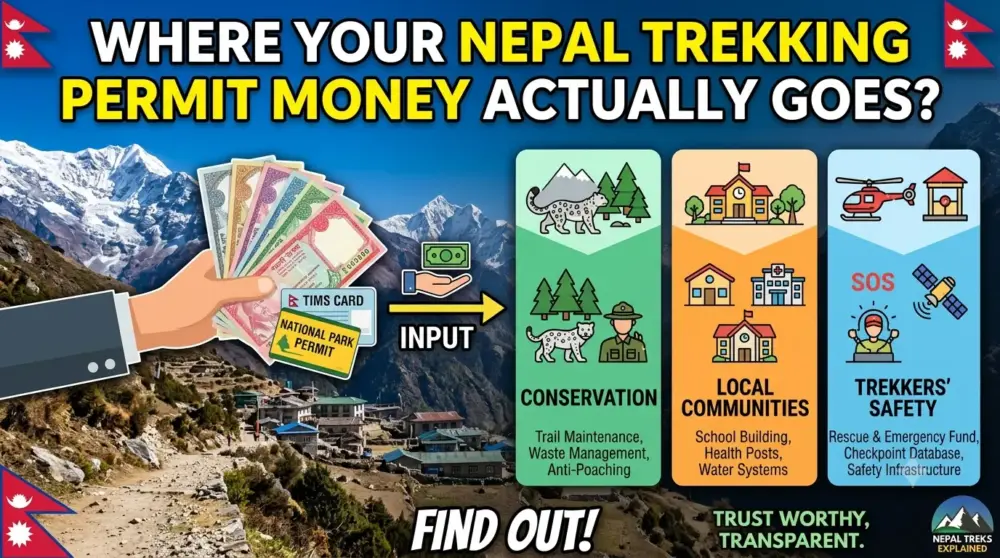
Nepal Trekking Permit Money funds far more than access to the trails. They help pay for conservation, trail maintenance, waste management, ranger posts, and community projects across trekking regions like Annapurna, Everest, and Langtang. Here’s where the money actually goes and how it supports local communities.
The short version
Your permit fee mostly goes to two places: the conservation body or national park that issued it, and a smaller slice back into the villages along your route. Think trail repairs, ranger posts, waste collection, and in some regions, schools or water systems. It’s managed by groups like the National Trust for Nature Conservation, not some faceless government fund. Keep reading for the specifics, because “it goes to conservation” is the kind of vague answer that doesn’t actually tell you anything.
Nobody reads the permit; everyone should
Here’s what usually happens. You land in Kathmandu, your agency hands you a form, you scribble your passport number on it, pay the fee, and never think about it again until a ranger at a checkpoint three days into the trek asks to see it.
I get why. It looks like paperwork. But the Annapurna Conservation Area alone is 7,629 square kilometers, home to over 100,000 people, and somebody has to keep the bridges from collapsing and the trash from piling up at 3,000 meters. That somebody is partly funded by the fee you barely glanced at.
And the rules keep moving, which doesn’t help. TIMS used to be mandatory everywhere. It isn’t checked on the Everest or Annapurna trails anymore, though Langtang and Manaslu still require it, and most agencies now handle it digitally so you never even see the paperwork. The one thing that hasn’t changed is the conservation area permit itself. That’s still what gets scanned at the gate.
Where Nepal Trekking Permit Money Actually Goes
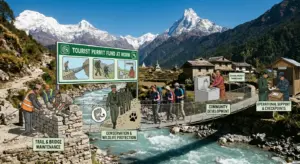
Nepal Trekking Permit Money is split a few ways, and honestly the split shifts depending on the region and the year, so treat any exact percentage you read online with some skepticism.
A chunk goes to trail work. Bridge repairs after monsoon damage, rebuilding sections wiped out by landslides, signage, waste bins that actually get emptied instead of overflowing.
Another chunk funds conservation itself. Forest protection, anti-poaching patrols, and in the higher altitude zones, monitoring programs for species like the snow leopard.
Then there’s the part that surprises people: community development. In villages like Ghandruk, Manang, and parts of Lower Mustang, conservation area money has gone toward schools, drinking water systems, even small renewable energy setups. It’s not huge sums, but it’s nothing either.
And a portion just keeps the system running. Checkpoint staffing, rescue coordination, the information centers you walk past without stopping.
The economy that exists because you showed up
Permits are one line item. The much bigger story is everyone whose income depends on trekkers actually walking through their village.
Guides. Porters. The family that’s run the same tea house for three generations. Farmers hauling vegetables up to kitchens that sit two days’ walk from the nearest road. Mule drivers. A growing number of women-owned guesthouses in Annapurna and Langtang, which is a genuinely newer development worth noticing.
None of that runs on the permit fee. It runs on you choosing a locally owned lodge over something pre-booked from Kathmandu, and spending money in the village instead of carrying everything in with you.
Who’s actually holding the money?
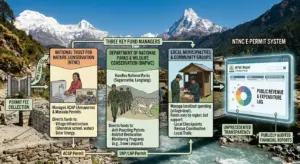
Three groups, roughly.
The National Trust for Nature Conservation runs Annapurna and Manaslu, and issues the ACAP permit. The Department of National Parks and Wildlife Conservation handles the national parks, Sagarmatha and Langtang included. And local municipalities or community groups manage a slice of the village-level spending, which varies a lot by region.
No one hands you an itemized receipt. But NTNC’s e-permit system is public if you actually want to dig into it, and that’s more transparency than most travel expenses ever get.
Three regions, three different stories
| Region | Where fees have shown up |
| Annapurna | Trail rebuilding, waste campaigns, community forestry, water supply in Ghandruk and Manang |
| Everest (Sagarmatha) | Park conservation, trail upkeep above Namche, waste collection with the Sagarmatha Pollution Control Committee |
| Langtang | Post-earthquake rebuilding, tourism recovery, local jobs |
Langtang deserves more than a table row, honestly. The 2015 earthquake triggered a landslide that flattened most of the valley. What brought it back wasn’t a single grant or NGO campaign. It was trekking revenue and the people who kept booking the trek even when the headlines had moved on. That’s not a marketing line; it’s just what happened.
Things people get wrong about all this
That it’s just a tax, partly true, but a real share goes back into the specific area it was collected from, not a general treasury somewhere in Kathmandu.
That locals never see the money. They do, unevenly. Villages sitting right on the main trail benefit more visibly than ones off the beaten path, which is a fairness problem worth being honest about, but “nothing reaches the ground” just isn’t accurate.
That skipping the permit saves money. It saves you maybe twenty dollars and costs you your insurance coverage, your legal standing if something goes wrong, and in restricted areas like Upper Mustang, it can get you turned around at a checkpoint entirely.
What actually moves the needle beyond the fee
Paying the permit is the floor, not the ceiling. If you want your trip to do more:
Book a licensed guide instead of chasing the cheapest unlicensed option. Stay in family-run tea houses rather than chains that route profit out of the valley. Buy food and gear repairs from village shops instead of loading up entirely in Kathmandu. Pack out what you can’t dispose of properly, and skip the single-use plastic where you have a choice. And if your schedule allows it, trek shoulder season, since spreading demand out helps more than piling everyone into the same six weeks.
Quick FAQs
Do trekking permits actually help local communities?
Yes, though how much varies by region. Conservation permits fund a mix of park operations and community projects like schools and water access.
Where does the money go, specifically?
Mostly trail maintenance and conservation, with a smaller share toward local infrastructure, managed by bodies like NTNC and the national park system.
Do I still need a TIMS card?
Not on Everest or Annapurna anymore. Still required in Langtang and Manaslu. Confirm with your agency before you go, since this has changed more than once in recent years.
Can I trek without a permit?
No, it’s a legal requirement in every protected region, and restricted areas enforce it strictly.
Do fees differ by region?
Quite a bit. Most standard conservation areas sit in a similar range, while restricted regions like Upper Mustang cost significantly more. Rates shift, so check current numbers before you book.
We’ve been running treks through these regions since 1989, long enough to have watched TIMS rules, permit boundaries, and conservation fees change more than once. If you want a straight answer on what your specific route actually requires this season, get a tailored quote from our team, or just message us on WhatsApp.




How to book a trip?

make free inquiry

confirm the trip
