


Gokyo Lakes vs Everest Base Camp: Which Trek Has the Better Views? (2026 Guide)
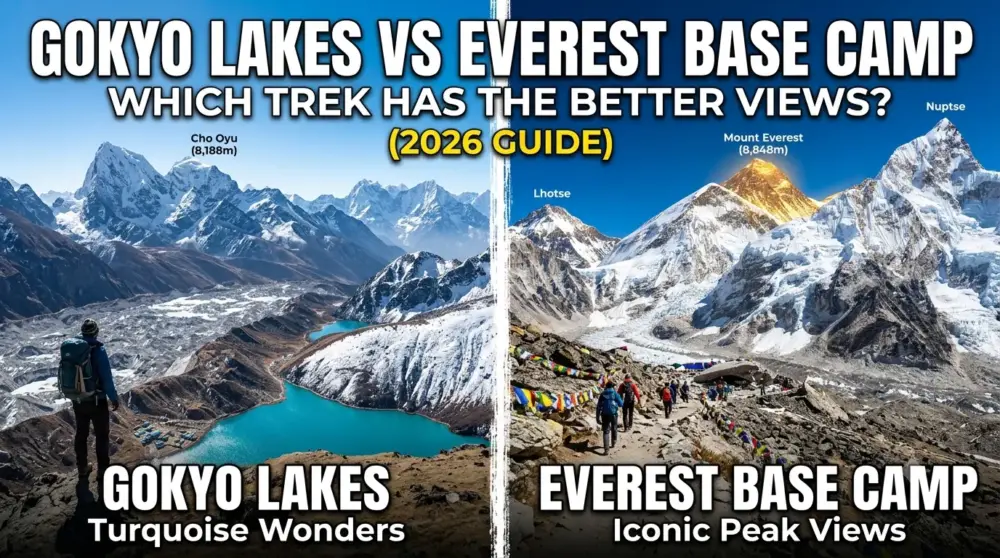
Gokyo Lakes vs Everest Base Camp
We get this question on the phone more than almost any other. Gokyo or Base Camp, which one? And I’ll be upfront, there isn’t a clean winner here. They’re not really competing for the same prize.
Everest Base Camp puts you right under the mountain, next to the Khumbu Icefall, on the most recognised trekking route on earth. Gokyo pulls you up a quieter side valley to a string of glacial lakes and a summit, Gokyo Ri, where four 8,000m peaks line up in front of you at once. Different trip, different photos, and honestly, a very different crowd on the trail.
We’ve been guiding in this region since 1989. So none of this is guesswork pulled from someone else’s brochure; it’s what our guides come back and tell us after every season.
Gokyo Lakes vs Everest Base Camp at a glance
| Gokyo Lakes Trek | Everest Base Camp Trek | |
| Typical duration | 11 to 13 days | 12 to 14 days |
| Highest point | Gokyo Ri, around 5,357m (need to confirm exact figure) | Kala Patthar, around 5,545m (need to confirm exact figure) |
| Crowds | Quiet, even in high season | Busy, especially October and November |
| Main draw | Wide panorama, glacial lakes | Standing at Everest’s base, Khumbu Icefall |
| Difficulty | Moderate to hard | Moderate to hard |
| Suits | Photographers, repeat visitors, people who’d rather skip the queue | First timers, bucket list trekkers |
Both routes fly into Lukla and follow the same river valley for the first couple of days. Then they split, one heading up toward Gokyo, the other toward Base Camp.
Okay, but which one actually has the better view
Fine, I’ll just answer it plainly, because most articles dance around this and it’s annoying.
From Gokyo Ri you get a wide shot. Everest’s up there, sure, but so are Cho Oyu, Lhotse and Makalu, and below all of it the Ngozumpa Glacier, the longest in Nepal, stretches out with the Gokyo Lakes sitting turquoise against grey rock. It’s the kind of view people end up talking about years later, not because it’s dramatic, but because it’s so wide open.
Kala Patthar is a tighter frame. You’re much closer to Everest itself, close enough that the summit takes up a big chunk of your eye line, Nuptse and Pumori crowding in right beside it. Less scenery around it, more mountain right in front of you.
Neither one is a lesser version of the other, whatever anyone tells you. Want the big panorama with lakes in the frame? Gokyo. Want to feel genuinely small standing under Everest? Kala Patthar wins that one. Pick based on what you actually want your photo to look like.
And the difficulty
Don’t book either one thinking you’re taking the “easy option,” because there isn’t one here. Both climb past 5,000m, both mean long cold mornings, both need proper acclimatization days built in.
Gokyo’s trail is quieter underfoot, but that pre-dawn push up Gokyo Ri is steep, and cold enough that you’ll want gloves on before you even leave the teahouse. EBC has more foot traffic overall, which sounds like a small thing until you’re stuck behind a slow group on a narrow stretch near Namche or Dingboche, and suddenly your morning’s taken an extra hour.
If you’re eyeing both in one trip, that’s the Three Passes route via Cho La, and it’s a different animal entirely. Usually 18 to 20 days (need to confirm the current itinerary length), and it’s really not the trip to attempt as your first time at altitude. Talk to your operator before you sign up for it, not after.
Crowds matter more than people expect
This is where Gokyo genuinely pulls ahead for a lot of our clients, and it surprises people how much it matters once they’re actually there. EBC is the most famous trek in the country, and in peak weeks the trail and the teahouses fill right up. You’ll be sharing dining rooms, waiting on the shower, sometimes queuing just to get the same photo everyone else came for.
Gokyo just doesn’t have that problem, even in the same weeks. Fewer people on the trail, more room at the lakes, teahouses that aren’t packed wall to wall. If a crowded viewpoint would take something away from the moment for you, this one factor might end up deciding it.
What it costs, roughly
Both treks run through the same permit system and the same Lukla flights, so on paper the costs land close together. Guide fees, porter fees, teahouse stays, meals, it’s a similar structure either way.
Where it actually diverges is demand. EBC books up faster in peak season, so some trekkers end up paying more just to lock in a room. Gokyo’s quieter trail tends to leave more flexibility. That said, permit and flight prices shift often, so don’t take a number from an article and run with it; confirm it with your operator before you set a budget.
So, which one’s right for you
First-time trekker who wants the classic experience? Everest Base Camp. It’s the established route, well supported, and honestly, the name recognition matters to people; that’s a fair thing to want.
Photographer, or just someone chasing that one big wide shot? Gokyo Lakes, easily.
Can’t stand trekking in a crowd? Gokyo again, no contest really.
Bucket list traveler who wants to say they stood at Base Camp? EBC. Nothing quite substitutes for that specific line in the story.
Experienced trekker with a couple of extra weeks to spare? Just do both, via Three Passes.
Questions people actually ask us.
Is Gokyo Lakes better than Everest Base Camp?
Not better, just different. Gokyo gives you the wider view and a much quieter trail. EBC gives you the base camp itself and a closer look at Everest from Kala Patthar.
Which trek has better views?
Genuinely depends what you’re after. Gokyo Ri is the wide panorama with lakes and glaciers in frame. Kala Patthar is closer and more dramatic, Everest filling more of the shot.
Is Gokyo easier than Everest Base Camp?
About the same, really. Gokyo has a steep pre-dawn climb; EBC has heavier foot traffic to navigate around.
Can beginners do the Gokyo Trek?
Yes, with a guide and the right acclimatization days built in. Same fitness baseline as EBC, nothing extra required.
Which trek is less crowded?
Gokyo, clearly, especially through October and November.
Can I combine Gokyo and Everest Base Camp?
Yes, on the Three Passes route via Cho La. Around 18 to 20 days, and it suits trekkers who’ve already spent time at altitude before.
Still can’t decide
Both routes need the same permits and a registered guide, so there’s no wrong choice as far as safety goes. Tell us your dates, your fitness level, and your budget, and we’ll give you our honest read, even if that means pointing you toward the other trek instead.
Trek the Everest region with the operator since 1989. Get a tailored quote in 24 hours, or message us on WhatsApp.



How to book a trip?

make free inquiry

confirm the trip
