


Dhampus Peak Climbing in 2026 — The Guide I Wish I Had Before Going
Okay, so I’ll be straight with you.
When I first started researching trekking peaks in Nepal, Dhampus Peak was not even on my list. Island Peak kept showing up everywhere. Mera Peak had a dozen agencies pushing it. Those are the names that dominate every “best Nepal climbing peaks” roundup, and honestly, I nearly just booked one of those and called it done.
Then someone who had actually been to Dhampus told me to stop overthinking it and just go there instead.
Best advice I ever ignored for six months before finally taking.
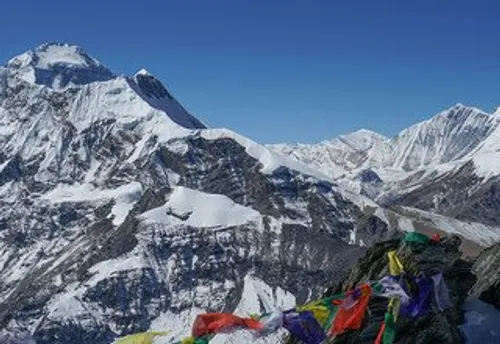
Dhampus Peak stands at 6,012 meters in Nepal’s Dhaulagiri region and is one of the most underrated climbs in the country. Not because it is secretly easy — it is not. because nobody knows about it — some people do. But because the combination of what you see, where you walk, and how few other teams you encounter up there is genuinely hard to find anywhere else on a trekking peak budget and timeline.
Thirty Himalayan peaks are visible from the summit. The Kali Gandaki Valley on the approach. A section called the Hidden Valley that sounds made up, but absolutely is not. And a base camp that does not feel like a parking lot in October.
Here is everything you need to plan this properly in 2026.
What Is Dhampus Peak and Where Exactly Is It
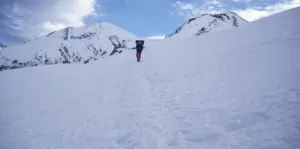
Some maps label this mountain as Thapa Peak. Both names refer to the same place — two names have been floating around in different agencies and expedition reports for years, so don’t be thrown off when you see both.
The mountain is in western Nepal, straddling the Myagdi and Mustang district border, sitting between the Annapurna and Dhaulagiri ranges. The Kali Gandaki gorge cuts right through this region. That gorge is, technically, the deepest river canyon on the planet, which starts to make sense once you are actually standing in it, looking up at the walls of the mountain on both sides.
The Nepal Mountaineering Association classifies Dhampus as a Group B trekking peak.
Elevation is 6,012 meters, or 19,724 feet. The standard climbing route goes up through the Hidden Valley and finishes along the west ridge with snow and glacier terrain in the final push.
The summit view is the thing that people who have been there bring up unprompted, often months later. Dhaulagiri at 8,167 meters is almost uncomfortably close. Annapurna I, Tukuche Peak, Nilgiri, Hiunchuli, Tilicho Peak, Mukut Himal. Roughly thirty peaks on a clear day. That number is real, and the panorama genuinely earns it.
Detail Information
| Detail | Info |
|---|---|
| Elevation | 6,012 m / 19,724 ft |
| Also Known As | Thapa Peak |
| Location | Myagdi & Mustang Districts, Nepal |
| Grade | Non-technical to Moderate |
| Best Seasons | Spring & Autumn |
| Typical Duration | 14 to 18 days |
How Hard Is This Climb
Not technically hard. That is the accurate answer.
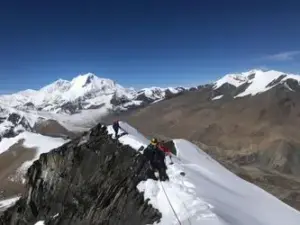
No near-vertical faces. No mixed climbing that requires an ice climbing course as a prerequisite. You will use crampons and carry an ice axe, and your guide will go through the practical basics at base camp before any of it matters on the mountain. People who have never worn crampons before their Dhampus climb have reached the summit fine.
What the mountain does have, and what catches people genuinely off guard, is altitude.
Here is what 5,500 meters after five consecutive trekking days actually feels like — you wake up at 2 am with a headache pressing behind your eyes. Your sleeping bag feels both too hot and somehow not warm enough. You eat half your breakfast because your appetite left somewhere around 4,800 meters and did not come back. You are walking at a pace that would embarrass you at sea level, and your legs are doing it anyway like that is just how walking works now.
None of that is a fitness failure. It is just what altitude does.
People who have done Everest Base Camp or completed the Annapurna Circuit already know this version of themselves and tend to manage it well on Dhampus. People whose trekking experience is all below 3,000 meters sometimes get a rude introduction to it at the worst possible moment.
Fit, motivated beginners summit at Dhampus every season. It absolutely happens. Just go in knowing that your gym fitness and your altitude fitness are two separate and not especially related things.
When To Go — Real Answer Not Just “Spring or Autumn”
Spring means March through May. April and May are the months with the most stable weather, clearest skies, and the rhododendron forests on the lower trail sections in full bloom, which makes the approach genuinely beautiful in a way that feels almost unfair, given you are also about to climb a mountain. Spring permits cost USD 250 per person because demand is highest then.
Autumn is September through November. The permit drops to USD 125. After the monsoon clears out of the valleys, the air quality changes in a way that sounds like a cliché until you actually experience visibility from 6,000 meters in October. I have heard guides who have done this route dozens of times say October is their favourite month up there, and I believe them completely.
Monsoon, June through August, is not a climbing window. Leeches on the lower trail, dangerous weather above 5,000 meters, and mud on paths that need to be dry. People do attempt it, but the experience is a different and significantly worse thing.
Winter is theoretically possible. The cold above 5,000 meters in January is not the same category of cold as a chilly morning anywhere else. Unless serious cold-weather mountaineering is already part of your background, winter is a hard pass.
The Route — Kali Gandaki Into the Hidden Valley
You get to Jomsom by a short flight from Pokhara. That landing is one of the more dramatic approaches in aviation; the runway sits in a valley with mountains on both sides, and the wind through the gorge makes every pilot earn their landing. From Jomsom, you make your way to Tukuche in the Kali Gandaki Valley, and that is where the climb properly starts.
The trail from Tukuche follows routes that salt traders used between Nepal and Tibet for centuries. Carved mani stones, old stone walls, villages that were not built for tourism, and still feel that way. There is real remoteness here that the more travelled Nepal trekking circuits have largely lost.
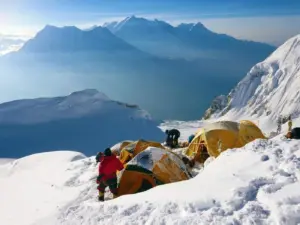
After base camp and acclimatization days, the route pushes through French Pass at 5,360 meters and into the Hidden Valley. This section is why people who have done Dhampus become almost evangelical about it. Wide, silent, surrounded by giants, with almost no other teams passing through. Most people who trek in Nepal never see that this place exists.
High Camp is set up from the Hidden Valley. Summit push goes out early the next morning, following the west ridge on snow and glacier terrain. The final section is exposed but manageable with the right footwear and a guide who knows the mountain. After the summit, descent goes back through toward Jomsom and a flight closes the loop to Pokhara.
Day by Day — 14 Day Itinerary
Day 1 — Land in Kathmandu. Meet your guide team, final permit paperwork, gear check.
Day 2 — Travel to Pokhara. The flight is 25 minutes. The bus is seven hours with better scenery.
Day 3 — Fly Pokhara to Jomsom. Drive or walk to Tukuche. Trek begins.
Days 4, 5, 6 — Trekking approach through the Kali Gandaki Valley. Teahouse accommodation throughout. Long days, good food, genuinely stunning scenery.
Days 7, 8 — Acclimatization at base camp level. Shorter hikes up and back. Your body needs these days even when you feel fine.
Day 9 — Move to High Camp.
Day 10 — Summit day. Early start, summit push to 6,012m, return to camp.
Days 11, 12 — Descent back to Jomsom.
Day 13 — Fly Jomsom to Pokhara. Hotel overnight.
Day 14 — Return to Kathmandu. Departure.
The extended 18 to 22 day version adds the full Dhaulagiri Circuit. If your schedule can absorb the extra days, that route is a serious upgrade to an already excellent trip.
Permits — Three of Them, None Optional
All three permits have to be arranged through a registered agency. The Nepal Mountaineering Association does not process individual applications. Give yourself two weeks minimum for the permit process.
The climbing permit costs USD 250 per person in spring. USD 125 in autumn. USD 70 in winter or summer. You also need the Annapurna Conservation Area Permit, known as ACAP, covering the protected region your trek passes through. And a TIMS Card, which is the standard trekking permit required across Nepal.
Total permit costs come in between USD 170 and USD 300, depending on the season.
What Everything Costs in 2026
A full expedition package with a reputable company — permits, guide, and climbing Sherpa, porters, cook staff, all accommodation from teahouses on the approach to tented camps on the mountain, all meals, and all transportation from Kathmandu through Pokhara and Jomsom and back — runs between USD 2,400 and USD 3,500 per person.
Outside that number: flights to Nepal from wherever you are, travel insurance with helicopter evacuation coverage, which is not negotiable on a Himalayan climb, any personal gear you want to own rather than rent, and tips for your crew, which local mountain staff genuinely rely on.
Green Horizon Tours builds packages without hidden costs. The number you receive in your quote is the trip you get.
Gear List — What You Actually Need
Clothing
Thermal base layer, fleece mid-layer, heavy down jacket, waterproof hardshell, insulated gloves with overmitts over them because regular gloves disappear at high altitude temperatures, balaclava, multiple pairs of wool socks. Summit mornings on this ridge are cold enough to make you regret every layering shortcut.
Boots
Double-layer mountaineering boots compatible with crampons for the technical sections, and a separate pair of hiking boots for the Kali Gandaki approach. Your feet will thank you for not spending a week on a trail in technical climbing boots.
Technical Gear
Crampons, ice axe, harness, helmet, and carabiners. Your agency specifies what they provide and what you source yourself or rent in Pokhara or Kathmandu.
Personal Essentials
Glacier glasses, SPF 50 sunscreen because UV at altitude is genuinely brutal and people underestimate it every single time, headlamp with fresh batteries, not the ones already in it, trekking poles, sleeping bag rated to minus 20 Celsius minimum, altitude medication, which you discuss with your doctor before leaving home, not after arriving in Nepal.
Altitude Sickness — Read This Part
Fitness does not protect you from altitude sickness. This is the most common misconception I encounter from people planning their first Himalayan climb. Some extremely fit people get knocked sideways above 5,000 meters. Some people in ordinary conditions walk through it. It is physiological and does not follow any logic related to how fast you can run a 5k.
Early signs: a headache that will not shift, nausea, no appetite, bad sleep, and a general mental fog that makes concentration harder than it should be. The moment any of those appear, tell your guide. The serious outcomes — fluid in the lungs or brain swelling — only happen when early warnings get ignored or pushed through.
Prevention is genuinely simple but has to be actually followed: stick to the acclimatization schedule without shortcuts, even on days when you feel perfectly fine, drink four litres of water daily, eat real meals, and when your guide says descend, you descend without a discussion about it.
Travel insurance with helicopter evacuation. Before you leave home. Non-negotiable.
Dhampus vs Other Trekking Peaks
Against Island Peak at 6,189 meters
Island Peak is more technical, significantly more crowded, and in the Everest region rather than the Annapurna. The summit day has a longer fixed rope section, and the base camp has noticeably more foot traffic throughout the season. Dhampus is quieter, slightly lower, and gives a wider panorama.
Against Mera Peak at 6,476 meters
Mera involves more sustained glacier work and sits higher. It is the natural next step after Dhampus rather than a direct comparison. Do Dhampus first.
Against Lobuche at 6,145 meters
Lobuche has steeper technical sections better suited to people with at least one trekking peak summit already on their record. Dhampus is where you start before Lobuche.
Questions People Actually Ask
Can a beginner do this?
Yes, with real preparation. Prior trekking above 4,500 meters is strongly recommended. Anyone who has completed Everest Base Camp or the Annapurna Circuit is well-positioned for Dhampus.
What is the success rate?
With proper acclimatization and a workable weather window, most prepared teams reach the summit. Altitude sickness and weather turn people back, not technical difficulty.
How far in advance should I book?
Three months ahead for spring. Six to eight weeks minimum for autumn, though earlier is genuinely better for date flexibility.
Is It Worth It
At 6,012 meters with Dhaulagiri filling the sky directly in front of you and the full Annapurna range stretched out to the east, with thirty peaks visible in every direction, and nobody else standing on that ridge with you — yes. It is absolutely worth it.
The trail is quiet. The Hidden Valley section is unlike anything else on the Nepal trekking map. The summit feels earned because it is. And the approach through the Kali Gandaki is the kind of walk that reminds you why you started caring about mountains in the first place.
Green Horizon Tours has been guiding climbs across Nepal since 1992. Our teams know Dhampus Peak through every season and every kind of weather. If you want a straight conversation about whether this climb suits your experience and timeline, reach out here — no sales pitch, just honest answers.


How to book a trip?

make free inquiry

confirm the trip
