


Himlung Himal Expedition (7,126 m): Complete Itinerary & Climbing Guide
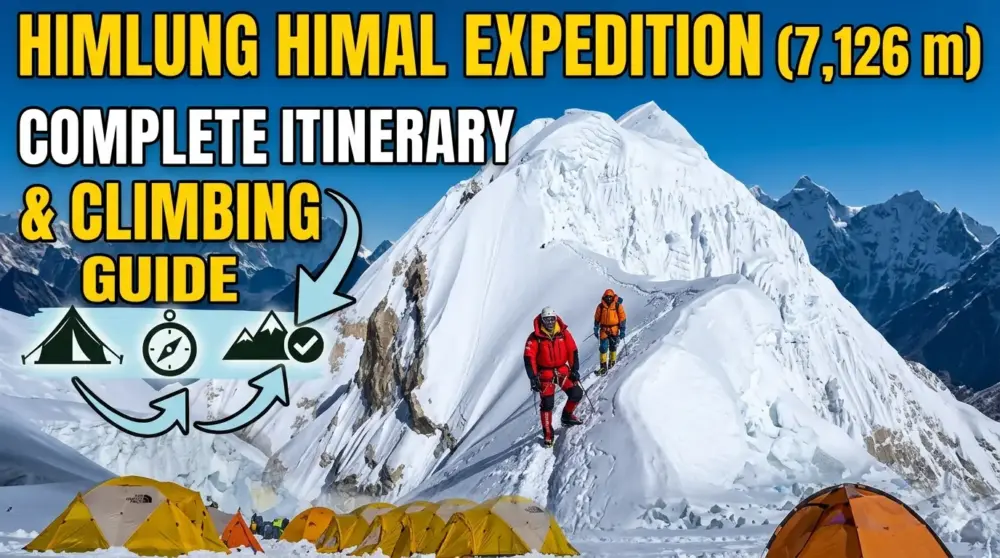
You’ve done Mera Peak. Maybe Island Peak, too. And somewhere between those summits and the flight home, something shifted. The trekking peaks don’t feel like enough anymore. You want something that keeps you up at night, something that makes your stomach drop a little when you look at the elevation profile.
That’s where Himlung Himal enters the picture.
At 7,126 metres, tucked inside the Nar-Phu Valley near the Tibetan border, this is the kind of mountain that earns real respect. Not because it’s the hardest, but because it’s genuinely serious — and almost nobody has stood up there compared to the crowds on Everest or Manaslu.
Here’s everything you need to plan your expedition properly.
Quick Facts Worth Knowing First
| Detail | Information |
|---|---|
| Elevation | 7,126 m (23,380 ft) |
| Region | Nar-Phu Valley, Manang, Nepal |
| Expedition Duration | 25 to 30 days from Kathmandu |
| Difficulty Grade | PD+ (Snow and Ice) |
| Base Camp | 4,900 m |
| High Camps | C1: 5,425 m / C2: 5,900 m / C3: 6,300 m |
| Best Seasons | Spring (Apr–May) and Autumn (Sep–Nov) |
| Permit Needed | Climbing permit + Restricted Area Permit |
| First Ascent | 1992, Japanese expedition |
One thing that’s changed recently — Nepal now requires every Everest permit applicant to have at least one 7,000 m summit. Himlung has become the most popular way to tick that box. And for good reason.
Why Himlung Himal? Here’s What Makes It Different
Plenty of peaks sit at 7,000 m. Not all of them are worth your time. Himlung is.
Genuine Remoteness
The Nar-Phu Valley was closed to outsiders until the early 1990s. Even now, it needs a special restricted area permit to enter. That means the trail to base camp doesn’t look like a highway. You walk through medieval stone villages, pass ancient monasteries, and spend days in landscapes most visitors to Nepal will never see.
Fewer Crowds
The crowds just aren’t there. While Manaslu Base Camp sees hundreds of climbers every season, Himlung might have a handful of teams at any given time. On some days, on approach, you won’t cross another group.
Extraordinary Summit Views
The summit view is genuinely extraordinary. From 7,126 m, you’re looking out at Annapurna II, Gangapurna, Tilicho, Dhaulagiri, Manaslu, and the flat white stretch of the Tibetan plateau.
Climbers who’ve been up there describe it as one of the finest panoramas in the entire range.
Ideal Training Ground for 8,000 m Peaks
It’s the smartest training ground for 8,000 m peaks. Three high camps, structured acclimatization rotations, and real technical terrain above 6,000 m. Himlung teaches you how a big mountain expedition actually works before you set foot on something like Manaslu or Cho Oyu.
High Success Rates
Compared to other 7,000 m peaks, Himlung has one of the best summit records in Nepal. Well-prepared teams with good guides get up there far more often than they don’t.
Full 25-Day Himlung Himal Expedition Itinerary
Days 1 and 2 — Kathmandu Arrival and Prep (1,400 m)
- Airport pickup on Day 1, hotel check-in, and evening expedition briefing
- Day 2 covers permit processing at the Ministry of Tourism and final gear checks
- Thamel has good gear shops if you’re missing anything
- This admin phase matters a lot. Sorted permits in Kathmandu means zero delays on the mountain
Day 3 — Drive to Besisahar (760 m)
- Seven to eight hours by road heading northwest out of the city
- Terrain shifts dramatically from crowded valley to foothills to proper mountain country
- Lodge overnight, early rest
Day 4 — Drive to Koto (2,600 m)
- Rough 4×4 jeep road from Besisahar into the hills
- Koto is the checkpoint into the restricted Nar-Phu region — permits are checked here
- First real altitude for most climbers. Nothing dramatic, but your body notices.
Day 5 — Trek Koto to Meta (3,560 m)
- First full day walking, roughly 5 to 6 hours on the trail
- Gorge terrain, pine forest, the Marsyangdi River running loudly below
- Legs warm up, lungs start adjusting
Day 6 — Trek Meta to Phu Gaon (4,080 m)
- One of the best days of the whole expedition, no question
- Phu is a genuinely ancient Tibetan village — stone houses, prayer flags, yaks wandering through
- The cultural side of this expedition isn’t a footnote. It’s part of what people remember most.
- Walk slowly here. Talk to people. Take photos.
Day 7 — Rest Day at Phu Gaon
- Active acclimatization day — a short hike above the village is recommended
- The views from the ridge above Phu are already worth the trip
- Bodies at 4,000 m need patience, not ambition. Don’t skip this day.
Day 8 — Trek to Himlung Base Camp (4,900 m)
- Four to five hours across the Pangri glacier moraine to base camp
- Camp sits on a grassy shelf with Himlung rising directly above
- Tents go up. The expedition starts properly here.
Acclimatization Rotations (Days 9 to 20)
This is where most expeditions get won or lost. Rushing acclimatization is the single biggest reason teams fail on Himlung.
The three rotation system isn’t optional — it’s what keeps you safe and gets you to the summit.
Rotation 1 — Base Camp to Camp I (5,425 m)
- Climb to C1, sleep a night, come back down to base camp
- Your body starts producing more red blood cells at this point
- Feels slow. Is necessary. Trust the process.
Rotation 2 — Camp I to Camp II (5,900 m)
- Technical terrain appears properly here
- Fixed rope sections, sustained snow climbing, and real glacier work
- Return to base camp and rest 2 to 3 days
Rotation 3 — Camp II to Camp III (6,300 m)
- The altitude effects become real above 6,000 m
- Appetite drops, sleep gets restless, and every step takes more effort than it should
- This is completely normal. Your body is adapting.
- Rest at base camp and wait for a weather window before the push
Summit Push — What Actually Happens
The alarm goes off around midnight or 1 AM on summit day. It is very cold. Minus 25°C is common at Camp III. Frozen boot laces, headlamps, the quiet of a camp waking up before dawn.
From Camp III to the summit is roughly 800 vertical metres on steep snow and icy ridges.
Sections between 45 and 50 degrees are normal above Camp II. Front-pointing on crampons, ice axe working constantly, fixed ropes clipped all the way.
Most teams reach the summit between 6 and 10 in the morning.
Standing at 7,126 m, the Himalayan giants spread out below you in every direction. It takes a few minutes to actually take it in. That’s the moment climbers talk about for the rest of their lives.
Descent back to base camp takes one to two days. Take your time on the way down. Most accidents on big mountains happen on descent, when legs are tired, and concentration drifts.
Return Journey (Days 21 to 25)
Day 21
- Break down base camp, begin trek back toward Phu
Days 22 to 23
- Trek Phu to Koto, retracing the valley route
Day 24
- Jeep from Koto to Besisahar, drive back to Kathmandu
Day 25
- Rest day in Kathmandu, celebration dinner, depart the next morning
That drive back to Kathmandu after a summit tends to be very quiet. Good quiet.
How Much Does the Himlung Himal Expedition Cost?
Pricing depends on group size, operator, and service level. Here’s an honest breakdown for 2026 and 2027.
Full-Board Guided Packages (Kathmandu to Summit and Back)
- Groups of 2 to 4 people: roughly USD 7,000 to USD 8,500 per person
- Groups of 5 or more: roughly USD 6,500 to USD 7,500 per person
- Solo expedition: can exceed USD 9,000 to USD 9,500
What’s Typically Included?
- Climbing permit and restricted area permit
- TIMS card and conservation area fees
- Experienced Sherpa climbing guides
- Base camp cook team and all meals on the expedition
- Tents and group climbing equipment
- Kathmandu hotel nights and airport transfers
What’s NOT Included?
- International flights
- Personal travel and evacuation insurance — this is mandatory, not optional
- Personal climbing gear (crampons, harness, ice axe, layering system)
- Summit bonus for your Sherpa (customary — factor in around USD 500 to USD 700)
- Tips for cooks and support staff
- Personal snacks and drinks beyond main meals
Permit Costs
- Climbing royalty: USD 500 per person in spring / USD 250 in autumn
- Nar-Phu restricted area permit: USD 100 per person per week in peak seasons
At Green Horizon Tour, every quote is fully itemised. No “from” pricing with surprises buried in the exclusions.
Get in touch, and a cost breakdown can be built specifically around your team size and dates.
Best Time to Climb Himlung Himal
Spring — April and May
- During the primary climbing season, most expedition teams go in the spring
- Temperatures rising, skies generally clear, reliable weather windows
- April is slightly less crowded, and May has longer stable periods
Autumn — September to November
- Post-monsoon skies are the clearest of the year
- October is the peak of peak season — visibility is spectacular
- Slightly colder than spring at altitude, but extremely rewarding
Avoid Completely
Monsoon Months (June to August)
- Heavy snow, unpredictable conditions, and dangerous upper mountain
Deep Winter
- Wind loads at high altitude become dangerous, and summit windows are near impossible
Who Is Himlung Himal Actually For?
Let’s be straight about this because a lot of blogs aren’t.
Himlung is often labelled “entry-level 7,000 m climbing,” and that’s accurate in a relative sense. But relative doesn’t mean easy.
Summit day is 10 to 12 hours, gaining 1,100 metres from Camp III, at temperatures that can hit minus 30°C. The ridge above Camp II runs at 45 to 50 degrees.
You are operating at an altitude where your body is in a permanently stressed state.
You Should Attempt Himlung If
- You’ve trekked or climbed above 5,000 m before
- You’re physically strong and have been training specifically for this
- You have real experience with crampons, an ice axe, and clipping fixed ropes
- You’ve done peaks like Mera, Island Peak, or Lobuche East as a foundation
You Should Not Attempt Himlung If
- You’ve never been above 4,000 m
- You’re still learning the basics of crampon and rope work
- You’re planning to rely entirely on your guide to compensate for a lack of fitness
- You’re underestimating this because someone called it “beginner-friendly.”
Build the foundation first. Himlung will still be there in a year. And when you’re ready, you’ll summit it properly.
Permits You Need
Four permits are required for the Himlung Himal Expedition, and your operator handles all of them in Kathmandu before departure.
- Climbing Permit from Nepal’s Ministry of Culture, Tourism, and Civil Aviation
- Restricted Area Permit for the Nar-Phu Valley
- TIMS Card (Trekkers’ Information Management System)
- Annapurna Conservation Area Permit
Budget roughly USD 700 to USD 900 per person for permit costs, depending on the season.
Attempting Himlung without proper permits is illegal and will result in your team being turned back at checkpoints.
Himlung Himal FAQs
How Long Is the Full Expedition?
Most well-structured expeditions run 25 to 30 days from Kathmandu arrival to departure, including approach, three acclimatization rotations, summit push, and return.
What Is the Summit Success Rate?
Himlung consistently records one of the highest success rates among Nepal’s 7,000 m peaks. Well-prepared teams with proper guides succeed far more often than they don’t — some operators report 80% or above for guided groups.
Do I Need Supplemental Oxygen?
Not standard for Himlung, unlike 8,000 m peaks. Emergency oxygen is always carried. Some climbers with slower acclimatization choose to use it on summit day, but it’s not required.
How Cold Does It Get?
At Camp III and above, expect minus 20°C to minus 30°C at night and on early morning summit starts. Proper down equipment is non-negotiable.
Is Prior 6,000 m Experience Required?
Strongly recommended. Experience above 5,000 m and confidence with technical glacier equipment make the difference between a safe attempt and a dangerous one.
Can a Total Beginner Do This?
No. Go climb Mera Peak or Island Peak first, get comfortable at altitude, build your technical skills, then come back for Himlung. That path works. Skipping it doesn’t.
Why Climb With a Local Nepalese Operator?
There are international companies that run Himlung expeditions. They cost significantly more, and a large portion of that money goes back to offices in Europe or North America — not to the Sherpa guides and local staff who are actually keeping you safe on the mountain.
Booking through a local operator like Green Horizon Tour means:
- Your Sherpa guides are properly paid, equipped, and insured
- Logistics are handled by a team that knows this valley intimately
- You’re contributing to local communities along the route
- You get flexible, personal service rather than a packaged group product
Our team has worked in Nepal’s restricted valleys for years. We know Himlung. We know the approach. And we’re genuinely invested in every climber we take out there coming home with a summit and a safe return.
Get in touch at the Green Horizon Tour Official Website to start planning your 2026 or 2027 Himlung Himal expedition. We’ll answer every question you have, honestly, without the sales pitch.


How to book a trip?

make free inquiry

confirm the trip
