


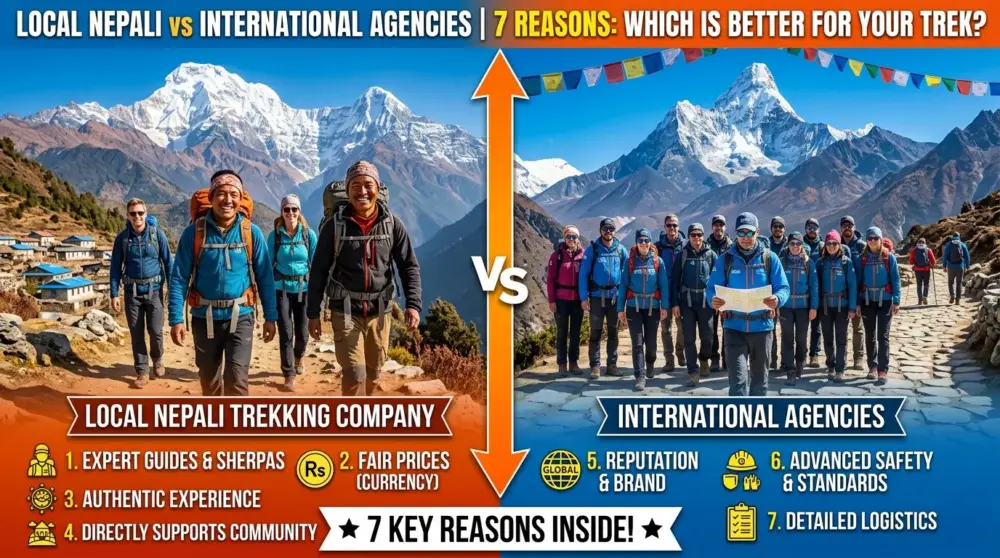
Local Nepali Trekking Company vs International Agencies: 7 Reasons Which Is Better for Your Trek?
Nobody talks about the moment it hits you.
You’re sitting at a teahouse somewhere above Namche Bazaar, legs aching, hot tea in both hands, and your guide Dawa is telling you about the time he summited Mera Peak in a snowstorm because a client insisted on pushing through. He’s laughing about it now. You’re laughing too. And somewhere in the back of your head, you realise — this man grew up four valleys from here. He has been walking these trails since he was old enough to carry a load. No travel agency in London or Sydney found him. His family did not advertise him on a glossy website.
You found him because you booked directly with a local Nepali company.
And that changes everything about how a trek actually feels.
Right. Let’s get into it properly.
What Even Is a Local Nepali Trekking Company?
People get confused by this, and honestly, the confusion is understandable.
A local trekking company is registered in Nepal, run by Nepali people, and operates entirely from within the country. The guides are local. The porters are local. The teahouses they know and trust are ones they’ve stayed in personally, sometimes for years. When something goes sideways on a trail, and occasionally things do go sideways, these are the people who already know who to call.
International agencies, the big adventure brands with beautiful websites based in the UK or Australia, or the US, they sell you Nepal from abroad. Which sounds fine. Until you find out that by Nepali law, they must subcontract all the actual trekking to a locally registered Nepali company anyway. Every single one of them.
So what you’re really paying for when you book internationally is their marketing budget, their foreign office rent, their commission, and their profit margin. The actual trek? That’s still run by a Nepali team on the ground.
You were always going to be working with a local operator. The only question is whether you pay them directly or pay someone overseas to forward your money to them after taking a very large cut.
Local vs International Trekking Agencies: The Real Differences
| What Actually Matters | Local Nepali Company | International Agency |
|---|---|---|
| Price | Fair and transparent | Marked up 30 to 60 percent |
| Trail knowledge | Personal and deep | Secondhand, filtered through a sales team |
| Flexibility | Change things on the fly | Fixed packages, limited options |
| Guide quality | Licenced, experienced, often trail-born | Same guides, booked through a middleman |
| Where money goes | Stays in Nepal | Mostly leaves Nepal |
| Communication | Direct, often WhatsApp, no wait | Multiple departments, delays |
| Customisation | Yes, genuinely | Technically, yes, practically not really |
That table probably already answered most of your questions. But let’s go further because the numbers alone don’t capture how different the experience actually is.
7 Honest Reasons to Trek with a Local Nepali Company
1. The Price Gap Is Frankly Shocking Once You See It
Most people don’t realise how dramatic the difference is until they sit down and actually compare.
Everest Base Camp with a reputable international adventure brand: somewhere between $2,000 and $3,500 for a standard 14-day trek. Everest Base Camp with a registered local Nepali company: $900 to $1,600. Same mountain. Same teahouses. Same trail. Same tea at Gorak Shep.
That gap, that $1,000 to $1,500 sitting between those two prices, that is the cost of the middleman. Nothing more. No extra safety, no extra service, no secret premium experience. Just a commission going to someone who never set foot on the trail.
Some people book international anyway because the website looks more professional. That’s a very expensive preference.
2. The Cultural Part Isn’t a Package Add-On
Here’s the thing nobody tells you in the brochures.
When your guide actually grew up near the region you’re trekking, the cultural experience isn’t something that gets scheduled into your itinerary. It just happens. Constantly. He stops at a chorten and explains what it means because his grandmother told him. He knows the family running the teahouse because they went to school together. He says something in Nepali to an old man on the trail, and they both laugh, and you ask what was said, and the answer is genuinely funny.
That’s not a cultural immersion programme. That’s just being around someone who lives here.
No international agency can package that, no matter how good their copywriter is.
3. Your Money Actually Reaches the People Who Earn It
Nepal’s tourism economy is not abstract. It is a guide’s daughter going to school. It is a porter’s family eating well through the off-season. It is a teahouse owner upgrading a kitchen.
When you book directly with a local company, the money moves fast, and it moves locally. Guide wages, porter wages, local accommodation, local transport, and food from local suppliers. Very little leaves Nepal.
When you book internationally, a significant portion of your payment stays exactly where it was collected — in a foreign office, paying foreign overheads. The local Nepali operators get a negotiated rate that is often lower than you would assume. Sometimes that pressure gets quietly passed down to porter wages. That’s not a scare story. It’s what happens when there’s a money chain with too many links.
Booking locally removes the chain entirely.
4. Local Knowledge Is Not the Same as Research
No booking platform, no matter how sophisticated, knows that a specific section of trail above Dingboche gets brutally windy after 2 pm in October. No head office in Melbourne knows that there was heavy snowfall on the pass three days ago, and the safer alternate route adds two hours but is worth it. No operations manager in Edinburgh knows which teahouse has the best yak stew at 4,800 metres.
Your local guide knows all of this. Not because he read it somewhere. Because he walked it last week, or last month, or because another guide in his network radioed ahead.
That kind of knowledge protects you in ways you will never fully see or appreciate, because the problems it prevents never happen.
5. Flexibility Is Real, Not Just Promised
International agencies advertise flexibility. What they typically mean is: you can choose from three departure dates, and we can add a rest day if you email us eight weeks in advance and the operations team approves it.
Local companies are genuinely flexible because they are working with you specifically, not managing a rolling calendar of hundreds of clients. Want to slow down because the altitude is hitting harder than expected? Fine. Want to take a detour to a village that doesn’t appear in any travel guide? Probably doable. Want to extend by two days because you simply don’t want to leave? Let’s talk about it.
This is the difference between a company that built an itinerary and a person who actually cares how your trip goes.
6. Your Guide Is Qualified — Fully and Officially
Let’s put this one down firmly because it keeps coming up.
Every professional trekking guide in Nepal must hold a licence issued by the Nepal Tourism Board. Most reputable local companies go further and hire guides who also carry wilderness first aid certification, high-altitude training, and years of actual guiding experience at elevation.
The guide assigned to your trek by a local Nepali company has almost certainly done your route more times than most international agency staff have visited Nepal. He knows the symptoms of altitude sickness before you notice them yourself. He carries a pulse oximeter. He knows the evacuation procedure not because he read it in a manual but because he has used it.
Local does not mean unqualified. That assumption has cost a lot of trekkers a lot of money over the years.
7. Sustainable Tourism Has to Actually Be Sustainable
Many international agencies put “sustainable” and “responsible” on their websites. It’s good marketing. Sometimes it’s also true. But the structural reality is that a foreign company’s first obligation is to its shareholders or owners, not to a trail in a country they visit twice a year.
Local companies live here. Their children will grow up near these trails. Their community depends on those mountains being healthy, clean, and welcoming for the next generation of trekkers. Leave-no-trace isn’t a policy they adopted for PR purposes. It’s just how they operate, because the alternative is destroying the thing that feeds their families.
Is It Actually Safe to Trek with a Local Company?
Yes. With a properly registered company, genuinely yes.
The two things to verify before anything else: Nepal Tourism Board registration and TAAN membership. TAAN is the Trekking Agencies’ Association of Nepal. Every real, active, legitimate local trekking company has a TAAN number. Ask for it upfront. Verify it yourself at taan.org.np. Takes three minutes.
Read reviews on TripAdvisor and Google, but read them the right way. Look for reviews that name the guide, describe a specific situation, and mention real places and real moments. Generic five-star reviews that could apply to any company anywhere in the world are not useful data points. Look for volume too — a company with 200 reviews over five years tells a different story than one with 14 reviews from last month.
A registered local company has direct connections to mountain rescue teams and local emergency services. When something goes wrong at altitude, they don’t wait for approval from a head office. They act.
How to Pick the Right Local Trekking Company
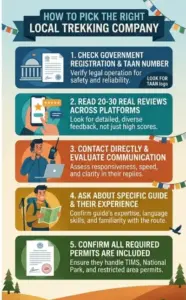
Check the government registration and TAAN number first. Read at least 20 to 30 real reviews across different platforms. Contact them directly and see how they communicate — speed and clarity tell you a lot. Ask specifically which guide would handle your trek and what their experience is. Confirm that every permit your route requires is included and handled by them.
A good local company answers all of this without hesitation. A bad one gets vague when you push.
Three Myths That Keep People Overpaying
“Local means lower quality.” The same guides, the same trails, the same teahouses. The quality of the experience comes from the people running your trek, and those people are Nepali either way.
“International companies are safer.” Safety at altitude is determined by your guide’s competence and your company’s emergency protocols — both of which are local regardless of who took your booking.
“Language will be a problem.” Professional guides in Nepal speak English. Many speak German, French, or Japanese. This concern is genuinely about 25 years out of date.
Best Treks to Book with a Local Nepali Company
Everest Base Camp is the big one, and local companies handle it at a fraction of what international brands charge. Annapurna Circuit gives you an incredible variety, and a local guide will know every teahouse and shortcut along the way. Langtang Valley is close to Kathmandu, still genuinely wild, and far less crowded than the famous routes. Manaslu Circuit, Upper Mustang, and Kanchenjunga are exactly the kind of remote, restricted treks where having a locally embedded, properly connected company is not just better. It’s essential.
All of them can be shaped around your schedule, your fitness level, and how fast or slow you actually want to move.
FAQs
Is trekking with a local Nepali company cheaper?
Most of the time, significantly so. Expect to save between 30 and 60 percent compared to international agencies for the same route and standard of service.
Are local trekking agencies reliable in Nepal?
Registered ones, absolutely. TAAN membership and Nepal Tourism Board registration are the two things to check before any booking.
Do local companies sort out guides, porters, and permits?
Yes. Any reputable local company handles all of this as part of their standard service.
How do I verify a company is legitimate?
Ask for their TAAN membership number and government registration. Both are publicly verifiable online.
Can I customise the itinerary?
Yes, and with genuine flexibility. This is one of the strongest reasons to book locally rather than through a fixed international package.
The Actual Bottom Line
The guide who walks you up to base camp woke up before you. Checked the sky. Made a call about the pace for the day based on how you looked at breakfast. Quietly slowed things down when your breathing got shallow without making you feel embarrassed about it. Told you something about that ridge that you will remember for twenty years.
That person is Nepali. They always were. They were always the heart of every trek in these mountains.
You can reach them directly. You can pay them fairly. You can sit across a table in Thamel, or send a WhatsApp, and know exactly who you’re trusting with your safety in some of the most remote terrain on earth.
Or you can pay a foreign company a large commission to introduce you to that same person.
The mountain doesn’t change either way. But your experience of getting there absolutely does.
Plan your trek directly with our local team at greenhorizontour.com



How to book a trip?

make free inquiry

confirm the trip
