


Nepal at 2083: A Nation Reborn Through Fire and Hope
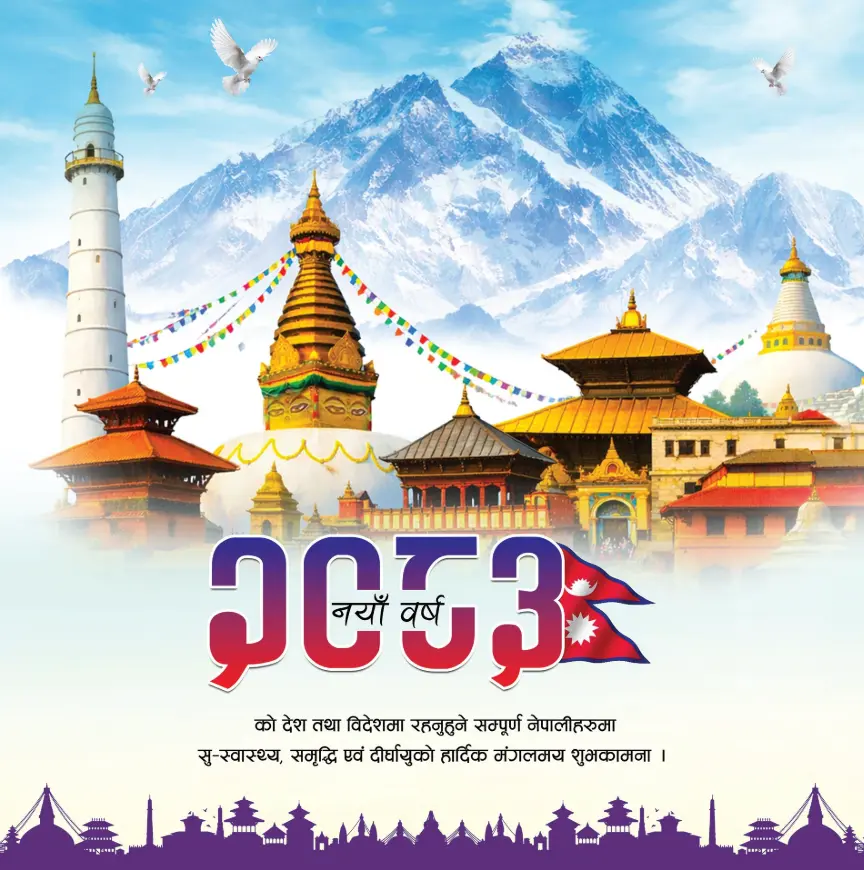
A Reflective Chronicle
New Year 2083 B.S.
Nepal at 2083 is a reflection of a nation reborn through political change, youth movements, and hope for transformation. There is something about a new year in Nepal that never quite feels like what the calendars tell you it should be. You step outside in the warmth of Baisakh, the jacaranda trees beginning their slow purple bloom across Kathmandu valley, and somewhere between the smell of incense from the neighborhood temple and the distant thud of dhol drums, you ask yourself the same question that every Nepali generation has asked before you: Are we finally getting somewhere?
I have been asking myself that question a lot lately. And this year, for the first time in a long while, I think the answer might actually be yes.
Nepal at 2083: The Country We Inherited
To understand where Nepal stands in 2083, you first have to remember what we carried into this decade. We were a country that had survived a decade-long civil war, a catastrophic earthquake, a global pandemic, and more governments than most people can count on two hands. Political instability was not just a phrase in a newspaper editorial. It was the smell of the air. It was the reason your uncle left for Qatar, and your cousin was filling out paperwork for a Canadian visa.
The statistics from the early 2070s and 2080s told a grim story. Youth unemployment hovered stubbornly above thirty percent in most years. Brain drain had hollowed out universities, hospitals, and engineering firms. Corruption indices consistently ranked Nepal in the bottom third among South Asian nations. The rivers flooded every monsoon, and the cities choked on dust every spring, and the government seemed perpetually too busy reshuffling coalition partners to pay attention to either.
And yet Nepal survived. It always has. That is both the tragedy and the miracle of this place.
The Year Everything Cracked Open
The turning point, if historians will agree on one, probably started not with a single dramatic event but with a slow accumulation of frustration that finally found its voice around 2079 and 2080.
Those were the years when a generation that had grown up watching YouTube tutorials on governance and reading about anticorruption movements in other countries decided that enough was enough. Young Nepalis who had previously channeled their energy into studying abroad or building startups suddenly turned around and faced the system directly.
The Gen Z protest movement, which the press began calling “Naulo Nepalko Awaj” or the New Voice of Nepal, began quietly enough. A few thousand university students gathered at Maitighar Mandala in Kathmandu following yet another parliamentary deadlock that had paralyzed government services for weeks. Social media amplified what the traditional press initially ignored. Within seventy two hours, the gathering had spread to Pokhara, Biratnagar, Butwal, Dhangadhi, and dozens of smaller cities and towns.
What was striking about this movement was what it was not. It was not a partisan rally. It was not funded by a single political party or backed by an NGO with foreign money.
These were young people, mostly between eighteen and thirty, who had organized themselves through WhatsApp groups and TikTok videos and who carried handwritten signs that said things like “We deserve a government that shows up to work” and “Stop stealing our future.”
The demands were specific and unglamorous, which somehow made them more powerful. The protesters wanted transparent public procurement. They wanted civil service examinations that were not rigged. They wanted the parliament to actually convene and vote. They wanted politicians who had been charged with corruption to step aside while investigations proceeded. They wanted the electricity to stop cutting out in the middle of online classes.
They were not asking for a revolution. They were asking for a country that functioned.
When the Streets Spoke Louder Than Parliament
The protests of 2080 became the largest sustained civic mobilization in Nepal since the People’s Movement of 2062 and 2063. For forty-one consecutive days, demonstrations continued in Kathmandu alone. Counter movements organized by party loyalists tried to paint the protesters as foreign agents or destabilizing forces, a familiar playbook that had worked many times before.
It did not work this time.
Part of the reason was generational. The party structures that had dominated Nepali politics since the 1990s were built around hierarchies of loyalty and patronage that simply did not appeal to young people who had grown up in a more networked, less deferential world. When a senior party leader went on television and told protesters to “trust the process,” the clip was remixed into a satirical video within hours and had been shared four hundred thousand times by the next morning.
The protests also had an unexpected ally in the diaspora. Nepalis living in Australia, the United States, the United Kingdom, South Korea, and across the Gulf states began sending not just remittances but also solidarity. Virtual town halls connected protesters in Kathmandu with Nepali engineers in Melbourne and Nepali nurses in London who were all asking the same question: Why should we have to leave to live a dignified life?
That question reframed the political conversation in a way that no opposition politician had managed to do for years. Suddenly, the brain drain was not just an economic statistic but a moral indictment.
The Political Earthquake of 2081
By 2081, the pressure from the streets had produced something unexpected: genuine political realignment.
The old tripartite shuffle between the major communist factions and the Nepali Congress, which had defined Nepali politics for three decades, began to fracture not from the top but from within. Younger members of these parties, who had grown up watching their elders form and dissolve alliances every few months, began breaking ranks.
A coalition of reform-minded legislators from across party lines, many of them first and second-term members of parliament in their thirties and early forties, pushed through an Anti-Corruption and Governance Reform Act that had been stalled in committee for six years. The bill introduced independent oversight of government procurement, mandatory asset disclosure for all civil servants above a certain grade, and, for the first time, real legal teeth for enforcement.
Nobody expected it to pass. It did, by a narrow margin, in the early hours of a Thursday morning that most senior party leaders apparently did not think was worth attending.
The passage of that act was celebrated in the streets the way Nepal usually celebrates cricket victories, which is to say, loudly, emotionally, and with people dancing in intersections until three in the morning.
It was not enough on its own. Nobody pretended it was. But it was a signal that the architecture of impunity that had protected the politically connected for so long was starting to show cracks.
The Federal Experiment Finally Takes Hold
One of the underreported stories of the 2080s has been the gradual, imperfect, but real deepening of federalism.
When Nepal adopted its federal constitution in 2072, the skeptics were plentiful and often correct. Provincial governments were established without the resources, trained personnel, or genuine authority to do much of anything. Many became simply smaller and more
local versions of the dysfunction that people had hoped federalism would dismantle.
But by the late 2070s and into the 2080s, something began to shift. A few provinces, particularly Gandaki and parts of Lumbini, started using their authority over local development planning in genuinely innovative ways. Gandaki in particular developed a model of integrating remittance income with local agricultural investment that produced measurable improvements in rural income. It was far from perfect and had its own share of controversy, but it demonstrated that the federal structure could generate local solutions rather than just replicating central government failures at a smaller scale.
The 2082 local elections were the most competitive and least violent in Nepali history. Turnout among first-time voters under twenty-five reached sixty-eight percent nationally, a number that would have seemed fantastical a decade earlier. Women won mayoral positions in fourteen of twenty-two major urban municipalities. Independent candidates, not affiliated with any major party, won over two hundred local government seats across the country.
The political class noticed. When voters demonstrate that they will actually choose differently, politicians begin, however slowly, to behave differently.
The Economy: Painful Transitions and Fragile Gains
It would be dishonest to write a celebration of Nepal in 2083 without acknowledging that the economy is still fundamentally fragile in ways that no amount of political progress has yet resolved.
The remittance economy, which has kept Nepal’s foreign exchange reserves stable and millions of families out of poverty for decades, is slowly and painfully restructuring.
Automation has hit Gulf construction and manufacturing harder than anyone predicted, and the number of Nepali migrant workers in certain categories has declined significantly since 2078. This has created real hardship in districts that had become structurally dependent on remittance income.
At the same time, the digital economy has grown faster in Nepal than almost any other sector over the past decade. Kathmandu now has a legitimate tech startup ecosystem with several companies that have attracted serious regional investment. Fiber broadband has reached seventy-two percent of rural municipalities, up from under thirty percent a decade ago. A Nepali software company became the first from this country to list on a foreign stock exchange in 2081, which was the kind of news that required a moment to absorb.
Tourism has recovered from the twin shocks of the pandemic era and some difficult years of infrastructure neglect, though the recovery is uneven. The Everest corridor remains crowded to a degree that conservationists find alarming. But the development of community-based trekking routes in less-visited regions, especially in the far western hills and the trans Himalayan zones of Mustang and Dolpo, has begun distributing tourism income more broadly and more sustainably.
Agriculture remains the employment base for a majority of Nepalis, and it remains undercapitalized, underirrigated, and burdened by fragmented landholding patterns that make modernization genuinely difficult. Climate change is making everything worse. The glaciers are retreating. The monsoon is less predictable. Flooding in the Terai has become more severe and more frequent. These are problems that require both national investment and international cooperation, and progress on both fronts remains frustratingly slow.
A Generation That Refuses to Leave
Perhaps the most significant thing happening in Nepal in 2083 is something that is difficult to quantify in any dataset.
Young Nepalis are increasingly choosing to stay.
This is not universal, and it would be foolish to romanticize it. Many young people still leave, and many who leave are making a rational and entirely understandable choice. The opportunities abroad remain real, and the opportunities at home remain limited in important ways.
But the generation that organized the protests of 2080, that voted in record numbers in 2082, that built the startups and the advocacy organizations and the independent media outlets and the community libraries and the urban farming cooperatives, that generation has made a different calculation. They have decided that Nepal is worth the fight.
You see it in unexpected places. A twenty-six-year-old woman from Rupandehi who turned down a scholarship to a university in the Netherlands because she was in the middle of building a mobile health platform for rural maternal care. A twenty-nine-year-old man from Solukhumbu who came back from three years in South Korea with savings, skills, and a plan to start a trekking equipment manufacturing cooperative in his home district. Young journalists in Pokhara, Dharan, and Nepalgunj are building local investigative outlets on almost no budget because they believe accountability journalism matters.
These are not extraordinary people in the sense of having access to resources or connections that others lack. They are extraordinary only in their stubbornness, which is perhaps the most Nepali quality of all.
What the Protests Left Behind
The protest movements of 2079 to 2082 left behind something more durable than any single piece of legislation. They left behind a political culture that is, incrementally but genuinely, less tolerant of the status quo. The young people who held signs at Maitighar are now running for local office, joining civil society organizations, working inside government ministries, and teaching in public schools. Their presence is changing institutions from within, slowly and imperfectly, but visibly.
A new civic vocabulary has entered common use. Questions about conflict of interest and transparency that once seemed like the domain of academics and development workers now come up in ordinary conversations. A mayor who, a few years ago, might have quietly directed a road contract to a cousin now has to worry about an Instagram account with two hundred thousand followers documenting every pothole and every suspicious tender.
This is fragile. Democratic culture is always fragile. It requires constant tending. But in Nepal in 2083, more people are tending it than at any point in this country’s troubled modern history.
The Mountains Have Not Changed
Through all of this, which is both the comfort and the challenge of this country, the mountains remain exactly as they were.
Sagarmatha still rises to the same height. The Koshi still runs from the same glaciers. The rhododendrons still bloom red across the same hillsides every spring. Pashupati still receives the same prayers at the same ghats where prayers have been offered for more than a thousand years.
Nepal’s relationship with its own landscape, which is to say with its own identity, is changing in ways that are worth watching. A younger generation of Nepalis is engaging with questions of environmental stewardship, indigenous rights, and climate justice in ways that draw on both global frameworks and deeply local knowledge. The movement to protect community forests, the campaigns against plastic in mountain trails, and the advocacy for Tharu and Madhesi cultural rights within a federal framework are connected threads in a larger conversation about what kind of country Nepal wants to be.
That conversation has no clean resolution. It probably never will. Nepal is too complicated and too contradictory for clean resolutions.
A Personal Reckoning
I want to be careful not to write a story that is more hopeful than the facts allow.
Nepal in 2083 is still a country where getting justice in a court of law depends enormously on who you know. It is still a country where caste discrimination shapes life chances in ways that official rhetoric has not yet managed to change. It is still a country where women face violence and discrimination that laws have only partially addressed. It is still a country where the border with India creates economic dependencies and political pressures that limit sovereignty in ways most Nepalis feel, but few discuss openly.
The generation that rose in protest did not fix these things. It could not. These are problems with roots that run deeper than any single movement can reach in a few years.
What that generation did was make it harder to pretend that these problems do not exist. They made it more difficult for the comfortable to stay comfortable without at least acknowledging that something is wrong. They changed the emotional tenor of civic life from resigned cynicism to something more like impatient engagement.
That is nothing. In fact, looking at the arc of Nepali history, it might be everything.
The Year Ahead
So here we stand at the threshold of 2083, a year that will begin, as Nepali years always do, with the smell of flowers and the sound of drums and the particular quality of Baisakh light over the Himalayan skyline.
The parliament faces a full legislative calendar of difficult choices on fiscal policy, education reform, and climate adaptation. Provincial governments will continue the messy work of building functional institutions from scratch. Local governments will be held accountable by citizens who have discovered that accountability is actually possible. Young people will continue the unremarkable and essential work of building something better than what they inherited.
None of this is guaranteed. Nepal has disappointed its own hopes many times before and will likely do so again. Hope, in this country, has always had to be held with a certain firmness, an acknowledgment that it can be lost, combined with a refusal to let it go entirely.
But standing here today, I find myself with more reasons for that kind of hope than I have had in years. Not the naive hope that imagines the future will simply be better. The harder, more honest hope that recognizes the future can be made better by enough people willing to do enough difficult and unglamorous, and necessary work.
Nepal is not there yet. But Nepal is on its way.
Naya Barsha 2083 ko Shubhakamana. May this year bring us closer to the country we deserve to be.





How to book a trip?

make free inquiry

confirm the trip
