


Inside a Nepali Tea House Experience: What Trekkers Can Really Expect
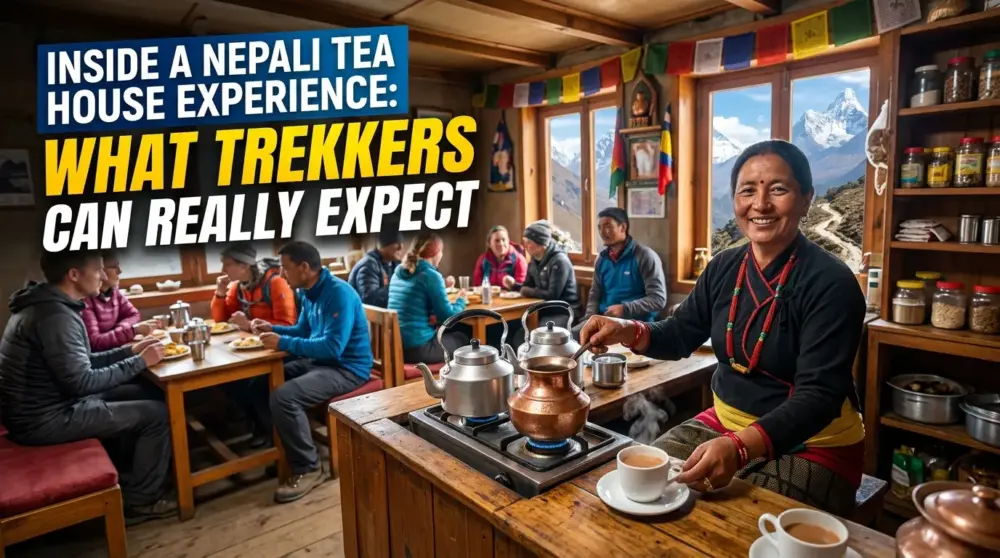
Nobody tells you about the smell.
That hit of woodsmoke and something frying in yak butter the second you push open the door of a Nepali tea house after eight hours on a trail. Your calves are screaming. Your lips are cracked from the dry altitude air. And then you step inside, and this little wooden room just… wraps around you like a blanket.
That is the Nepali tea house experience. And once you have had it, you will spend years trying to explain it to people who haven’t.
This is not a polished description of facilities and room types. This is what it actually feels like to sleep, eat, and spend your evenings in one of these mountain lodges. The good parts, the uncomfortable parts, and the parts that make you want to cry a little without fully understanding why.
What Even Is a Tea House?

A tea house in Nepal is a small family-run lodge sitting along a trekking trail. Not a hotel. Not a hostel. Something that does not really have a Western equivalent.
The simplest version of one is a room attached to someone’s kitchen. The most developed version has a proper dining hall, hot showers, and a menu that lists pasta, pizza, and apple pie alongside Dal Bhat. Both of them are called tea houses, and both of them are worth every rupee.
They started centuries ago as rest stops for traders moving goods between Tibet and Nepal across the high passes. Somewhere along the way, trekkers showed up. The families who ran these stops started building extra rooms, expanding their kitchens, and eventually, the entire system that makes independent trekking in Nepal possible was born. Today, you could walk the entire route to Everest Base Camp or Annapurna without carrying a tent, a stove, or a single meal. The tea houses handle everything.
Where You Will Find Them
Everest Base Camp
The Everest Base Camp route is the most famous tea house corridor in the world. From the moment you land in Lukla, every settlement along the trail to Gorak Shep has at least a few lodges waiting for you. Namche Bazaar, about three days in, has tea houses that would genuinely surprise you — decent wifi, hot showers that actually work, menus with things like lasagne and fresh-baked bread.
Annapurna Region
The Annapurna region gives you a different energy. The tea houses on the circuit and the route to Annapurna Base Camp are monitored by Nepal’s conservation authority, so pricing is standardized, and quality is consistent. Something is reassuring about that, especially if it is your first time on a long trail.
Langtang
Langtang, sitting just north of Kathmandu, has lodges that feel more intimate. Fewer trekkers, smaller dining rooms, more time actually talking to the families who run the place. If you want to feel like less of a tourist and more of a guest, Langtang does that.
Manaslu
Manaslu is where things get properly remote. The tea houses there are basic in the way that makes you genuinely grateful for a flat surface to sleep on. It is raw, and it is real, and it is spectacular.
The Room Situation — Be Honest With Yourself
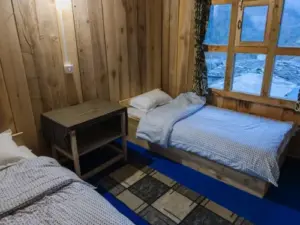
The rooms are small. Usually two single beds pushed against opposite walls, a window, a blanket folded at the foot of the bed, and a door with a lock that you will use. That is it. Plywood construction in most places. Walls that are more of a suggestion than a sound barrier.
At lower elevations and in the bigger villages, you might get an attached bathroom, a thicker mattress, even a heater. Do not count on any of that above 4,000 meters. Up there, you get the bed and the blanket, and you are grateful.
The blankets are fine. But at altitude, fine is not always enough. Bring a sleeping bag. Even a lightweight one makes the difference between a rough night and a decent one. Temperatures inside unheated rooms at 4,500 meters can go well below freezing. Your feet will let you know.
Electricity runs on solar in most high-altitude tea houses. Charge your phone and camera batteries before 9 pm when the power starts to dip. Better yet, carry a power bank so you are not scrambling the next morning with 4% battery before a seven-hour walk.
One thing nobody puts in the brochure: the walls between rooms are thin enough that you will hear every cough, every alarm, every whispered conversation from your neighbors. Buy earplugs before you leave Kathmandu. Buy two pairs.
The Food Is Better Than You Think
Dal Bhat
Dal Bhat. You will eat it on day one, and you will still be ordering it on day fourteen, and you will not be sick of it. Lentil soup poured over steamed rice, vegetable curry on the side, pickle, sometimes a papad, refills usually included. It is perfectly engineered for people who need to climb a mountain the next morning.
Most tea houses offer free second helpings of Dal Bhat. This is not an accident. The families who built this dish into the daily rhythm of mountain life understood long before sports nutritionists did what a body needs at altitude. Eat it. Order extra. Do not feel embarrassed.
Other Food You Will Find
Beyond Dal Bhat, the menus are longer than you expect. Tibetan bread, which is thick and doughy and fried and perfect with honey, shows up at every breakfast table on every trail. Momos appear in the evenings — steamed dumplings stuffed with vegetables or meat — and on a cold night after a long day, they taste obscenely good. Noodle soups, thukpa, porridge, eggs cooked four different ways, and pancakes. You will not go hungry.
Prices climb as you climb. A bowl of noodles that costs you NPR 200 in a lower village might cost NPR 500 near the top of the trail. This is not exploitation. Every single ingredient you are eating was carried up that mountain on a porter’s back. The price makes sense when you picture that.
The Part of Tea House Life Nobody Really Talks About
The Dining Room
Every tea house has one central room where everyone eats. There is usually a stove in the middle of it — a big oil drum or a wood burner — and by 6 pm, that room fills up with every trekker who arrived that afternoon. Germans, Koreans, Australians, a few locals, your guide if you have one, and the family’s kids doing homework in the corner.
What happens in those rooms over the course of an evening is something I have never been able to fully explain. People who were strangers three hours ago end up swapping trail beta, sharing food off their plates, and playing cards on the benches. Someone gets a headache from the altitude, and three people immediately produce different remedies. Someone else pulls out a speaker. The fire gets going properly around 7 pm, and the room gets loud and warm and a little bit magical.
You go there to eat. You stayed for two hours longer than you planned. This happens every single night.
The People Running These Places
Sherpa families in the Everest region. Gurung and Tamang families in Annapurna and Langtang. These communities have been hosting strangers for generations, and it shows in a way that is very hard to describe without sounding sentimental.
The hospitality is not a performance. Nobody is playing a role. A woman brings you butter tea because you look cold and she has noticed. An older man explains the weather forecast for the next two days using hand gestures and broken English that somehow communicates more than the app on your phone. The kids wave from across the room. There is a warmth in these interactions that has nothing to do with tourism and everything to do with how these communities actually are.
Take your boots off at the door. Greet people with Namaste. Eat what is put in front of you with genuine appreciation. Do not treat the dining room like a restaurant — it is someone’s home. These small things matter, and the families notice them.
What It Costs
Tea houses in Nepal are genuinely affordable, especially in the lower sections of any route. Rooms run between USD 5 and USD 15 a night, depending on altitude and location. Dal Bhat is usually USD 4 to USD 8. A hot shower, where available, costs around USD 2 to USD 5 on top of that. WiFi is another USD 2 to USD 5 if you need it. Charging your devices separately might cost USD 1 to USD 3.
Carry cash the whole way. Nepali rupees. Most tea houses have no card machine, ATMs vanish after the lower villages, and being stuck without local currency on a high mountain is a genuinely stressful situation you do not need. Load up before you leave Kathmandu.
WiFi and Hot Showers — The Honest Version
WiFi
WiFi exists on the major routes. In Namche Bazaar, it is perfectly usable. At Dingboche or Lobuche on the EBC route, it is slow and unreliable. Above 5,000 meters, do not count on it at all. Buy a local SIM with a data package in Kathmandu if staying connected matters to you.
Hot Showers
Hot showers follow the same logic. Available in most tea houses in the lower and mid-altitude sections. Solar-heated. Extra charge. Above 4,000 meters, they get less common and cooler. At the highest lodges, a wet wipe is a completely respectable substitute, and no one will judge you for it.
The Real Challenges
The cold at night above 4,000 meters is not a small thing. Rooms are unheated. Thin walls. You feel the altitude in your sleep in ways that are hard to predict. Some nights are fine. Some nights, you are awake at 3 am with cold feet and a headache that ibuprofen barely touches.
Toilets at the higher elevations are squat style, shared with the other rooms on your floor, and basic in every sense. Bring toilet paper because tea houses run out. Bring hand sanitiser. Know that these are the conditions going in, and they will not bother you the way they might if you arrived expecting otherwise.
Privacy is minimal. Walls are thin. The communal nature of tea house trekking is mostly a wonderful thing and occasionally not. Some mornings, you want five minutes of quiet, and the dining room does not offer that. Step outside with your tea and watch the mountains until you feel better. This always works.
Before You Go — Practical Things Worth Knowing
- Take more cash than your budget says you need. The trail has a way of producing expenses that did not appear in the planning.
- A sleeping bag rated to 0°C minimum is not optional above 4,000 meters, regardless of what any packing list says.
- Charge devices early every evening. Solar power fades by 9 pm on most high-altitude routes.
- Book your guide before peak season. October and November are incredibly busy, and tea houses fill up completely on popular stretches.
- Drink water all day. More than feels necessary. Altitude dehydration is quiet and quick, and it will take your legs from you before you realize what happened.
- Go easy on alcohol above 3,000 meters. It hits harder, and the hangover at altitude is a punishment that does not fit the crime.
Which Trek Should You Do First?
Annapurna Base Camp Trek
If it is your first time and you want a proper introduction to the Nepali tea house experience with a good level of comfort and incredible scenery, the Annapurna Base Camp Trek is hard to beat. Well-run lodges, diverse landscapes, and tea houses that give you a genuine taste of mountain life without pushing you into the most remote conditions.
Everest Base Camp Trek
If you want the full iconic Himalayan experience and you are willing to go higher and push harder, the Everest Base Camp Trek is the one. The tea houses along that route are part of trekking history, and stepping into them feels like stepping into every story you have ever read about Nepal.
Langtang Trek
Langtang is the right call if you want fewer people, more authentic family interactions, and something that feels a little less like a tourist trail.
All of them are extraordinary. Pick based on what you want to feel, not just what you want to see.
The Thing That Actually Stays With You
When you get home, and people ask what Nepal was like, you will talk about the mountains. The scale of them, the light on them in the morning, the way they sit there, completely indifferent to how small you feel.
But late at night, when you are being honest, what you think about is the dining room at 7 pm with the stove going and a cup of something hot and a table of strangers who felt like friends by the time you went to bed. You think about the woman who brought you tea without being asked. The kid who pointed at your boots and laughed. The guide who sat with you through a hard morning without saying a word because he understood that was what you needed.
The mountains are what bring people to Nepal. The tea houses are what send them home changed.
If you are ready to find out what that feels like for yourself, the team at Green Horizon Tour has been planning authentic Himalayan trekking journeys for years. Reach out, and we will help you build a trip worth every single step.
Quick Answers for Common Questions
Are Nepali tea houses safe for solo travelers?
Yes, completely. Tea houses on major trekking routes are safe and welcoming for solo trekkers. Lock your room, keep valuables in your bag, and use normal common sense.
Do tea houses provide blankets?
They do, but bring your own sleeping bag for high-altitude treks. The blankets are not always enough once you are above 4,000 meters.
Can vegetarians eat well in tea houses?
Better than almost anywhere. Dal Bhat is vegetarian, most soups and noodle dishes are vegetarian, and the breakfast options are almost entirely plant-based. Eating meat at altitude carries more risk than it is worth anyway.
Is WiFi reliable on the trails?
In lower and mid-altitude sections, yes. Above 4,500 meters, do not rely on it. Get a local data SIM in Kathmandu as a backup.
Do tea houses take cards?
Almost none of them do. Cash only. Nepali rupees. Carry more than you think you need.
How cold is it inside at night?
At 4,000 meters and above, room temperatures can drop below 0°C. A sleeping bag is essential.
Which trek has the best tea house trail overall?
Everest Base Camp for the iconic experience. Annapurna Circuit or ABC for comfort and variety. Langtang for something quieter and more personal.


How to book a trip?

make free inquiry

confirm the trip
