Beyond Dal Bhat: 8 Authentic Nepali Dishes Every Traveler Must Taste
8 March, 2026
By Sanket
Nepal’s cuisine is far richer than the everyday dal bhat that fuels trekkers and locals alike. While dal bhat is comforting and reliable, the country’s true culinary treasures lie in its region. The cuisines of Nepal offer a wide variety of regional specialities that many tourists never get the chance to try.
Here are some authentic Nepali foods you should try beyond Dal Bhat.
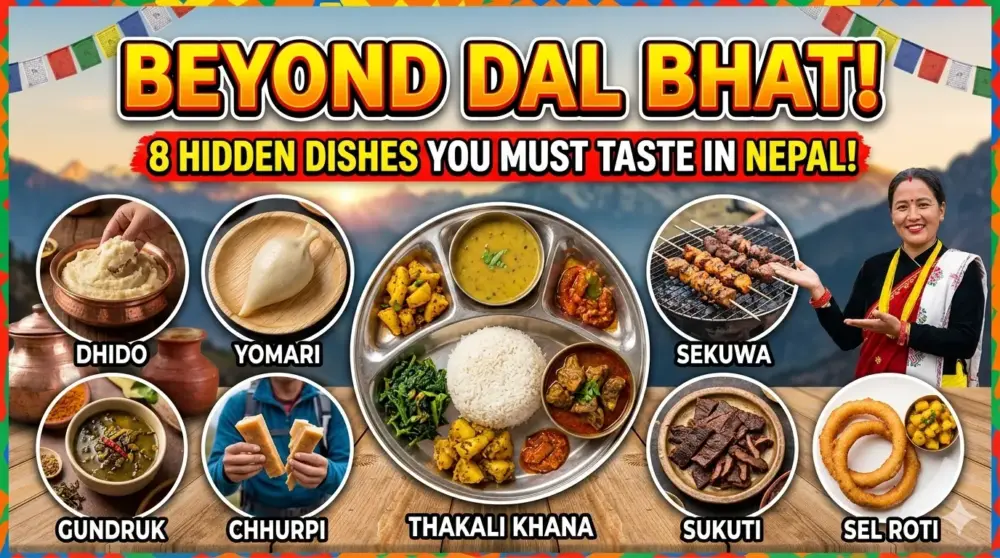
1. Dhido-A Traditional Dish Beyond Dal Bhat
Dhido is one of Nepal’s oldest traditional cuisines, especially common in the hill and mountain regions. Before rice became widely accessible, Dhido was the main daily food for many Nepali communities.
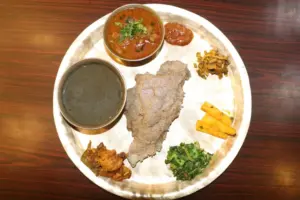
Dhido is a thick, hearty porridge made by stirring flour from millet, buckwheat, corn, or barley into boiling water until it forms a dense, dough-like consistency. It is traditionally eaten with hands by rolling it into balls and dipping it into curries, gundruk, or vegetable sides. If you try dhido in rural homestays in Langtang, Mustang, or along trekking routes, you can experience the true essence of Himalayan resilience. Many trekkers discover traditional foods like dhido while travelling through mountain regions such as Langtang Valleyand Mustang.
Dhido is typically served with:
Lentil Soup
Vegetable curry
Meat curry
Fermented greens such as gundruk
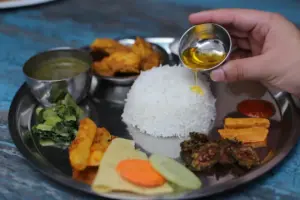
2. Thakali Khana Set– A Complete Meal Beyond Dal Bhat
Unlike a simple Dal Bhat meal, the Thakali set often includes a wider variety of side dishes and distinct flavours that represent the culinary traditions of the Himalayan region. The Thakali people of the Kali Gandaki River valley built their wealth on the ancient salt trade between Tibet and the Indian plains, and their food reflects that prosperity. This meal is known for its balanced flavours, variety, and careful presentation.
A typical Thakali Khana Set includes:
Steamed rice
Lentil soup (dal)
Spinach or leafy greens
Potato curry
Pickles and Chutneys
Meat curry
Femented vegetables
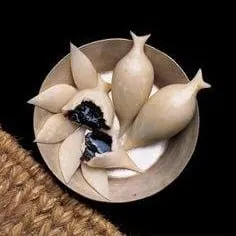
3. Yomari– A Sweet Treat Beyond Dal Bhat
Yomari is not just a dumpling, but also a wish, a festival, and an art form. It is typically made during Yomari Punhi, the full moon that follows the rich harvest, celebrated primarily in the Kathmandu Valley. These are teardrop-shaped steamed dumplings, crafted from freshly pounded rice flour dough and filled with chaku (a thick, spiced molasses made from jaggery and sesame) or sweetened lentils. It is sweet, chewy, and subtly spiced, which is also gluten-free and vegetarian. You can hunt for fresh yomari in Bhaktapur or Patan during the season, or at Newari specialty shops year-round.
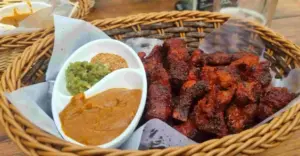
4. Sekuwa– A Popular Street Food Beyond Dal Bhat
Sekuwa is one of Nepal’s most flavorful street foods and a favourite among meat lovers. It is a tender chunk of meat (chicken, lamb, pork, goat, or buffalo) marinated in yoghurt, ginger-garlic, mustard oil, spices, and chillies, then skewered and grilled over open flame or charcoal for a smoky, charred finish. It is also a popular snack enjoyed in restaurants, street stalls, and gatherings with friends.
Sekuwa is often served with:
Sliced onions
Fresh lemon
Tomato or chill chutney
5. Gundruk– A Traditional Flavor Beyond Dal Bhat
Gundruk is a unique fermented leafy green (mustard, radish, or cauliflower leaves) widely consumed in rural areas of Nepal. It is sun-dried and naturally fermented, creating a tangy, probiotic-rich side dish akin to sauerkraut or kimchi. It’s a winter essential in the hills and mountains. It provides what preserved foods always provide: a mineral sourness, a complexity that fresh vegetables simply cannot offer, and the taste of a specific season.
Gundruk can be prepared in several ways:
As a soup
Mixed with tomatoes and spices
As a pickle
6. Chhurpi– A Unique Himalayan Food Beyond Dal Bhat
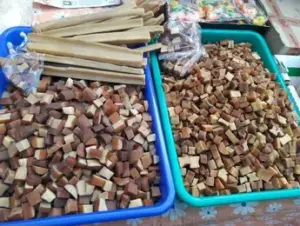
Churpi
Chhurpi is a hard, chewy cheese made from yak or cow milk, boiled and pressed into blocks. It is high in protein and long-lasting. It is a traditional Himalayan cheese made from yak or cow milk. There are two main types:
Soft chhurpi: It is usually used in curries and soups.
Hard chhurpi: It is extremely tough and chewed slowly like candy.
Hard chhurpi is also one of Nepal’s finest edible souvenirs, as it can be kept for months without refrigeration.
7. Sukuti– A Traditional Snack Beyond Dal Bhat
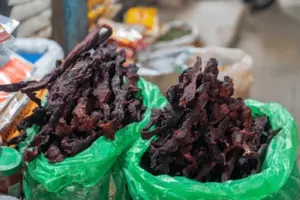
Sukuti
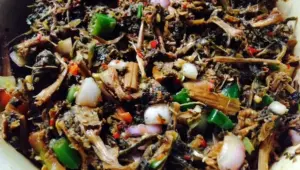
Nepal has no great tradition of refrigeration, but it has an extraordinary tradition of preservation. Sukuti is meat, most commonly buffalo, goat, or venison. It is dried in a thin strip over a smoky fire or in the open mountain air until it becomes intensely flavoured, chewy, and shelf-stable for months. Sukuti is eaten as a snack, crumbled into beaten rice (chiura), fried with onions and green chillies as a side dish, or incorporated into the Thakali set meal.
8. Sel Roti– A Festival Food Beyond Dal Bhat
Selroti
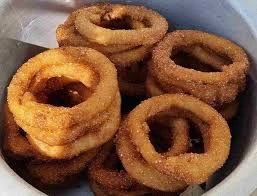
Sel rotis are hollow, ring-shaped rice-flour doughnuts fried in ghee or oil until golden and slightly crisp on the outside, soft and airy within, lightly sweetened with sugar. They are made in large batches and are prepared by women who begin before sunrise and are distributed as gifts between neighbours and relatives throughout the Tihar festival.
The recipe for sel roti varies by family; some add coconut, some add banana, and some fry it in clarified butter. Outside of festivals, they appear at roadside stalls paired with potato curry or plain yoghurt.
Why Exploring Local Food Matters
Food is the most intimate form of culture. It is what people choose to grow, preserve, share, and celebrate across generations. In Nepal, where over 125 ethnic groups coexist across ecosystems, food tells stories that no museum exhibit or guidebook passage can fully convey, reflecting the diverse traditions, rituals, and histories of these communities.
Nepal’s culinary heritage is extraordinary. The above dishes are an introduction, not a conclusion. By trying regional foods, travellers can: