


Complete Nepal Travel Guide

Nepal travel guide for first-time visitors:
Eleven at night, at Tribhuvan International Airport, I am standing outside with a backpack that suddenly feels twice as heavy as it did at check-in back home.
A man cycles past balancing six gas cylinders on the back of his bike. He does not fall over.
Nobody had mentioned that part of Nepal to me before I landed- the noise and clutter of just arriving- and honestly nobody needs to. You stop noticing it by day two and start missing it the day you leave.
That is roughly how most first trips here go.
Small country, squeezed between two enormous neighbors, India on one side and China on the other, and somehow it still fits in eight of the fourteen highest mountains on earth, over a hundred ethnic groups, and temples and stupas close enough together that you can hear both sets of bells from the same street corner.
This is the guide I wish someone had handed me before my first flight out, the stuff nobody quite gets around to mentioning.
When to Go
Four fairly distinct seasons here, and honestly, which one you land in will shape your trip more than almost anything else you decide.
Autumn: Late September Through November
Autumn, late September through November, is when everyone tells you to go, and they are not wrong.
Clear skies, mild air down in the valleys, crisp air higher up, mountain views that actually look like the postcards for once.
It is also when every guesthouse in Pokhara fills up, and flights get pricier by the week, so if October is your window, book earlier than feels necessary.
Spring: March Through May
Spring, March through May, is my personal favorite, though I will admit I am biased.
The rhododendron forests along the trekking trails go red and pink in a way that actually stops you mid-walk to stare, which does not happen to me often.
Weather holds up fairly well too, though by April the afternoons get hazy enough to flatten the far-off mountain views.
Winter: December Through February
Winter, December through February, is quiet and cheap, and Kathmandu itself is genuinely pleasant to wander around in. Still, the high passes start closing and serious altitude trekking gets hard, sometimes impossible.
Monsoon: June Through August
Then there is monsoon, June through August.
Muddy trails, leeches in the lower hills (yes, actual leeches), flights to the mountain airstrips getting bumped a day or two by cloud cover.
That doesn’t mean you should skip it entirely, though.
Stick to Kathmandu, boat around Pokhara, stay low, and the hills turn a green you will not see any other time of year.
Quick Season Snapshot
| Season | Months | Best For | Watch Out For |
|---|---|---|---|
| Autumn | Late Sep to Nov | Clear mountain views, festivals | Crowds, higher prices |
| Spring | Mar to May | Rhododendrons, trekking | Afternoon haze |
| Winter | Dec to Feb | Budget travel, sightseeing | High passes closed |
| Monsoon | Jun to Aug | Lush scenery, fewer tourists | Landslides, flight delays |
Visas and Entry
Most people can grab a visa on arrival, either at Tribhuvan International Airport or at the land borders.
Bring a passport with at least six months left, a passport photo, and a way to pay the fee; cash or card usually works.
Last I checked, fifteen days runs about thirty dollars, thirty days around fifty, ninety days around one hundred twenty-five.
Prices move, though, so check the Department of Immigration’s site before you fly.
Do not take my word for it, or any blog’s word, mine included.
A few nationalities cannot get a visa on arrival at all and need to sort it through an embassy beforehand, so a five-minute check specific to your passport is worth doing early, not the night before your flight.
Getting There and Getting Around
Kathmandu’s Tribhuvan International Airport handles most of the arrivals, direct flights in from India, the Gulf, bits of East Asia, plus connections from further out in Europe and North America.
Pokhara has its own international airport now too, but nearly everyone flying long-haul still touches down in Kathmandu first.
Getting around inside the country means choosing between domestic flights, tourist buses, local buses, or hiring a car and driver.
Flights to Pokhara or Lukla save a huge amount of time, but weather grounds them constantly, so leave more slack in your schedule than you think you need, especially near the end of your trip if you have an international flight to catch after.
Tourist buses between Kathmandu, Pokhara, and Chitwan are comfortable enough and let you actually watch the terrain shift outside the window.
Local buses cost less and come with their own kind of adventure.
Not for anyone in a rush, or anyone who values personal space, but memorable.
Around Kathmandu itself, taxis and apps like Pathao or InDrive are the easiest way to get anywhere.
Agree on the fare before you climb in, or push for the meter, because the tourist markup is basically a rite of passage here and every driver will try it at least once.
Money Matters

The Nepali rupee is what you will be dealing with.
ATMs are everywhere in Kathmandu and Pokhara, fewer once you leave the bigger towns, and basically nonexistent once you are actually out on a trekking route.
Carry more cash into the hills than feels reasonable.
You will use it.
- ATMs charge their own fee on top of whatever your bank charges, and most cap you at a fairly low withdrawal amount, so plan on more than one trip to the machine.
- Cards work at a lot of hotels and restaurants in Kathmandu and Pokhara now. Outside those two cities, do not count on it.
- Small notes are gold. Nobody, and I mean nobody, has change for your big bill.
- Bargaining is normal in markets and with any unmetered ride; just keep it friendly. Getting worked up over fifty rupees makes you look bad, not smart.
Health, Altitude, and Safety
If any part of your trip goes above three thousand meters, altitude is the real risk, more than anything you might eat or drink.
The rule that matters, really the only one, is to go up slowly.
Build rest days in wherever the route climbs fast, and take a headache or nausea or dizziness seriously the moment it shows up instead of walking it off.
People use Diamox to help prevent it, which is fine, but that is a conversation for a doctor who actually knows altitude medicine, not the guy at the next teahouse table who read about it once.
Get travel insurance that covers high-altitude trekking and helicopter evacuation specifically, not just whatever standard policy your card or agent throws in.
A lot of basic plans exclude trekking past a certain altitude entirely, buried somewhere in text nobody reads.
Read it anyway.
Otherwise, stick to treated or bottled water, skip the ice unless you trust the place, and give your stomach a day or two before diving into street food, no matter how good those momos smell from across the street.
Someone told me once, the mountain is not going anywhere.
Your knees might.
Pace yourself.
Culture and Etiquette
Hindu and Buddhist customs shape daily life here more than most first-time visitors expect: marigolds strung across taxi dashboards, prayer flags snapping over every mountain pass.
- Take your shoes off before temples, monasteries, and most homes too.
- Walk clockwise around stupas and mani walls, keeping them on your right.
- Cover your shoulders and knees at religious sites.
- Use your right hand, or both hands, when handing things over, money and food especially.
- Ask before you photograph someone. This one gets skipped a lot, and it should not be.
Nepalis are patient with visitors who mess this stuff up, more patient than I probably deserved on my first trip, but people notice when you actually try.
Where to Go First
Kathmandu Valley

Most trips start and end in the valley, and most itineraries do not give it enough time.
Durbar Square, Swayambhunath, Boudhanath, Pashupatinath- four UNESCO sites within reach of each other, each one worth a proper half day rather than a rushed hour squeezed between other plans.
Patan and Bhaktapur sit quieter, and in places better preserved than Kathmandu itself.
Newari rooftops, narrow brick lanes, the kind of place that rewards wandering without a map more than it rewards a checklist.
Pokhara
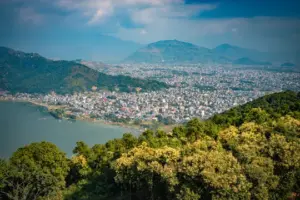
Pokhara sits beside Phewa Lake, Annapurna rising behind it on the mornings you get lucky with clear skies.
It is Nepal’s adventure hub, a jumping-off point for most Annapurna treks, plus paragliding, boating, or just sitting somewhere quiet after Kathmandu wears you out.
Sarangkot, a short drive up, is the sunrise spot everyone raves about.
Worth the early alarm?
Once, at least, yes.
Chitwan National Park
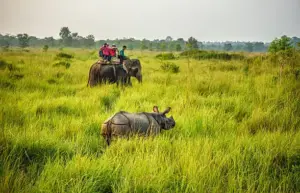
Chitwan is a different pace entirely.
Lowland jungle, jeep safaris, canoe rides down the river, a real shot at spotting a one-horned rhino if you are patient.
Two or three days tacked on works well here, a break from both the altitude and the temple circuit.
Trekking Regions
Everest, Annapurna, and Langtang take most of the trekking traffic, and each has its own personality.
Everest region trades on the name Everest Base Camp itself, understandably, but Gokyo Lakes and the Three Passes route nearby get a fraction of the crowds for scenery that is arguably even better.
Annapurna has the most variety, from short teahouse walks all the way up to the full circuit.
Langtang sits closer to Kathmandu and suits anyone short on time who still wants real high mountain terrain.
Which one fits you depends mostly on how many days you have and how much company on the trail you can tolerate.
Food Worth Trying
Nepali food lives a bit in the shadow of its neighbors, India pulling from one side, Tibetan and Chinese influence from the other, but it has plenty of character of its own.
- Dal bhat: Lentils, rice, vegetables, refilled without you asking, eaten by most Nepalis daily and for good reason.
- Momos: Dumplings steamed or fried, buffalo, chicken, or vegetable filling.
- Newari food in the valley: Yomari, bara, worth hunting down specifically in Patan or Bhaktapur.
- Sel roti: Around festival time, a ring-shaped fried rice bread.
- Thukpa and thenthuk: Tibetan-style noodle soups, exactly what you want after a cold day up high.
What to Pack
What you pack depends a lot on whether trekking is actually part of the plan, but a few things apply either way.
Layers beat any single heavy item, since temperatures swing hard between morning and night even down in the valleys.
Broken-in walking shoes, a headlamp for the power cuts that happen more than you would expect, a water bottle plus purification tablets or a filter, a light rain jacket.
That covers most days.
If you are trekking, add a real down jacket, poles, and a sleeping bag rated below freezing, either packed from home or rented cheaply in Kathmandu or Pokhara.
Rental shops are everywhere in both cities, and the gear is decent.
A Simple Ten-Day First-Timer Itinerary
Something like this works well if it is your first time and you want a taste of everything without racing through it.
| Days | Focus |
|---|---|
| 1 to 2 | Kathmandu Valley: Durbar Square, Swayambhunath, Boudhanath |
| 3 | Drive or fly to Pokhara |
| 4 to 7 | Short Annapurna foothills trek, such as Ghorepani Poon Hill |
| 8 | Back to Pokhara, rest and lake time |
| 9 | Travel to Chitwan for a jungle safari |
| 10 | Return to Kathmandu, departure |
This pacing leaves room to breathe.
That matters more here than most places I have traveled, since road distances lie to you constantly, an hour on the map turns into three, and altitude or weather or a broken bus axle will rearrange your week without asking permission first.
Final Thoughts
This place is kinder to travelers who show up without a rigid plan.
Buses run late.
The one day you finally reach the viewpoint, a cloud rolls in and swallows the whole mountain.
Power cuts mid-shower, always mid-shower.
None of it is a real problem once you expect it, and you will start expecting it fast.
What actually sticks with people is smaller than any single peak or temple: a monk turning prayer wheels before the town wakes up, a plate of dal bhat shared with three strangers on a trail because there was nowhere else to sit, the particular quiet of a mountain village once the light drops off the ridge and the whole valley just stops.
Book loosely.
Walk slower than feels efficient.
Let the place set its own pace, because it will anyway, whether you plan for it or not.
Frequently Asked Questions About Visiting Nepal
Around 7–10 days can provide a good introduction to Kathmandu, Pokhara, and another destination, but longer trips allow you to explore more slowly and include a proper trek.
October and November are among the most popular months for trekking and mountain views, while March through May is another strong period. The ideal month depends on your destination and activities.
Nepal can be relatively affordable compared with many international destinations, but costs vary significantly depending on accommodation, transportation, activities, trekking route, and travel style.
Most visitors travel through Nepal without serious problems, but normal travel precautions still apply. High-altitude trekking introduces additional risks; you don’t generally need a guide simply to visit Kathmandu, Pokhara, or other major tourist destinations. Trekking requirements are different and can depend on the specific route and current regulations, adding risks and making preparation, acclimatization, weather awareness, and appropriate insurance particularly important.
You don’t generally need a guide simply to visit Kathmandu, Pokhara, or other major tourist destinations. Trekking requirements are different and can depend on the specific route and current regulations, so check the latest requirements before planning a trek.
For a first trip, consider combining the cultural attractions of Kathmandu Valley, the mountain scenery and activities around Pokhara, a wildlife experience in Chitwan, and a trek if your schedule and fitness allow.


How to book a trip?

make free inquiry

confirm the trip
