


TREKKING ADVICE: What Trekkers Usually Get Wrong on Their First Nepal Trek

Nine mistakes that quietly derail first-time trekkers, and how experienced guides watch them happen year after year.
Every October and every April, a new wave of trekkers lands in Kathmandu convinced they already know what to expect. They have watched the drone footage. They have read the packing lists. Somewhere between the airport and the first teahouse, most of that confidence quietly falls apart.
This isn’t a knock on anyone. Nepal rewards preparation, but it punishes assumptions, and first-timers tend to arrive with a lot of borrowed ones, from gym routines, ski trips, or a friend’s photos from a trip a decade ago. The mountains don’t care how many stairs you climbed on a machine at the gym or how light your carry-on was. They care about pace, judgment, and a handful of details most people only learn the hard way.
After watching hundreds of first-time trekkers work through their opening days on the trail, a clear pattern shows up. The mistakes are rarely dramatic. They’re small miscalculations that compound quietly until day four or five, right around the point where the trail stops feeling like a hike and starts feeling like a test.
Here is what actually trips people up, and what to do about each one before you fly to Lukla or drive out of Pokhara.
What First-Time Trekkers Assume vs. What Usually Happens Instead
| What First-Time Trekkers Assume | What Usually Happens Instead |
|---|---|
| Being fit means altitude won’t affect me. | Fitness barely matters above 3,000 meters. Pace and rest days do the real work. |
| Boots worn once at home are trail-ready. | Unbroken boots cause blisters that can end a trek by day two. |
| The total cost is the flight plus the permit. | Food, charging, wifi, and tips add up fast once the trail climbs. |
| Independent trekking without a guide is still possible. | A licensed guide is legally required in almost every national park and conservation area. |
| Any water that looks clean is safe to drink. | Treating your own water saves money and keeps stomachs out of trouble. |
| A shorter itinerary is simply the smarter choice. | Skipped acclimatization days are the single biggest cause of early turnarounds. |
Fitness Won’t Save You From Altitude
This is the mistake that causes the most turnarounds, and it usually has nothing to do with how strong someone is.
Above roughly 3,000 meters, the air holds less oxygen no matter how many miles you can run at sea level. The body needs time, not effort, to adjust.
Marathon runners get altitude sickness. So do mountain guides on an off week. Fitness changes how comfortable the walking feels. It doesn’t change how fast your blood can start producing more red cells.
The itineraries built by experienced operators aren’t padded for profit. Those extra nights in Namche Bazaar or Dingboche exist because the body needs roughly two nights at the same elevation for every 500 to 1,000 meters gained above 3,000 meters.
Trekkers who ask to skip a rest day to save time, or who quietly push through a pounding headache because they don’t want to be the one slowing the group down, are usually the ones who end up being evacuated.
Tell your guide the truth about how you feel. A mild headache on arrival is normal. One that gets worse after resting is not, and hiding it doesn’t make it go away. It just delays the decision to descend until descending is harder.
Gym Fit Is Not Trail Fit

A lot of first-time trekkers train hard in the months before their trip, then are surprised by how much their legs hurt on day one.
The mismatch usually comes down to specificity. Spin classes and treadmill intervals build cardiovascular fitness, which helps, but they rarely prepare anyone for six hours of uneven stone steps with a loaded daypack, or for the particular ache of descending for three hours straight on a trail made of loose rock.
Downhill walking is the part almost nobody trains for, and it’s often harder on the body than the climb. Quadriceps take a pounding on long descents in a way flat cardio simply doesn’t replicate.
The fix isn’t complicated. Walk hills. Walk them with a pack that weighs close to what you’ll actually carry. Do back-to-back long days on weekends rather than one hard workout followed by rest, since the trek itself is a string of consecutive demanding days, not a single event.
Trekking poles help more than most people expect, particularly on the way down, and practicing with them before the trip means you’re not learning the rhythm for the first time at 4,000 meters.
New Boots and the Wrong Layers
Somewhere on every popular route there’s a trekker nursing blisters from boots bought the week before flying out.
Leather and modern synthetic boots both need breaking in, and that process takes weeks of regular wear, not one lap around the block. If your boots haven’t been on at least a handful of real walks before you land in Kathmandu, that’s a mistake still waiting to happen.
Layering trips people up just as often. Many first-timers pack one heavy jacket and assume it’ll handle everything from a warm afternoon in Pokhara to a freezing night at 4,500 meters.
A proper system is thinner and more flexible than people expect: a moisture-wicking base layer, a light insulating midlayer, and a windproof and waterproof outer shell, added or removed as the day changes.
Cotton is the biggest offender, since it holds sweat against the skin and stops insulating the moment it gets damp.
Teahouses surprise people too. Rooms are unheated, walls are thin, and the temperature drop after sunset is sharp even during the main trekking seasons.
A sleeping bag rated colder than you think you need, or a liner added to a borrowed one, tends to matter more than any other single piece of gear.
The Budget Mistake Nobody Warns You About

Flights and permits are the easy costs to plan for, since they’re paid before you ever reach Nepal.
The costs that catch people off guard are the ones that grow with elevation. A bottle of water or a plate of fried rice costs more in Lobuche than in Kathmandu, not because anyone is overcharging, but because everything on that menu arrived on the back of a porter or a mule.
Wifi, hot showers, and device charging are often billed separately the higher you climb, and those small charges add up fast over ten or twelve days.
Then there’s tipping, which isn’t optional in practice even though nobody puts it on the invoice. Guides and porters are usually paid modestly by the agency, and tips make up a meaningful share of their income for the season.
Budgeting around 25 to 35 dollars a day just for a guide, before tips, food, and incidentals, gives a far more realistic picture than the headline price quoted on a website.
Trekkers who show up with exactly enough cash for the itinerary they booked, and nothing extra, tend to have a stressful final week.
The Guide Requirement Isn’t Optional Anymore
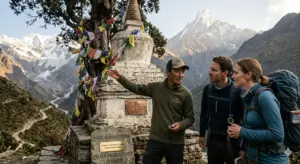
Older blog posts and forum threads still circulating online describe a version of Nepal where a determined trekker could show up, buy a permit, and walk the Annapurna Circuit alone.
That version doesn’t exist anymore.
Since 2023, and fully enforced across the 2026 season, every foreign trekker inside a national park or conservation area has to be accompanied by a licensed guide arranged through a registered trekking agency.
That covers essentially every well-known route, including Everest Base Camp, Annapurna, and Langtang.
The rule changed again in March 2026, though not in the direction some trekkers hope. Solo travelers can now apply for restricted area permits without needing a second trekker to join them, which used to be a real obstacle for people traveling alone. The guide requirement stayed exactly as mandatory as before.
Regions like Upper Mustang, Manaslu, Nar Phu Valley, and Kanchenjunga still require additional restricted area permits on top of a guide.
None of this is bureaucracy for its own sake. Checkpoints, guide registration, and permit tracking are part of how search and rescue teams know where every trekker on a trail actually is if the weather turns or someone needs a helicopter evacuation.
Trekkers who plan around outdated information usually find out about the rule at the first checkpoint, which is a frustrating and entirely avoidable way to start a trip.
Guides and Porters Aren’t Background Characters
It’s easy for a first-time trekker to think of a guide as someone who points at the trail and a porter as someone who carries the bags, then spend two weeks barely speaking to either one.
That misses most of what they actually do.
A good guide is reading altitude symptoms, weather, trail conditions, and group dynamics constantly, and the trekkers who get the most out of their trip are the ones who talk to their guide honestly, not just about the route but about how their body feels each morning.
Porters deserve more respect than they usually get from first-timers.
Reputable agencies cap porter loads at a reasonable weight and provide proper clothing and shelter, but that only works if trekkers book through agencies that actually follow those standards, and if trekkers don’t quietly hand over extra items because their own pack felt too heavy on day three.
Learning a few words of Nepali, tipping fairly at the end of the trek rather than the bare minimum, and treating your crew as the reason the trip is possible rather than a service you paid for tends to change the whole experience.
Not just for them. For you as well.
Food and Water Mistakes That Sneak Up on You
Dehydration at altitude is sneaky because the usual signal, thirst, becomes less reliable the higher you climb.
Trekkers who aren’t deliberately drinking three to four liters a day often mistake early dehydration for altitude sickness, or make a mild case of altitude sickness worse.
Buying bottled water the entire way isn’t really a solution either. It’s expensive, it adds plastic waste to trails that already struggle with it, and a simple filter or purification tablets solve the same problem for a fraction of the cost.
Food is its own trap.
The temptation on a cold evening in a warm dining room is to order the most comforting item on the menu, whether that’s a pizza or a cheese-heavy dish, and those choices sit badly at altitude far more often than plain, familiar food does.
Dal bhat exists on every teahouse menu for a reason beyond tradition. It’s usually the freshest option, refills are included, and it gives the body steady fuel instead of a heavy meal to digest overnight at 4,000 meters.
Alcohol causes the same problem in a sharper form, since it worsens dehydration and can mask the early symptoms of altitude sickness right when noticing them matters most.
The Shortest Itinerary Is Rarely the Smart One
Every trekking route can technically be compressed.
Guides get asked constantly whether a ten-day itinerary can become seven, or whether an acclimatization day can be swapped for extra distance instead.
It usually can, in the sense that nobody will stop you. It’s also one of the more reliable ways to end a first Nepal trek early.
Those extra days exist for a physiological reason, not as padding to increase the price, and they double as a weather buffer on routes where a single delayed flight into Lukla can eat an entire day of an already tight schedule.
Trekkers who build in the recommended pace tend to arrive at their high point, whether that’s Kala Patthar, Thorong La, or Gokyo Ri, rested enough to actually enjoy it, rather than gutting it out on legs that haven’t had a real rest day since Kathmandu.
A slower itinerary almost always makes for a better trip, not just a safer one, and first-time trekkers are usually the ones who benefit most from resisting the urge to compress it.
Small Cultural Missteps That Are Easy to Avoid
Most cultural mistakes on the trail come from not knowing rather than not caring, and a few small habits go a long way.
Mani walls, chortens, and prayer wheels should be passed on the left, moving clockwise, which is easy to remember once someone points it out and easy to get backward if nobody does.
Monasteries expect shoes off and shoulders covered, and a camera should come out only after asking, especially inside a gompa or when photographing someone at prayer.
Handing out sweets or money directly to children feels generous in the moment and tends to do more harm than good, since it can encourage children to beg from tourists instead of attending school.
Donating through a guide, a teahouse, or a local school does far more for a community than anything handed out on the trail.
None of this requires deep cultural study before you go. It just requires paying attention once you arrive, and asking your guide when something is unclear instead of guessing.
Getting It Right the First Time
None of this is meant to make a first Nepal trek sound intimidating.
It’s one of the most rewarding trips most people will ever take, and every mistake on this list is completely avoidable once you know it’s coming.
Altitude rewards patience. Gear rewards a little planning. Guides and porters reward basic respect and honesty.
None of it is complicated. It just isn’t obvious until someone tells you, which is exactly what a good outfitter and a properly built itinerary are for.
The trekkers who have the best trips are rarely the fittest ones in the group. They’re the ones who arrived with realistic expectations, packed for the mountain rather than the Instagram photo, and trusted the pace their guide set instead of their own timeline.
Get that part right, and the rest of the trek tends to take care of itself.


How to book a trip?

make free inquiry

confirm the trip
