


Teahouse Trek vs Camping Trek in Nepal: Real Differences Explained
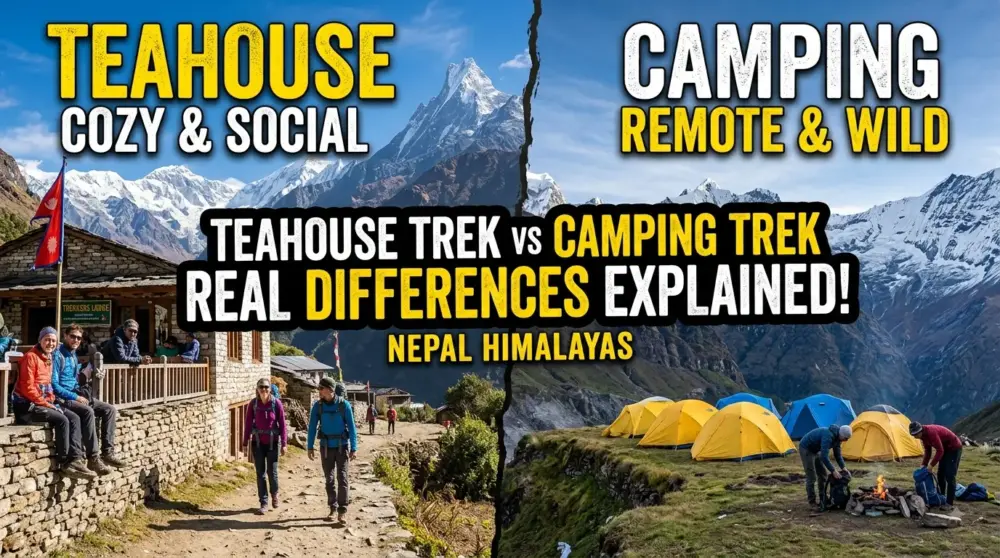
Quick answer, since you probably don’t want to read ten paragraphs to get it: on a teahouse trek you sleep in local lodges and eat meals someone else cooked in a proper kitchen. On a camping trek your crew hauls tents and a mobile kitchen and sets up camp fresh each evening, which is what routes like Upper Dolpo and Kanchenjunga still require, because there’s simply nothing else out there. Teahouse trekking is cheaper and a lot less to think about. Camping costs more and takes real planning, but it gets you into places a lodge has never reached.
Here’s where it actually diverges.
Teahouse trekking, what you’re really getting
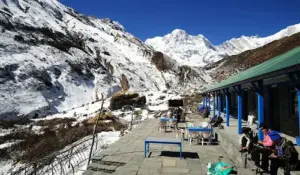
A teahouse is basically a family’s home that also rents rooms and cooks dinner. You walk in around 3 or 4 pm, someone shows you a room, you eat, you sleep, you leave in the morning. That’s it. No tents. No cook staff trailing behind you. Just your own daypack and whatever’s in your duffel that the porter’s carrying.
The rooms won’t win any awards. Twin beds, a thin mattress, a blanket that’s seen a lot of trekkers before you, walls thin enough to hear your neighbor zip their sleeping bag. Bathrooms are usually shared. Some of the busier lodges on Everest and Annapurna now have attached bathrooms, at least lower down. Get higher up, and you’re looking at a squat toilet and, some nights, no running water because the pipes have frozen solid.
Food is dal bhat, fried rice, noodles, momos, maybe a sad attempt at a pizza if you’re near a bigger village. Prices go up the higher you climb, because every bag of rice and every gas canister got carried in on someone’s back or a mule’s. Wi-Fi exists, mostly, for a fee, and gets patchier the further you get from a road.
Everest Base Camp, Annapurna Base Camp, the Annapurna Circuit, Langtang Valley, Mardi Himal, Poon Hill: all teahouse the whole way. Manaslu Circuit has swung teahouse too over the last few years, though a couple of the higher, quieter stops like Dharamsala still only have a handful of beds, so peak season sometimes means sleeping on the dining room floor if you didn’t book ahead.
Camping trekking, what actually happens out there
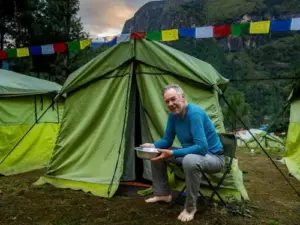
A camping trek brings the lodge with it. Sleeping tents, a kitchen tent, a dining tent, a cook, kitchen helpers, and enough porters to carry the whole operation. Your guide scouts and picks the site, the crew has it half set up by the time you roll in, and dinner’s cooked fresh rather than ordered off a laminated menu.
This isn’t roughing it for the sake of roughing it. It’s the only way to trek routes where lodges never got built, or where the few that exist can’t be relied on. Upper Dolpo. Kanchenjunga. Makalu Base Camp. Dhaulagiri Circuit. Big stretches of the Great Himalayan Trail. Camp or don’t go.
What it costs you is complexity. More crew, more gear, more days of planning before anyone’s even on the trail. And more money, since you’re funding a full portable kitchen instead of renting a room that was already standing there.
The two, side by side
| Feature | Teahouse Trek | Camping Trek |
| Cost | Lower | Higher |
| Comfort | Bed, basic room | Tent, sleeping bag |
| Food | Set lodge menu | Cooked fresh by your crew |
| Privacy | Thin walls, sometimes shared rooms | Your own tent, more control |
| Flexibility | Fixed lodge locations | Camp almost anywhere on route |
| Crew | Guide, maybe a porter | Guide, cook, kitchen staff, porters |
| Works best on | Established, popular trails | Remote or trail-less terrain |
| Suits | First timers, tighter budgets, families | Trekkers chasing real remoteness |
Good snapshot if you’re scanning. Keep reading for the parts that don’t fit neatly into a table.
What it actually costs
On a teahouse trek you’re mostly paying for the room (often just a few dollars if you eat there too), meals, a guide, and permits. Camping stacks tent hire, a cook and kitchen crew’s wages, cooking gear, and extra porters on top of that same guide and permit cost. As a general pattern, camping runs meaningfully more per day than teahouse trekking on similar terrain, since you’re bankrolling an entire moving lodge instead of borrowing a room someone already built. Exact numbers shift with the season and the operator, so treat anything you read online, including this, as a starting point rather than a quote. Worth confirming current pricing directly before you commit either way.
So which one’s actually for you
If this is your first trip to Nepal, or money’s a real factor, or you just don’t want to think about logistics beyond “walk, eat, sleep,” teahouse trekking is the easier call. You also get the bit people underrate: actually talking to the family running the lodge, not just passing through.
If you want a route that has no lodges at all, or you’d rather not share a trail with forty other groups, or you’re building toward a restricted-area permit trek or a peak climb, camping is where that happens. It costs more effort as well as money, and most people who choose it know that going in.
A word on safety
Both styles come down to the same thing in the end: how good is your guide’s judgment on weather, altitude, and pacing? That matters more than which roof you’re sleeping under. Camping in the deep remote areas does mean slower help if something goes wrong, since you’re further from a road or an airstrip. Teahouse routes tend to have better phone signal, and on busier trails, there are other groups nearby if you need a hand. Either way, ask your operator what their actual emergency plan looks like before you sign up, not after.
Questions people actually ask
Is camping trekking more expensive than teahouse trekking?
Yes, pretty much always. You’re funding a whole kitchen and lodging crew instead of a room that was already there.
Is Everest Base Camp a teahouse trek?
It is, start to finish. No camping involved.
Which Nepal treks require camping?
Upper Dolpo, Kanchenjunga, Makalu Base Camp, Dhaulagiri Circuit, and several sections of the Great Himalayan Trail.
Can beginners handle a camping trek?
Some do fine, especially with a solid guide and honest fitness prep, but most camping routes are also the remote, demanding ones, so a bit of trail experience first isn’t a bad idea.
Which is better in monsoon?
Teahouses give you a dry room to sit out the rain. Camping in monsoon means wet tents and slick trails, which is why most operators steer clear of camping routes at that time of year.
Can a trip mix both styles?
Yes, and it happens more than you’d think. Teahouses where they exist, camping where they run out. Manaslu’s higher stretches are a good example.
Bottom line
Want it affordable, comfortable, and along a trail that’s been walked a thousand times before, with something hot waiting at the end of the day? Teahouse. Want the parts of Nepal most trekkers never see, and you don’t mind your crew hauling the kitchen along with you? Camping.
Not sure yet which one fits your trip? Tell us your dates, your fitness level, and the kind of route you’re picturing, and we’ll help you compare real itineraries side by side.



How to book a trip?

make free inquiry

confirm the trip
