


Best Trekking Routes in Nepal for Kids Under 12(Easy & Safe Family Treks)
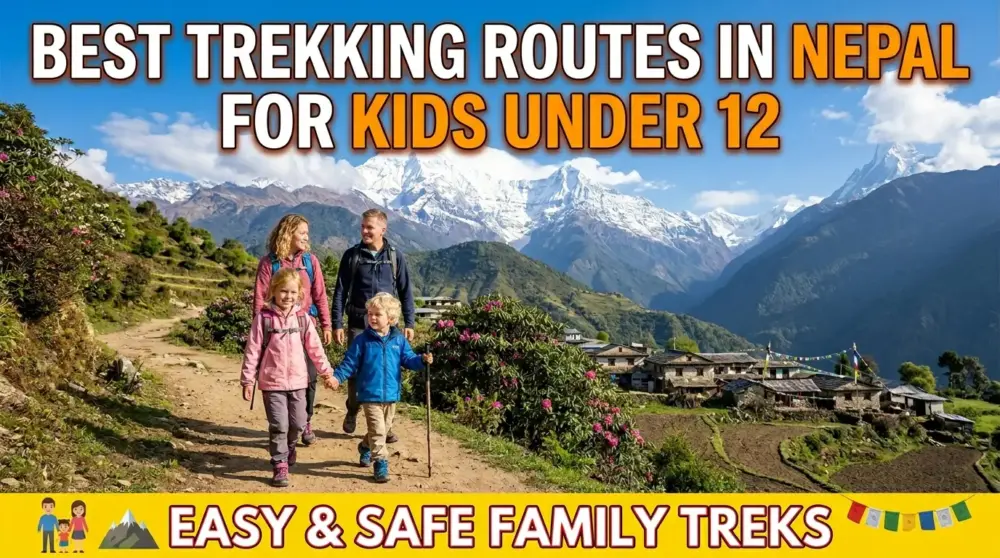
Trekking routes in Nepal for kids were something I almost said no to three years ago. Three years ago, I almost talked my husband out of this trip entirely.
We had two kids, seven and nine at the time, and I was convinced Nepal trekking was something you did before kids, not with them. I’d seen the photos. The climbers. The serious faces and the heavy gear and the altitude tents. And I thought, no way. Not with a second grader who still needs someone to tie his shoes.
We went anyway. And I’ll tell you exactly what happened. My nine-year-old cried on day one because her feet hurt. My seven-year-old refused to eat dinner that night because he said the dal smelled weird. And by day three, both of them were racing each other up the path to Poon Hill at five in the morning while my husband and I wheezed behind them, trying to keep up.
So yes. Kids under 12 can go trekking in Nepal. They can do it safely. They can do it happily. And if you pick the right route and stop trying to treat it like an adult expedition, your children will probably do it better than you.
Here’s everything I wish someone had told me before we booked.
Is Trekking in Nepal Safe for Kids?
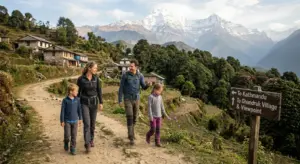
Safe is a funny word because nowhere is perfectly safe, and Nepal isn’t trying to pretend otherwise. But honestly? The popular family routes in Nepal felt safer than I expected. Better marked than some trails I’ve done in Europe. Teahouses every few kilometres. Locals who immediately want to feed their children something.
The altitude concern is real and worth taking seriously. Kids don’t always tell you when they feel off, and that’s the actual danger. Not the trails, not the distances. Just altitude and the fact that children are bad at reporting symptoms.
Stay below 3,500 metres and that risk drops dramatically. All six routes in this guide do exactly that, or give you a clear option to stay below it. Get a guide who knows what early altitude sickness looks like in children. And go slow. Go genuinely, uncomfortably slow. Slower than that. Now you’re at the right pace.
Why Families Keep Coming Back to Nepal
It’s not one thing. It’s everything together.
The teahouses are a big part of it. You’re not camping. You’re not cooking. You finish walking, you sit at a table, someone brings your kid a plate of fried rice or pasta or Tibetan bread, and a cup of hot chocolate. Then they sleep in a bed. Then you do it again tomorrow. That structure is genuinely easier to manage with children than most people expect.
The cost matters too. We did five days, including the guide, the accommodation, all meals, and two porters, for around what a weekend glamping trip costs back home. That’s not a typo.
And then there’s the people. I keep coming back to this because it genuinely surprised me. In one village, an older woman came out of her house just to give my son a small cloth bracelet. She didn’t speak English, and he didn’t speak Nepali. He wore that bracelet for four months after we got home. Still talks about her. That’s Nepal.
Best Trekking Routes in Nepal for Kids Under 12
1. Ghorepani Poon Hill Trek
Four to five days. This is where most families start, and most families don’t regret it.
Maximum altitude is 3,210 metres, which keeps the risk of altitude sickness low. Walking days are four to five hours, sometimes less. The trail goes through a rhododendron forest that in March and April looks like someone went absolutely wild with a pink and red paintbrush across every hillside. Gurung villages along the way are small and quiet, and the kind of place where your kid will want to look inside every doorway.
But the thing everyone does this trek for is sunrise from Poon Hill itself. You’re out of bed at four in the morning. It’s cold and dark, and your kids are complaining, and you’re wondering why you agreed to this. Then the light comes up behind Dhaulagiri and hits the Annapurna range, and the whole sky turns colours that don’t have proper names. My daughter didn’t say a single word for about ten minutes. Just stood there with her mouth open. She’s twelve now and still brings it up.
Good for kids aged 7 and above with some walking experience.
2. Everest View Trek
Five to six days. You come home having seen Everest with your own eyes. Not on a screen. Actually seen it. That’s the whole point.
This one reaches 3,880 metres at the Everest View Hotel, higher than Poon Hill, so you need to build in a proper acclimatisation day and watch your kids carefully through the middle days. Headache or not hungry means you stop, rest, maybe go down a bit. No heroics.
For kids aged 9 and above who are reasonably active and not prone to getting carsick on winding roads, this trek is absolutely doable and worth every bit of extra planning. The Sherpa villages in the Khumbu are unlike anywhere else on earth.
3. Langtang Valley Trek (Short Version)
Four to six days. Only a few hours from Kathmandu by road, which cuts a huge chunk of the travel stress right out of the trip.
Langtang is quieter than the Annapurna routes. Way quieter. The valley has this wild, dramatic quality, big green slopes, yak pastures, rivers that are so loud you feel them before you hear them. The Tibetan cultural influence in the villages is fascinating for kids who’ve been doing some reading about the region beforehand.
At Kyanjin Gompa, there’s a cheese factory. Made from yak milk using old Swiss techniques. I mention this specifically because both my kids, who refused to eat any local food for the first day and a half, ate an entire block of yak cheese between them. Go figure.
4. Australian Camp Trek near Pokhara
Two to three days. This is the one to do if your kids are young, under 7, or if your family has never done anything like this before.
The trail is gentle. The altitude is nothing to worry about. The views of Annapurna from the camp are genuinely spectacular in a way that feels almost unfair given how short and easy the walk is. You’re back in Pokhara in two or three days, which means if someone gets a blister or a cold or just decides they hate trekking, you have not committed to anything catastrophic.
Start here. Figure out whether your family likes it. Then plan the longer trek for next time.
5. Nagarkot to Dhulikhel Trek near Kathmandu
One to two days. Don’t underestimate this one just because it’s close to the city.
The ridge walk between Nagarkot and Dhulikhel gives you Himalayan views on a trail that’s genuinely easy, zero altitude concerns, and close enough to Kathmandu that you can do it as a day trip or an overnight. We did it before our main Poon Hill trek as a kind of warm-up, and our kids were immediately obsessed. Combine it with a day in Bhaktapur, and you’ve got a brilliant two-day introduction to Nepal before the real trekking starts.
6. Helambu Trek
Four to five days. Low altitude, quiet trails, Sherpa and Tamang villages, and almost no other tourists.
This trek never shows up on the front page of trekking roundups, and I think that’s because it doesn’t have one dramatic selling point. It’s just genuinely, consistently beautiful the whole way through. Families who do Helambu tend to be the ones who’ve already done Poon Hill and want something different. They almost always say it was their favourite.
Nepal vs Other Family Trekking Destinations
| Factor | Nepal | European Alps | Patagonia |
|---|---|---|---|
| Cost for a family | Very affordable | Expensive | Very expensive |
| Easy trails for young kids | Excellent | Good but pricey | Very limited |
| Where you sleep | Warm teahouses | Mountain huts | Usually camping |
| Culture along the trail | Deep and real | Moderate | Minimal |
| Altitude issues | Manageable on the right routes | Low | Low |
| The youngest age at which it works | Around 6 | Around 8 | Around 10 |
Tips I Learned the Hard Way
Let your child set the pace. Completely. Throw your adult hiking pace out entirely. The families I saw struggling on the trail were always the ones where a parent was slightly ahead and slightly impatient. The families having a great time were the ones where the kid was basically leading.
On hydration, set a phone alarm every 45 minutes. When it goes off, everyone drinks. No discussion. Kids at altitude stop feeling thirsty properly and will walk right into dehydration without realising it.
Pack snacks your child will actually eat when tired and grumpy at altitude. This is not the moment for the healthy snacks you bought at the airport. Chocolate. Biscuits from village shops. Dried mango. Whatever your kid genuinely loves. I packed those little fruit jelly packets my son liked, and he ate them every single day like they were medicine. They basically were.
Hire a guide. This is not optional advice dressed up as optional. A good guide who knows family trekking changes the entire experience. Ours in Nepal knew every teahouse owner on the Poon Hill route, knew which paths got slippery after rain, knew how to talk to my daughter when she hit a wall on day two and needed five minutes with someone who wasn’t her parents. Worth every rupee and then some.
What to Actually Pack for Kids
Shoes that have been worn before. Weeks before. The month before, ideally. New hiking boots on a Nepal trail will destroy your child’s feet by day two.
Warm base layers that pull moisture away from the skin. A fleece that actually fits. A windproof jacket, because even in spring, the mornings in Nepal are genuinely cold. Sunscreen is applied every single morning without negotiation because UV at altitude is brutal. A small daypack for each older child carrying their own water bottle and snacks, so they feel ownership of the trek.
Enough pairs of warm socks to change daily. A basic first aid kit. Whatever your doctor prescribes for altitude concerns. And wet wipes. Infinite wet wipes.
When to Go
March through May is the sweet spot. Rhododendrons are out, the weather is mostly stable, temperatures are comfortable for walking with kids, and the mountain views are usually clear.
September through November is equally reliable, maybe even better for views.
June through August is monsoon season. The trails get slippery, leeches come out on the lower paths, and the mountains hide behind clouds for days at a time. December and January can work on low routes, but you’re packing heavier, and the cold makes everything harder for young children.
The Mistakes That Actually Ruin These Trips
Choosing a route that’s too hard because you feel like the easy one won’t justify the flights. It will. The easy routes in Nepal are not boring. They’re extraordinary.
Ignoring symptoms in your kid because they seem minor. Unusual headache, not wanting to eat, and more tired than the day before at the same altitude. These are the signs. Take them seriously. Go down if needed. Nobody has ever regretted going down.
Rushing. Over-planning. Cramming six walking hours into a day because you want to see more. The families who come home saying Nepal was the best trip of their lives are almost always the ones who did less and felt more.
One Last Thing
The morning we left Nepal, my son asked if we could move there.
He was seven. He had complained about the smell of dinner on day one. He had needed his shoes tied every morning of the trek. And at the end of it, he wanted to live there.
I’ve thought about that a lot since. I think what happens on these trails with children is that they get to be capable in a way that normal life doesn’t give them. They walk somewhere hard, and they make it. They eat food they’ve never tried. They talk to people with whom they share no language. They wake up at four in the morning and see a mountain turn gold, and they understand, maybe for the first time, that the world is enormous and genuinely worth exploring.
Nepal gives kids that. The trails are easy enough to be safe and hard enough to matter. That combination is rarer than you’d think.
Go. Take your kids. Book through a team that knows what they’re doing and knows these mountains properly.
Green Horizon Tour is at greenhorizontour.com. Tell them your children’s ages and what kind of pace you’re hoping for. They’ll take it from there.
FAQs
What is the easiest trek in Nepal for kids?
Australian Camp near Pokhara. Two to three days, very low altitude, gentle trails, brilliant Annapurna views. It’s where families with young children or first-timers should always start.
Is Everest Base Camp suitable for kids under 12?
Genuinely no for most kids this age. Too long, too high, too physically demanding. The Everest View Trek gets you into the Khumbu with actual Everest views at a fraction of the difficulty and risk.
At what age can children start trekking in Nepal?
Short day hikes work from around age 5 or 6 on low-altitude trails near Pokhara or Kathmandu. Multi-day treks work well from age 7 upward, with some preparation walking beforehand.
Do children need permits for trekking in Nepal?
Yes, TIMS cards and national park permits apply to everyone, including children. A proper agency like Green Horizon Tour sorts all of this before you ever reach a trailhead.
How long should kids trek per day?
Three to five hours of actual walking. Split it up. Rest when someone asks to rest. Stop when something interesting appears, a waterfall, a funny-looking yak, a suspension bridge that bounces. Those stops are not delays. They’re on the trip.




How to book a trip?

make free inquiry

confirm the trip
