


Lukla Flights: Delays, Ramechhap & How to Cope (Complete 2026 Guide)
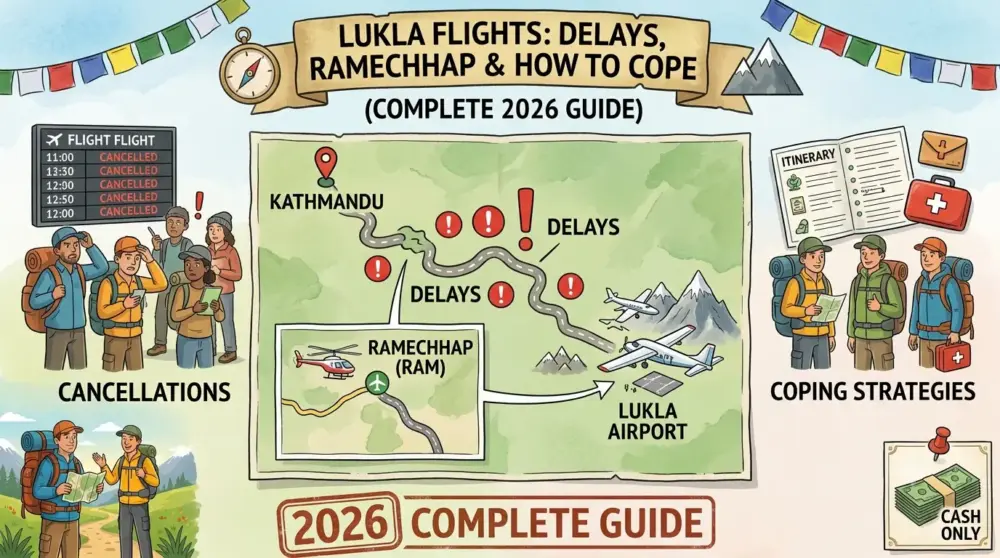
The short answer: Lukla flights get delayed because mountain weather runs the show — not the airline, not the schedule, not you. During peak trekking months, most flights now leave from Ramechhap (a 4- to 5-hour drive from Kathmandu) because it gives pilots a longer, cleaner window before the clouds roll in. Build buffer days. Get good insurance. Read this before your trek starts.
Let’s get something straight before we go any further.
Lukla flight delays are not a sign that something went wrong. They are not your operator’s fault, the airline’s fault, or a Nepal infrastructure problem. They happen because Tenzing-Hillary Airport sits at 2,860 metres inside a narrow Himalayan valley where weather changes faster than most people can process. In one hour, it’s clear. For the next hour, you can’t see the end of the runway.
Every Everest trekker deals with this. The ones who handle it well are those who understood it before they packed their bags.
Why Lukla Flights Get Delayed
The runway at Lukla is 527 metres long, slopes uphill, and has a rock face on one end and a sheer drop on the other. There is no instrument landing system. Pilots fly entirely on what they can see. When visibility drops below minimums — whether from fog, cloud, rain, or wind — every aircraft on the ground stays on the ground. Full stop.
Weather Is the Boss
Morning is the only reliable window. Flights typically operate between 6 AM and 9 or 10 AM, before the valley clouds build. On a good day, airlines run multiple rotations. On a marginal one, one or two flights slip through and then operations pause. On a bad day, nothing moves at all.
This is not a flaw in the system. It is the system. The alternative — pilots attempting landings in conditions that aren’t safe — would have killed people a long time ago.
Traffic Makes It Worse
Even on clear days, only so many aircraft can cycle through Lukla’s single short runway in a few morning hours. When dozens of trekkers are all trying to fly in on the same October morning, the maths becomes brutal. Slots fill, delays stack, and some people don’t make their first departure regardless of the weather.
The Ramechhap Situation (Read This Carefully)
This is the part nobody warns trekkers about until the night before. You booked a flight to Lukla from Kathmandu. Fine. But if you’re trekking during spring or autumn — which most people are — there is a strong chance you will not be flying from Kathmandu.
Kathmandu’s Tribhuvan International Airport runs all of Nepal’s international flights on a single runway. During peak season, the sheer number of Lukla departures creates chaos. The Civil Aviation Authority of Nepal moved peak-season operations to Manthali Airport in Ramechhap district to fix it.
Ramechhap sits at 474 metres. Lower altitude means cleaner morning air, less fog, and more consistent visibility. The flight from there to Lukla takes only 15 to 20 minutes — half the time from Kathmandu — which means aircraft can complete more rotations before conditions deteriorate.
The trade-off: you’re driving 4 to 5 hours from Kathmandu, usually leaving between 1 AM and 2 AM.
Yes, really. 1 AM.
Kathmandu vs. Ramechhap at a Glance
| Kathmandu | Ramechhap | |
| Flight to Lukla | 30 to 35 minutes | 15 to 20 minutes |
| Early drive required | No | Yes, depart ~1 AM |
| Congestion level | High in peak season | Low |
| Delay risk | Higher | Lower |
| Baggage allowance | 10 kg + 5 kg carry-on | Same |
From March to May and from September to November, Ramechhap is the standard. Your operator confirms the night before. A good operator has already explained this weeks ago.
Outside peak season, flights usually go from Kathmandu. Not always — check with your agency before assuming.
What Actually Happens When Your Flight Is Cancelled
You’ll find out between 5 AM and 8 AM, usually through your guide or agency contact. Weather updates come early, and operators monitor conditions through the night.
If it’s a short delay — say, cloud cover that might lift by mid-morning — you wait. Many days that start with a cancellation end with flights later in the morning. Don’t assume the whole day is lost until midday at the earliest.
If conditions don’t improve, you’re rebooked for the next morning. Your operator handles this. If you booked independently, you handle it yourself, which is one concrete reason to go through a registered local company rather than sort logistics alone.
The Helicopter Option
When fixed-wing operations are grounded and you have a hard international departure coming up, helicopters become the conversation. They’re more flexible in marginal conditions, don’t need a long runway, and can often get out when Twin Otters can’t.
Shared helicopter: Split between multiple passengers, a seat from Ramechhap or Kathmandu to Lukla typically runs USD $400 to $600 per person. Demand and season move that number.
Private charter: Significantly more expensive. Relevant for medical situations or when you’re two days delayed, and your international connection is tomorrow.
Helicopters still operate under VFR. They’re not magic in zero visibility. But they’re a real and commonly used option when timing gets tight.
Planning your Everest trek? Get a tailored quote from our team → greenhorizontour.com/quick-inquiry
How to Not Lose Your Mind During a Delay
Most trekkers who struggled with Lukla delays made one of three mistakes before they left home.
Mistake 1: Booking a tight international return. If your flight to Frankfurt leaves 24 hours after you’re scheduled to be back in Kathmandu from Lukla, you have essentially zero margin. One delay day and you’re in trouble. Two days’ delay and you’re scrambling for a helicopter. Build at least two buffer days between your expected Lukla return and your international departure. This single decision eliminates 80% of delay-related stress.
Mistake 2: No travel insurance. Your policy needs to cover domestic flight cancellations, additional nights in Kathmandu or Ramechhap, and helicopter evacuation costs if that becomes necessary. Read the policy details, not the headline. Some plans cap delay coverage at an amount that barely covers one extra hotel night in peak season.
Mistake 3: Checked bags with essentials in them. Keep your passport, medication, a power bank, one warm layer, and snacks in your carry-on. Not because bags get lost — they usually don’t — but because if you end up waiting at Manthali Airport at 7 AM for a weather update, you want those things in your hands.
One more thing: wear your heaviest gear on the plane. Boots, down jacket, camera. It doesn’t count toward your 10 kg limit. Every experienced Lukla trekker does this. It’s not cheating; it’s how the math works.
Best Time to Fly to Lukla
Spring and autumn give you the best shot at a smooth departure. That doesn’t mean delay-free — it means the odds are better, the windows are longer, and the scenery on the flight is spectacular on clear mornings.
| Season | Reliability | What to Know |
| Spring (March to May) | Good | Busy period, Ramechhap standard |
| Autumn (Sept to Nov) | Best overall | October books out 6 to 8 weeks ahead |
| Winter (Dec to Feb) | Variable | Fewer trekkers, more snow risk |
| Monsoon (June to Aug) | Lowest | Frequent cloud, highest cancellation rate |
October is the most popular and most competitive month. If you’re targeting it, book Lukla seats early — not as an afterthought once your international flights are confirmed.
Quick Practical Checklist Before You Fly
Before you leave Kathmandu for Manthali or the domestic terminal, run through this:
Bags sorted the night before (not at the airport at 5 AM). Carry-on has passport, medication, power bank, snack, one warm layer, phone charged, and number given to your guide. An international return flight has a minimum of 2 buffer days. Travel insurance confirmed, and policy details understood. Departure airport confirmed with your operator the evening before
Morning flights only. The first rotation of the day gives you the best chance. If you’re on a 9 AM slot and conditions have been marginal, check with your guide before heading to the airport.
Frequently Asked Questions
Why are Lukla flights so often delayed?
Tenzing-Hillary Airport operates under Visual Flight Rules with no instrument landing system. Pilots must see the runway clearly to land. Mountain weather — fog, cloud, rain, crosswind — can close the airport with almost no notice, and the usable morning window is only a few hours long.
Why do flights leave from Ramechhap and not Kathmandu?
Kathmandu’s single runway can’t handle peak-season Lukla volumes without creating dangerous congestion. CAAN moved peak-season departures to Manthali Airport in Ramechhap, which is quieter, sits lower, and gives airlines a more reliable morning VFR window. The flight is also shorter — 15 to 20 minutes versus 30 to 35.
How many buffer days do I actually need?
Two at the end of your trek, minimum. One is the floor, not the target. Never book your international departure for the day after your scheduled Lukla return.
Can I take a helicopter to Lukla instead?
Yes. Shared seats typically cost USD $400 to $600 per person. Private charters run higher. Helicopters are more flexible in marginal weather but still can’t fly in zero visibility. They’re a real and commonly used backup, not a luxury reserved for emergencies.
What if my return flight from Lukla is cancelled?
Your operator will rebook you on the next available slot, often the same day if visibility improves by mid-morning. If multiple days pass and a hard international connection is approaching, the helicopter conversation starts. This is why insurance that covers those costs matters.
Are Lukla flights actually safe?
Yes. The reputation for danger is earned by the airport’s geography, not its safety record. Only CAAN-certified pilots with specific Lukla training operate the route. Flights are cancelled whenever conditions aren’t right — that conservative standard is what keeps the record as clean as it is.
Which airlines fly to Lukla?
As of 2026, Tara Air, Summit Air (Goma Air), and Sita Air operate the route. Your trekking company books on your behalf and manages rebooking if conditions change. Don’t try to manage Lukla flight logistics without a ground contact in Kathmandu.
What’s the baggage limit on Lukla flights?
10 kg checked, 5 kg carry-on. This is firm on both Kathmandu and Ramechhap departures. Excess baggage charges apply, and in peak season, airlines sometimes refuse additional bags to keep weight within safe limits for the aircraft. Pack before you leave Kathmandu.
The Honest Closing Thought
Almost every experienced Everest trekker has a Lukla delay story. A morning sitting at Manthali watching the fog decides whether today is flying day. Some version of it is essentially a rite of passage for anyone heading into the Khumbu.
What separates a good experience from a stressful one isn’t the weather — you can’t control that. It’s whether you planned for it. Two buffer days, a solid insurance policy, and a trekking operator who handles rebooking so you don’t have to. That’s the whole formula.
Green Horizon Tours has been running Everest logistics since 1989 — Lukla bookings, Ramechhap transfers, early morning van pickups, helicopter arrangements when the weather forces the call. We brief clients before they arrive in Kathmandu. We monitor conditions on the morning of travel. We handle rebooking without putting that problem on you.
Trek Everest Base Camp with the operator since 1989 — get a quote in 24 hours


How to book a trip?

make free inquiry

confirm the trip
