


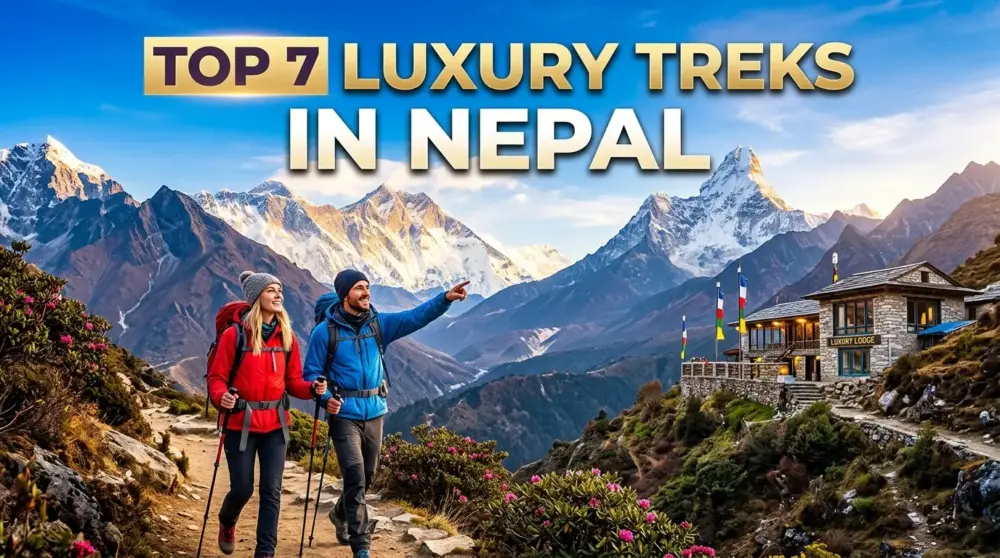
TOP 7 LUXURY TREKS IN NEPAL
The Morning That Changed Everything
Luxury treks in Nepal are not simply about comfort in the mountains—they are about experiencing the Himalayas with depth, access, and clarity. These journeys combine world-class landscapes with refined logistics, allowing you to focus entirely on the scale, culture, and silence that define Nepal’s greatest trekking regions. It’s 5:47 a.m., and your fingers are already cold even through the liner gloves.
The lodge is still half dark, the kitchen fire is only just waking up, and someone across the hall is pulling on gaiters with that particular rustling sound that only happens at altitude. You step outside, mug of black tea in hand, steam curling away faster than you’d expect, and the mountains do something they never quite do in photographs. They don’t just appear. They arrive.
The sky above Namche Bazaar goes from deep navy to a bruised rose to something between amber and fire, and for about four minutes no longer, Ama Dablam holds the last of the shadow on its southwest face while everything around it blazes. Nobody says anything. There’s nothing worth saying.
That moment right there is Nepal. That specific, unrepeatable stillness at the edge of something enormous. And what more and more travelers are discovering, much to the slight annoyance of the old-school trekking purists, is that you don’t have to sleep on a foam mattress in a drafty teahouse to experience it.
The past decade has seen a quiet revolution in how Nepal receives its mountain visitors. A new category of traveler has emerged: people who want the raw emotional weight of high-altitude Himalayan landscapes but also expect a hot shower before dinner, a lodge that knows the difference between a Riesling and a Sauvignon Blanc, and a guide who has summited Everest twice and can explain Tibetan Buddhism with genuine depth. The infrastructure has responded.
From the heated stone lodges of the Khumbu to the ancient walled city of Lo Manthang in Upper Mustang, Nepal now offers a tier of trekking experience that sits comfortably alongside the great luxury outdoor journeys of the world. Patagonia, the Dolomites, the Canadian Rockies. The difference is that Nepal still has something the others don’t quite manage: genuine remoteness. A sense that the world you left behind isn’t just paused, it’s actually gone.
What Makes a Trek “Luxury”?
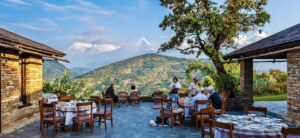
What makes a trek ‘luxury’ in this context? Not threadcount alone. It’s the combination of private or semi-private lodges with real beds and working heating systems, guides who are trained not just in mountain safety but in cultural and ecological depth, helicopter access for those who want to skip the lower approach valleys, porter and equipment ratios that mean you’re never carrying more than a daypack, and meals that actually fuel the body properly rather than the somewhat repetitive dal bhat only rotation that defines budget trekking.
It also means thoughtfulness, a guide who notices you’re struggling with altitude and quietly adjusts the day’s schedule, a lodge manager who brings you ginger honey tea without being asked, a route that is paced around experience rather than distance.
These seven treks are not the only luxury routes in Nepal, but they are the seven that, in terms of scenery, infrastructure, cultural depth, and sheer emotional return on investment, justify the price of the flight to Kathmandu. Each one is different in tone, terrain, and what it asks of you. Choose wisely
1. Everest Base Camp Luxury Trek
The One That Started It All
There is a particular arrogance to saying you’ve trekked to Everest Base Camp, and it’s entirely earned. Even on a luxury itinerary, which is really saying something. This route demands everything you have on certain days. The Khumbu is not a forgiving landscape. It is cold, steep, high, and uncompromising. But it is also one of the most visually and emotionally loaded corridors on earth, and the luxury operators who have set up here have understood that their job is not to make it easy. Their job is to make it worthy
The Journey
You fly into Lukla. That much is non-negotiable. The Tenzing-Hillary Airport is one of the world’s most discussed runways, a short strip perched on a ridge at 2,845 meters, with a drop at one end and a rockface at the other. The Twin Otter banks hard over the valley, the pilot drops the nose with a confidence that takes your breath, and then you’re on the ground, and porters are already materializing around you. It starts immediately.
The first two days along the Dudh Koshi river are deceivingly gentle. The trail winds through rhododendron forest in April, when the blooms are full, it looks genuinely unreal, deep crimson against the grey stone walls passing through Phakding and the swaying suspension bridges strung between cliff faces. Your guide will point out the sound of the river below, which changes register as you ascend, from a roar to a hiss to something almost gentle by Namche.
Namche Bazaar is where the Khumbu announces itself. The Saturday market still draws Tibetan salt traders on the old routes, and the town itself, terraced into a natural amphitheater above the river confluence, has become the de facto capital of Himalayan luxury. The Yeti Mountain Home here is the benchmark: rooms with valley-facing windows framed in stone and timber, underfloor heating, and a kitchen that produces yak cheese boards, Himalayan pasta, and apple crumble that would not embarrass a European mountain restaurant.
Above Namche, the trail climbs to Tengboche monastery, which is the most photographed in Nepal, with Ama Dablam rising directly behind it in that almost theatrical composition, and then continues through Dingboche, Lobuche, and Gorak Shep. The air gets thinner. Conversations get shorter. The landscape strips back to rock and ice and sky. On the final approach to Base Camp, you walk the lateral moraine of the Khumbu Glacier, looking down into a chaos of seracs and blue ice towers. It looks like the surface of another planet.
Base Camp itself, at 5,364 meters, is not beautiful in the conventional sense. It’s a boulder field, usually littered with expedition tents and prayer flags. But the view up the Khumbu Icefall, to the Western Cwm and the South Col beyond, stops every single person who gets there. Without exception. Because what you’re looking at is the route to the summit of the world, and the scale of it makes something shift inside you that you won’t quite be able to explain when you get home.
Luxury Elements
The Yeti Mountain Home group of lodges offers the gold standard along this route. Phakding, Namche, Tengboche, Dingboche, and Lobuche each have heated rooms, hot showers, Western-style beds, and menus that change based on altitude (lighter, more digestible food above 4,000m). The Everest View Hotel above Namche is another option, accessible by helicopter if the approach trails feel too slow.
Private helicopter transfers between Lukla and Kathmandu can be arranged for both arrival and departure, cutting the total logistics and giving you an unforgettable aerial perspective on the Khumbu as you leave. Many luxury operators also include a dedicated altitude doctor or high altitude trained paramedic on the team.
Highlights
Ama Dablam from Tengboche is possibly the most photogenic mountain on earth. The Hillary Monument at Namche. The Khumbu Glacier up close. Everest from Kala Patthar at dawn, when the summit pyramid catches the first light and everything below is still dark.
Difficulty & Duration
Strenuous. You will have hard days, especially above Dingboche. Fitness matters, but acclimatization matters more. A proper luxury itinerary builds in rest days at Namche and Dingboche. Don’t let anyone rush you through this. 14–16 days is the right length. Anything shorter compromises acclimatization.
Best Time to Visit
October and November are the classic post-monsoon window, during which skies are scrubbed clean, mountains are sharp as cut glass, and the Buddhist festival of Mani Rimdu at Tengboche in November, if timing allows. April is the pre-monsoon season, when the rhododendrons are in full bloom, and the light has a particular warmth. Avoid December through February unless cold-weather camping is your definition of luxury.
Insider Tip
Ask your guide to take you up to the Everest View Hotel above Namche, even if you’re not staying there. The terrace at sunrise, Everest, Lhotse, and Ama Dablam all visible at once, is worth the forty-minute detour. Order the sherpa stew. It’s better than anything on the menu.
2. Annapurna Base Camp Luxury Trek
The Sanctuary That Earns Its Name
Some treks feel like an approach to something, and then some treks feel like a destination from the very first step. Annapurna Base Camp is the latter. The route into the Annapurna Sanctuary is that ancient glacial bowl ringed by thirteen peaks over seven thousand meters, which is the closest thing I know to walking into the interior of a mountain range rather than along its edges.
The Journey
The trek typically starts from Nayapul, a dusty roadhead south of Pokhara, though luxury operators sometimes use a jeep transfer or short helicopter hop to Ghandruk to skip the lower approach entirely. Ghandruk is a beautiful Gurung village of stone and slate, rhododendron forests spreading above it, and the first clear views of Annapurna South and Hiunchuli already commanding the northern skyline.
The trail climbs through Chhomrong, arguably the last real village before the sanctuary, with an excellent lodge at the top of the ridge where you can sit on a terrace and watch the afternoon light move across Annapurna South’s west face and then descends into the gorge of the Modi Khola. The bamboo forests here are extraordinary. Tall, dense, filtering the light into something green and underwater, and you’ll hear the river below you before you see it for hours.
The Modi Khola gorge is where weather enters the equation. The canyon funnels cloud and rain up from the south, and the luxury lodges in Dovan and Himalaya Hotel have all learned to build fires early. This section can be wet, moody, and occasionally spectacular in a gothic sort of way, with mist threading through the bamboo, water pouring off the stone walls, and leeches in monsoon season that will find you no matter what you do.
And then the gorge opens. The Annapurna Sanctuary announces itself with a visual release that is one of trekking’s great moments as you step out of the narrow, forested canyon into a vast, open glacial amphitheater, 360 degrees of Himalayan peaks, the air thin and cold and startlingly clean. Annapurna I, the 10th-highest mountain on earth, fills the north. Machhapuchchhre, the sacred, never-climbed fish-tail peak, guards the entrance behind you. It is, depending on the time of day and how the clouds are playing, either overwhelming or serene. Usually both at once.
Luxury Elements
The Sanctuary Lodges operated by Pavilions Himalayas set the standard here, particularly the lodge at Annapurna Base Camp itself, which offers heated stone rooms, a spa using Himalayan herb treatments, and a dining room with panoramic windows facing the amphitheater. Gourmet trekking menus include locally sourced buckwheat, millet, and organic highland produce. The lodge at Chhomrong is worth an extra night. The terrace at sunset is genuinely one of Nepal’s finest dining views.
Helicopter return from base camp to Pokhara is available and increasingly popular as it saves two days and gives you an aerial perspective on the sanctuary that ground-level simply cannot offer.
Highlights
The 360-degree panorama at Annapurna Base Camp. The Gurung cultural villages of Ghandruk and Chomrong. The Modi Khola gorge in morning mist. Machhapuchchhre at any hour, but especially by moonlight.
Difficulty & Duration
Moderate to strenuous. The altitude doesn’t reach the extremes of the Khumbu, but ABC sits at 4,130 meters, and the ascent and descent involve significant daily elevation gain. 10–12 days allows for a proper pace and optional side excursions. Good cardiovascular fitness is needed but no technical experience.
Best Time to Visit
October through November and March through May. The spring trek comes with rhododendron forests in full bloom along the lower sections. The trail through Ghorepani in April can feel like walking through a botanical garden that happens to have Dhaulagiri in the background. October brings crystalline skies and warm afternoons.
Insider Tip
Spend an extra night at Annapurna Base Camp if the forecast allows. The dawn light on Annapurna I at 5:30 a.m., before the cloud builds, when the summit is catching the first gold and the glacier below you is still in deep blue shadow, is something you will carry for years. Most trekkers turn around the same day they arrive. Don’t be most trekkers.
3. Everest Panorama Luxury Trek
All the Drama, Half the Altitude
Not everyone has two weeks and a willingness to push through nights at 5,000 meters. But almost everyone wants to see Everest. The Everest Panorama Trek was designed for exactly this tension. It delivers Himalayan grandeur at a pace and altitude that most fit travelers can handle comfortably, without the acclimatization stress of the full Base Camp route.
The Journey
The route reaches Tengboche monastery as its high point, 3,867 meters, fully manageable with a reasonable itinerary, and the views from here of Everest, Lhotse, Nuptse, Ama Dablam, and Thamserku constitute one of the great mountain panoramas in the world. No hyperbole. The monastery courtyard in the late afternoon, with those peaks arranged behind it and the smell of juniper incense drifting from the main prayer hall, is a moment that stops conversation.
The approach follows the same trail as the full EBC trek through Namche Bazaar, so the luxury infrastructure is identical. The Yeti Mountain Home lodges, the Sherpa culture, and the Saturday markets. The difference is that you turn back at Tengboche rather than continuing up the valley, and this shorter turnaround means the itinerary can be genuinely generous rest days, cultural visits, and optional hikes to viewpoints like Khumjung and the Hillary School.
The hike to Khumjung village is underrated. The village itself is a home to a scalp claimed to be a Yeti’s, which sits on a plateau above Namche with open views west toward Kwangde and east toward Ama Dablam. The potato farmers here still work the same terraced fields they’ve worked for centuries, and on a clear afternoon, it’s possible to sit on a stone wall and watch yaks moving along the ridge with Everest visible above them, and feel that the modern world has, for a moment, genuinely receded.
Luxury Elements
Because the altitude ceiling is lower, some operators offer lodges that would be impractical higher up, including Namche’s more hotel-like properties with proper bathrooms, room service, and even a massage facility. The Panorama trek benefits from the Khumbu’s best luxury infrastructure without the physical cost of going higher. Helicopter options include Kathmandu to Lukla and Lukla to Kathmandu, keeping the journey entirely private.
Highlights
Tengboche monastery, the views, the incense, the morning puja ceremony, if your guide can arrange access. Namche Bazaar is a destination in its own right. The Everest View Hotel terrace. The Khumjung plateau. Ama Dablam’s southwest face catches alpenglow on the return.
Difficulty & Duration
Moderate. The maximum altitude of 3,867m is manageable for anyone with reasonable fitness and a proper acclimatization day at Namche. 8–10 days. This is the route for people who want a genuine Himalayan experience without extreme physical commitment.
Best Time to Visit
Same windows as EBC October–November and March–May. The lower altitude means slightly more tolerant weather in shoulder months; even late September and early December can be excellent on this route.
Insider Tip
Request a room facing east in Namche, any of them, any lodge. The sunrise view from those windows across the valley toward Thamserku and Ama Dablam is worth more than almost anything else on the trek. Get up at 5:30 a.m. and don’t move for twenty minutes.
4. Upper Mustang Luxury Trek
The Kingdom at the End of the World
Upper Mustang is where Nepal stops feeling like Nepal and starts feeling like something that predates the concept of countries entirely. The ancient Kingdom of Lo officially absorbed into Nepal in 2008 but still presided over by the last king, Jigme Dorje Palbar Bista, who continues to live in his palace at Lo Manthang which sits in a rain shadow north of the Annapurna massif, its landscape a bleached, wind-carved wilderness of ochre cliffs, carved gompa caves, and medieval walled cities that look like they were built for a different civilization entirely. Which, in a sense, they were.
The Journey
Upper Mustang requires a special Restricted Area Permit that costs $500 per person for the first ten days. This exclusivity is intentional and essential. It keeps this extraordinary corridor from being overwhelmed, and it means that even in peak season, you’re unlikely to encounter crowds on the trail.
The region was entirely closed to outsiders until 1992, and that relative isolation has preserved something that has vanished almost everywhere else in Himalayan Nepal: an intact Tibetan Buddhist culture in its medieval form.
The trek usually begins in Jomsom, reached by a short flight from Pokhara that crosses the Annapurna range at a low altitude. A flight that produces some of the best mountain photography you’ll get without a summit permit. From Jomsom, the trail follows the Kali Gandaki river north, through Kagbeni, where the restricted area begins, marked by a police checkpoint and an immediate change in atmosphere, and into the wind-blasted plateau beyond.
The Kali Gandaki is the world’s deepest river gorge measured between flanking peaks, and the wind that races up it in the afternoons is legendary. It pushes at your chest, forces your chin down, fills every fold of clothing with grit. By early afternoon on most days between Kagbeni and Chele, you’re walking slightly sideways. Your guide will think this is funny. By the fourth day, you will too.
But the landscape. The cliffs above Chele are striped in layers of red, ochre, yellow, and cream sedimentary geology compressed by the collision of continents, now exposed and eroded into forms that look deliberately artistic. The caves cut into these cliffs, hundreds of them, some at heights that require ladders to reach, and once used as monastic retreats or burial chambers, pepper the faces for kilometers. In the evening light, the whole plateau takes on a color that feels warm despite the cold, like a fire burning inside the rock.
Lo Manthang, the walled capital, arrives after several days of plateau walking like a hallucination. A medieval city of whitewashed walls and flat-roofed houses, four significant gompa, including the 600-year-old Jampa Lhakhang, and a palace that still has a king. The streets are narrow and made of packed earth, prayer wheels spin along every wall, and the sound of chanting drifts from behind monastery doors at unexpected hours. It is unlike anywhere else.
Luxury Elements
The Lomanthang Himalayan Resort near the walled city offers the best accommodation in the region with heated rooms, Tibetan-influenced interiors with carved woodwork and thangka paintings, and a kitchen that manages to produce excellent meals despite being at 3,840 meters and several days’ walk from the nearest road. The Mustang Holiday Inn inside the walled city itself is smaller but offers a more immersive historic stay.
Helicopter transfers from Pokhara directly to Lo Manthang are available. This cuts the approach trek but gives up some of the plateau journey, which is, honestly, part of the point. A suggested approach: fly in, walk out. Or engage a fully outfitted jeep-and-lodge circuit for those who want the terrain without the daily trekking mileage.
Highlights
Lo Manthang’s walled old city. The Tiji Festival in May, which goes for three days of masked Buddhist dance that draws the entire regional population and is one of the most extraordinary cultural events in Asia. The sky caves at Chhoser. The Kali Gandaki cliff formations. Sunset from any rooftop in the capital.
Difficulty & Duration
Moderate. The altitude is significant to Lo Manthang sits at 3,840 meters, with several passes above 4,000 meters, but the terrain is mostly plateau walking rather than steep ascent. 12–14 days for the full circuit. The special permit means this requires planning.
Best Time to Visit
May for the Tiji Festival, for which you need to plan a year, fills up. September and October for clear skies and post-monsoon freshness. The rain shadow means this region is actually trekable during monsoon (July–August), when everywhere else in Nepal is soggy, an unusual and genuinely impressive advantage.
Insider Tip
Hire a local Lopa guide in Lo Manthang in addition to your main trekking guide. The Lopa people are the indigenous inhabitants of the kingdom, and a local guide will open doors literally and figuratively that a Kathmandu-based guide simply cannot. The monasteries, the king’s palace visits, and the private family homes served butter tea. Access that turns a remarkable trek into an unforgettable cultural experience.


How to book a trip?

make free inquiry

confirm the trip
