


Extreme Altitude & Singletrack: Top Global Mountain Biking Routes for Adventure Enthusiasts
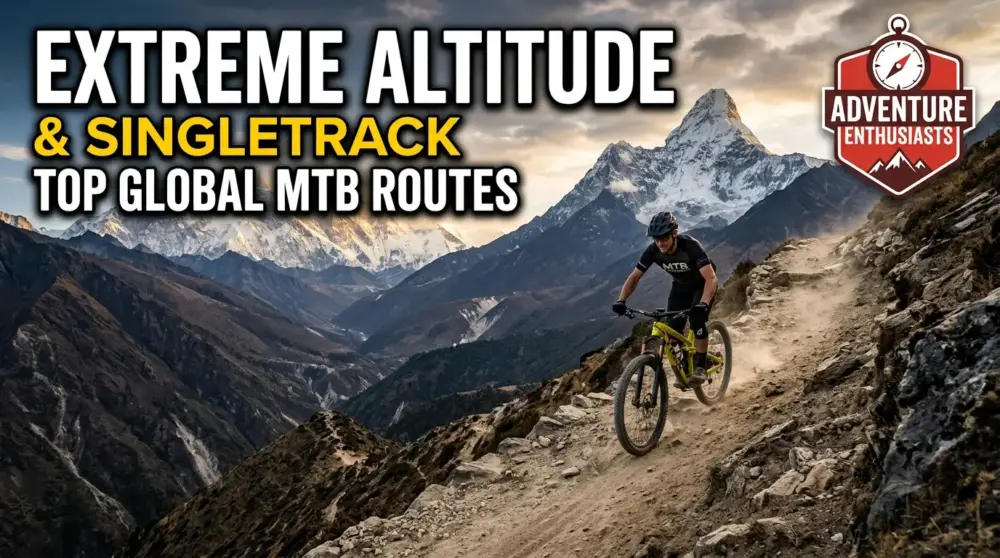
Mountain biking routes in Nepal represent the ultimate challenge for adventure cyclists seeking high-altitude passes, rugged singletracks, and remote Himalayan expeditions. For mountain biking purists, true adventure is not found on paved cycle paths or manicured bike parks. It is found on raw singletracks, ancient trade routes, and high-altitude backcountry trails where fitness meets technical handling. For mountain biking purists, true adventure is not found on paved cycle paths or manicured bike parks. It is found on raw singletracks, ancient trade routes, and high-altitude backcountry trails where fitness meets technical handling. When the jeep tracks turn to scree, the suspension is pushed to its absolute threshold, and the safety nets of urban centers disappear; that is where real mountain biking begins.
Nepal—celebrated globally as the ultimate frontier for foot mountaineering—has quietly evolved into the world’s premier destination for high-altitude mountain biking (MTB). It’s unique geographic staircase drops from the highest peaks on Earth down to sub-tropical jungle floors, providing a variety of vertical drops, technical singletracks, and rugged backcountry lines unmatched by any other country.
This extensive guide breaks down the country’s most formidable mountain biking frontiers, including iconic high-altitude expeditions, premium regional trail networks, and the highly technical trail systems hidden directly inside and along the rim of the Kathmandu Valley.
1. The Annapurna Circuit & Lupra Valley (Manang & Mustang)
The Classic High-Altitude Pass & Scree Descent
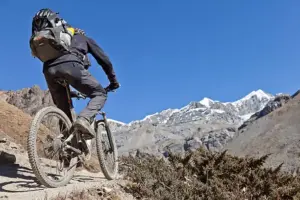
Historically celebrated as one of the world’s most iconic multi-day foot treks, the Annapurna Circuit has transformed into an epic, bucket-list frontier for hardcore mountain bikers and bikepackers. This is not a casual holiday cruise; it is a full-scale alpine expedition executed on two wheels.
[Besisahar: 760m] ──(Sustained Climb)──> [Thorong La Pass: 5,416m] ──(Extreme Descent)──> [Muktinath] ──> [Lupra Valley Singletrack]
The Challenge: Thin Air and Heavy Packs
Riding the Annapurna Circuit requires an intense combination of high-altitude endurance, technical rock-garden handling, and sheer physical resilience. You will face massive hike-a-bike sections where riding is impossible, forcing you to push or hoist a loaded 15kg to 20kg mountain bike up loose scree switchbacks in oxygen-depleted air. The weather is wildly unpredictable; a clear morning can rapidly devolve into a blinding high-altitude blizzard near the pass.
Route Breakdown and Topography
The journey traditionally starts in the subtropical lowlands of Besisahar (760m). From here, riders follow rugged, hand-carved jeep tracks and demanding singletracks winding along the roaring Marsyangdi River valley. As you ascend through Chame (2,670m) and enter the high alpine bowl of Manang (3,540m), the thin air becomes a physical wall.
The ultimate crucible of this expedition is crossing the snow-bound Thorong La Pass at an immense 5,416 meters (17,769 feet). Reaching the pass requires a pre-dawn push from Thorong Phedi or High Camp, navigating frozen paths where every pedal stroke feels like a sprint.
Once over the crest, you drop into the arid, windswept, Tibetan-style rain shadow of Lower Mustang. The descent from the pass down to the sacred pilgrimage site of Muktinath (3,760m) is a screaming, brake-burning downhill rush. From Muktinath, advanced riders bypass the main road and drop into the legendary Lupra Valley singletrack (Lupra Pass DH)—a dry, loose, high-speed canyon trail featuring natural wall rides, shale chutes, and river crossings that finish near the ancient hub of Jomsom.
Technical Parameters
-
Total Distance: Approx. 220–260 km (depending on route variations and vehicle transfers)
-
Total Elevation Profile: Over 6,000 vertical meters of climbing vs. ~4,500m of continuous descent
-
Riding Style: High-altitude bikepacking / All-mountain Enduro
-
Optimal Bike Choice: An aggressive full-suspension trail bike (130mm–150mm travel) with high-volume, tubeless tires to absorb high-velocity impacts against jagged alpine rocks.
2. Upper Mustang: Lo Manthang & The Forbidden Kingdom
The Arid Himalayan Desert & Ancient Caves Expedition
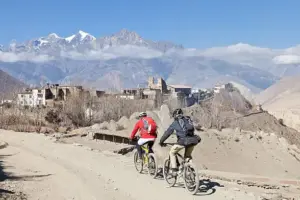
For riders who define adventure by pure exposure, unique geological formations, and profound cultural isolation, the journey into the Upper Mustang is the undisputed pinnacle of off-road desert mountain biking. This restricted region requires a specialized Department of Immigration permit ($500 per 10 days) and an authorized local guide, making it a pristine, preserved backcountry jewel.
[Jomsom / Kagbeni] ═══════ (High Passes: Gyu La, Marang La up to 4,500m) ═══════> [Walled City of Lo Manthang: 3,810m]
The Challenge: Relentless Headwinds and High Deserts
Upper Mustang is less about slick mud and wet roots and more about systemic dust exposure, high alpine passes, and navigating punishing afternoon headwinds. The Kali Gandaki gorge creates a natural wind tunnel that blows heavily north-to-south starting at midday. Riders must execute climbs across multiple mountain passes above 3,800 meters while managing dry, dehydrating desert air and technical, deep-sand tracks.
Route Breakdown and Topography
The route maps the ancient salt trading corridor to Tibet, starting from Kagbeni (2,810m) and pushing deep into the restricted boundary. The terrain is a visual spectacle of towering, crimson-colored sandstone cliffs, wind-carved caves, and high-altitude river beds.
Riders must conquer a sequence of demanding mountain passes, including the grueling Gyu La Pass (4,500m) and Marang La (4,230m). The trails consist of old singletracks used by mule trains and newly developed dirt paths that weave past remote villages like Samar, Ghami, and Charang.
The ultimate destination is the ancient, medieval walled city of Lo Manthang (3,810m). From here, riders can explore the surrounding Chhoser cave complexes right up to the Tibetan border, before executing technical, loose-over-hard rock descents back down through the remote, windswept village of Tange.
Technical Parameters
-
Total Distance: Approx. 150–180 km (point-to-point expedition)
-
Total Elevation Profile: Accumulated climbing of over 5,500 vertical meters
-
Riding Style: High-desert backcountry expedition / Rugged trail exploration
-
Optimal Bike Choice: A progressive 29er trail or enduro bike with a highly reliable drivetrain, fast-rolling but wide tubeless tires (2.4″–2.6″) to hook up in loose shale, sand, and heavy dust.
3. Ratnange & Pikey Peak (Lower Solukhumbu)
The Premium Singletrack Trail Center & Viewpoint Drop
If your idea of mountain biking adventure involves testing your technical handling skills against fast, flowing loam, steep pine-forest drops, and deep mountain singletracks, the Phaplu and Ratnange region in the lower Solukhumbu is a mandatory pilgrimage. Home to the highly active Ratnange Trail Center, this area features some of the best purpose-built and natural enduro trails in South Asia.
[Phaplu Hub] ──> [Ratnange Trail Center: 3,300m] ──> [Multi-Day Ridge Push] ──> [Pikey Peak Summit: 4,060m] ──(2.5-Hour Epic Descent)
The Challenge: Steep Root Networks and Intense Gradients
While the lower trail networks feature highly structured, flowing singletrack, pushing up to Pikey Peak requires excellent sub-alpine endurance. The lower sections transition into deep forests filled with slick, wet root networks, deep loam, and sections of jagged granite boulders that demand precise line choices, sharp mental focus, and constant momentum control.
Route Breakdown and Topography
The adventure centers around the mountain hub of Phaplu. From here, riders utilize 4×4 vehicles or pedal power to access the Ratnange Trail Center (3,300m), which features over 60 kilometers of trails like Moksh and Bucha—delivering everything from fast, bermed flow lines to steep, technical black-diamond woods sections.
For the ultimate backcountry epic, riders embark on a multi-day ridge journey from Phaplu toward Pikey Peak (4,060m), passing through the village of Jhapre. After a pre-dawn push to the summit to witness a panoramic sunrise showing eight of the world’s highest peaks (including Everest, Makalu, and Lhotse), riders drop their seats and engage a screaming, continuous 2.5-hour downhill singletrack descent that plunges through rhododendron forests, alpine meadows, and remote farming hamlets back to the valley floor.
Technical Parameters
-
Total Distance: Varied (60km+ local trail network; 45km Pikey expedition loop)
-
Total Elevation Profile: Local shuttles offer up to 1,000m of descent per run; Pikey Peak drops over 1,500 vertical meters in a single run.
-
Riding Style: Technical Enduro / All-Mountain Downhill
-
Optimal Bike Choice: A dedicated full-suspension enduro bike with 150mm to 170mm of travel, powerful four-piston hydraulic disc brakes, and heavy-duty casing tires to handle wet roots and sudden rock drops.
4. The Kathmandu Valley Rim & Core Trails
The Jungle Chutes, Clay Ruts, and Urban Escape Singletracks
For riders located inside or directly on the perimeter of the capital, the Kathmandu Valley functions as an aggressive, high-relief playground. The trails slicing down the valley rim and twisting through the interior are characterized by intense vertical drops, steep un-bermed hairpins, slick clay soil, and complex stone staircases. Because these trails double as historic walking and pilgrimage paths, conditions change constantly, keeping riders on their toes.
[Nagarkot Ridge: 2,175m] ──> [Jungle Loam & Clay Chutes] ──> [Ancient Stone Staircases] ──> [Changu Narayan]
[Shivapuri National Park]──> [Helipad & Ranger Witch Trails] ──> [Subtropical Canopy Drops] ──> [Budhanilkantha]
[Chobhar Gorge Sub-Hub]   ──> [Short Technical Rocky Deserts] ──> [Interior Pump & Jump Sessions]
[Hatiban Pine Forests]   ──> [Steep Root-Infested DH Drops]  ──> [South Valley High-Velocity Enduro]
Route Breakdowns and Topography Inside the Valley Hub
-
The Shivapuri National Park System (Northern Rim): This is the undisputed heart of advanced technical riding within the valley. Launching from the high ridges of Kakani or the Shivapuri Peak lines, these trails plunge straight through dense, subtropical jungle canopies. Iconic lines like the Helipad Descent and the Ranger Witch Trail (highly featured in the Asian Enduro Series) throw riders into fast singletracks, deep clay ruts, and massive stone staircases that test your fork’s high-speed compression damping to its absolute limit before ending near the Budhanilkantha shrine.
-
The Nagarkot Enduro System (Eastern Rim): Starting on the ridge of Nagarkot (2,175m), famous for its sweeping views of the Central Himalayan arc, this trail network features screaming descents through dense pine forests. The trails split into multiple technical lines (including the fast-paced Grand Slam and Tower lines), slicing down through natural rock gardens, root gaps, and stepped agricultural terraces before terminating near the UNESCO World Heritage site of Changu Narayan.
-
Hatiban Pine Forests (Southern Rim): Located near Pharping on the southern edge of the valley, Hatiban is a steep, pine-carpeted hillside that acts as Kathmandu’s dedicated downhill sandbox. The trails here are shorter but highly intense, packed with exposed, slippery pine roots, off-camber tight switchbacks, and gap jumps built directly into the steep slope. It is a premier training ground for local enduro and downhill racers.
-
Chobhar Gorge & The South-West Trails (Interior Valley): For a shorter ride inside the valley basin, the rocky ridges around Chobhar Gorge offer fast, technical cross-country and short enduro lines. It features dry, loose-over-hard terrain with sharp rock steps. From Chobhar, riders can link into the Bungamati and Khokana singletracks, which wind through ancient Newari farmlands, mud-brick villages, and deep river ruts along the Bagmati River.
Technical Parameters
-
Total Distance: 15 to 45 kilometers per trail link/network
-
Total Elevation Profile: Averaging 800m to 1,500 vertical meters of pure descent along the rim; 200m–400m punchy circuits internally.
-
Riding Style: Technical Enduro / All-Mountain Downhill / Steep XC
-
Optimal Bike Choice: A slack, aggressive full-suspension enduro bike (150mm–170mm travel) with large rotors (200mm+), and soft-compound, aggressive knobby tires to hook up in loose dirt and muddy jungle chutes.
5. Langtang Valley & Kyanjin Pastures
The Raw Glacial Gorge & Alpine Singletrack Frontier
For riders seeking an absolute wilderness experience characterized by deep river gorges, alpine pastures, and riding directly alongside colossal icefields, the Langtang Valley route offers a rugged, demanding hike-and-bike frontier.
[Syabrubesi: 1,550m] ──(Deep River Gorge)──> [Langtang Village: 3,430m] ──> [Kyanjin Gompa Pastures: 3,830m]
The Challenge: High-Consequence Exposure and Suspension-Busting Boulders
This route is a raw, non-mechanized trail. The lower section follows a deep, narrow river gorge where riders must navigate tight cliffside singletrack with high-consequence exposure. The trail surface is entirely natural: loose glacial moraine, field-boulder gardens, and steep stone switchbacks where carrying your bike over massive landslide debris fields is a regular necessity.
Route Breakdown and Topography
The route begins at the valley gateway of Syabrubesi (1,550m). Riders track upwards along the roaring Langtang Khola, climbing through dense oak and bamboo forests. The terrain opens up dramatically as you pass the old landslide zone of Langtang Village (3,430m) and enter the wide, glacial U-shaped valley floor.
The turnaround point is the historic settlement of Kyanjin Gompa (3,830m), surrounded by towering peaks like Langtang Lirung. Advanced riders can push further into the high-altitude yak pastures of Langsisha Kharka, riding narrow ribbons of singletrack surrounded by frozen glaciers. The return journey is a technical, physical descent down the valley, demanding excellent slow-speed trials skills, precise weight distribution, and absolute control over massive rock steps.
Technical Parameters
-
Total Distance: Approx. 70–80 km (out-and-back route)
-
Total Elevation Profile: ~2,300 meters of technical climbing and matching descent
-
Riding Style: Backcountry Alpine Trials / Extreme Wilderness Technical Exploration
-
Optimal Bike Choice: A heavy-duty, highly robust trail or enduro bike with reinforced sidewall tires (CushCore or equivalent tire inserts are highly recommended to avoid rim damage on sharp glacial boulders).
Strategic Comparison: Nepal’s Premier MTB Routes
To help you choose your next backcountry mission, this comparative matrix contrasts these five world-class routes based on elevation, terrain style, and primary physical demands.
| Route / Trail | Primary Region | Peak Elevation | Primary Riding Style | Topographical Profile | Technical Difficulty | Physical Demand |
| Annapurna Circuit | Manang / Mustang | 5,416m / 17,769ft | High-Altitude Bikepacking | Alpine rivers, glacial passes, arid shale canyons | Advanced | Extreme |
| Upper Mustang Expedition | Restricted Area | 4,500m / 14,763ft | Desert Backcountry | Sandstone cliffs, high passes, dry sandy singletrack | Advanced | Extreme |
| Ratnange & Pikey Peak | Solukhumbu | 4,060m / 13,320ft | Enduro / Flow / Downhill | Purpose-built flow lines, pine forests, alpine ridges | Expert | High |
| Kathmandu Valley Rim & Core | Capital Perimeter | 2,175m / 7,135ft | Technical Enduro / DH / XC | Subtropical jungle loam, clay chutes, roots, and stone steps | Expert | High |
| Langtang Valley | Langtang National Park | 3,830m / 12,565ft | Alpine Backcountry / Trials | Narrow river gorges, loose moraine, giant boulders | Expert | High |
Himalayan Backcountry Survival: Essential Packing Matrix
When you venture far beyond the safety net of urban bike shops and mobile phone networks in remote Himalayan districts, self-sufficiency is everything. A mechanical failure or safety oversight in an isolated valley can quickly escalate from an inconvenience into a survival situation. Your gear strategy must be meticulous.
1. The Ultimate On-Trail Tool Kit
-
Tubeless Repair System: High-thickness tyre plugs (bacon strips) and a tire reamer tool. For massive sidewall tears caused by sharp slate or glacial rocks, always carry a flexible tire boot or a piece of an old toothpaste tube to line the inside of the casing.
-
Chain Management: A multi-tool equipped with a built-in chain breaker and a pair of dedicated quick-links (master links) matching your drivetrain speed (11-speed, 12-speed, etc.).
-
Frame-Specific Spare Parts: A spare derailleur hanger specifically matching your bike’s make and model frame. Derailleur hangers are designed to bend or break during a rock strike to protect your frame; carrying a spare can save you from a 20-mile walk out of a canyon.
-
Inflation Setup: A high-volume hand pump (CO2 cartridges can fail or run out in cold, high-altitude settings) along with a spare heavy-duty inner tube, even if you are running a tubeless setup.
2. High-Altitude and Wilderness Protection
-
Variable Clothing Layers: Himalayan ecosystems can shift from scorching sunshine to freezing downpours or snow within an hour. Always carry a packable, fully seam-sealed waterproof jacket, a lightweight fleece or down layer, and long-finger windproof gloves.
-
First-Aid & Survival Essentials: A compact wilderness first-aid kit containing trauma dressings, antiseptic wipes, blister pads, and pain medication. Space blankets, a reliable lighter or waterproof matches, and a high-decibel survival whistle should live in your pack permanently.
-
Offline Navigation Assets: Do not rely on active cell phone towers. Carry a dedicated handlebar-mounted GPS bike computer with pre-loaded offline topographic maps, and supplement it with an offline mapping app (such as Trailforks or Gaia GPS) downloaded onto a fully charged smartphone paired with a rugged power bank.
Physical Preparation and Acclimatization Strategies
Conquering these rugged routes requires specific physical conditioning. You cannot rely solely on basic road cycling fitness when tackling technical, backcountry trails.
High-Altitude Training and Acclimatization
When riding routes like the Annapurna Circuit or Upper Mustang, elevation is the ultimate equalizer. At 5,000 meters, each breath delivers roughly half the oxygen available at sea level.
-
The Climb Strategy: If possible, arrive at the starting elevation of your trek 2 to 3 days early to let your body adjust before performing strenuous physical work.
-
Pacing Your Effort: Monitor your heart rate closely. Pushing into your anaerobic zone at high altitude causes rapid exhaustion that takes hours to recover from. Shift into an easy climbing gear and keep your cadence smooth and steady.
-
Hydration Dynamics: High-altitude air is incredibly dry, and your respiration rate increases significantly. Drink between 4 and 5 liters of fluid daily, supplemented with electrolyte powders to maintain proper sodium-potassium balances and prevent severe muscle cramping.
Core and Upper-Body Conditioning
Descending thousands of vertical meters over rough rock gardens puts immense strain on your upper body, core, and legs.
-
Anti-Arm-Pump Training: Build forearm and grip endurance by incorporating dead-hangs and farmers-walks into your gym routine. This helps maintain solid brake control during long descents.
-
Core Stabilization: Long hours holding an aggressive posture on a mountain bike require excellent lower-back and abdominal strength. Incorporate planks, kettlebell swings, and deadlifts to build a core that protects your spine from hard trail impacts.
Sustainable Trail Practices and Backcountry Ethics
As mountain biking expands into remote global frontiers, protecting these natural trails and supporting local host communities is essential for long-term sustainability.
-
Ride Open, Established Lines: Never cut corners or create new paths across delicate alpine meadows. This causes severe erosion and deep gullies during the rainy or monsoon seasons, permanently ruining the trail structure.
-
Yield Responsibly: Yield the trail appropriately to other users. When encountering trekkers or heavily loaded livestock trains (such as mules or yaks) on narrow mountain paths, always pull over completely on the safe hillside (not the drop-off side), stop your bike, and let them pass safely.
-
Support Local Economies: When traveling through remote regions like Nepal’s Mustang district or the isolated mountain towns along the Great Divide, spend your money directly within the communities. Stay in local teahouses, buy food from family-run lodges, and hire local guides and logistics teams. This ensures that adventure tourism directly benefits the people who maintain these historic pathways.
Conclusion: Finalizing Your Expedition Blueprint
Stepping away from manicured trails to take on the world’s most demanding backcountry mountain bike routes is a powerful, transformative experience. Whether you choose the extreme altitude of the Annapurna Circuit, the vast culture of Upper Mustang, or the raw jungle singletracks hidden directly inside the Kathmandu Valley Rim, these routes offer far more than a simple adrenaline rush—they are true expeditions that test your preparation, self-reliance, and mental grit.
Nepal offers some of the most diverse and challenging mountain biking routes in Nepal, ranging from the extreme altitude of the Annapurna Circuit to the technical singletracks of Kathmandu Valley and the remote wilderness of Langtang. Whether you are seeking multi-day bikepacking expeditions, enduro descents, or high-desert adventures, these mountain biking routes in Nepal provide unforgettable experiences for every serious rider.
The key to a successful backcountry expedition lies in balancing absolute respect for the environment with thorough logistical preparation. Build your fitness, refine your mechanical skills, respect the local cultures, and head out onto the trail knowing you are experiencing the absolute peak of global mountain biking adventure!


How to book a trip?

make free inquiry

confirm the trip
