Everyone told Prakash not to go in July.
His friends said wait for October. His colleague showed him a photo of a flooded road somewhere near Pokhara. His mother asked why he couldn’t just go somewhere with a beach.
He went anyway. Spent twelve days between Kathmandu, Upper Mustang, and Chitwan. Came back saying it was the best trip of his life.
That’s not a guarantee. Monsoon Nepal will frustrate you if you go in expecting clear skies and mountain views. But if you go in knowing what it actually is? Different story.
Here’s the honest guide nobody else seems to want to write.
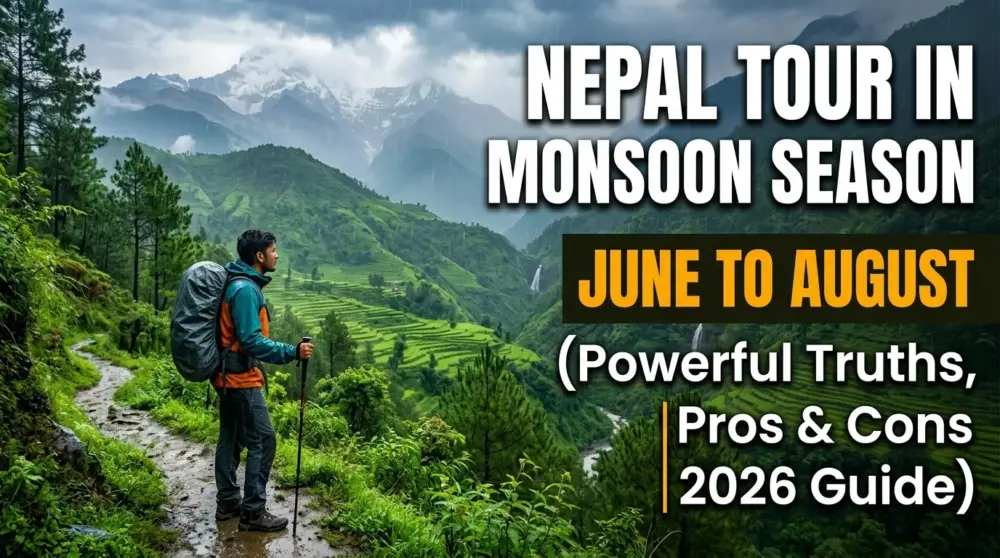
A Nepal tour in monsoon season — June through August — means lush green countryside, almost no other tourists, and noticeably cheaper costs. It also means rain, some flight delays, and the Himalayas mostly hiding behind clouds. Go to the right places with a flexible head, and it genuinely delivers.
What Monsoon Season in Nepal Is Actually Like
First thing to clear up: it doesn’t pour rain from sunrise to midnight every single day. Most of the time, you get a usable morning, clouds rolling in around midday, and then the real rain hits late afternoon into evening. Annoying? Sometimes. But manageable once you know the pattern and plan around it.
Second thing: Nepal is not one weather zone. The Terai plains in the south flood and get genuinely miserable. Kathmandu and Pokhara deal with regular showers but stay functional. Upper Mustang, which sits behind two of the biggest mountain ranges on earth, gets almost zero rain. The monsoon clouds physically cannot get over the Annapurna and Dhaulagiri walls. So while it’s pouring in Pokhara, people in Lo Manthang are having dry sunny days.
That geographical detail changes your entire trip planning once you understand it.
Why Monsoon Nepal Is Actually Worth Considering
The crowds vanish.
In October, the Poon Hill trail looks like a morning commute. In July, you might walk for two hours and see four people. Tea house owners sit with you. Temple courtyards feel sacred rather than busy. You get the Nepal that people talk about wanting but rarely find during peak season because they’re sharing it with ten thousand other people who had the same idea.
Everything costs less.
Hotels come down. Tour packages get discounted. Trekking companies want your business and will negotiate. For travellers watching their budget, this is a genuinely useful window.
Nothing looks like this any other time of year.
Terraced fields that sit brown and dormant in autumn flood with water and turn the hills into layered mirrors. Waterfalls explode on cliffs you wouldn’t even notice were there in October. The air after morning rain smells cleaner than anything. People who photograph Nepal during the monsoon often struggle going back to autumn because the colour and drama just isn’t the same.
Festivals that actually belong to Nepal.
Ropain, the rice planting festival, happens in late June or early July. Farmers in paddies, singing, mud flying everywhere, a kind of communal joy that has nothing to do with tourism. Gai Jatra takes over Kathmandu in August with processions, masks, and general chaos in the best sense. The Yartung horse racing festival runs in Mustang.
These happen whether tourists show up or not. Being there for them feels completely different from peak season, where everything starts to feel slightly performed.
The Parts Nobody Should Pretend Aren’t Real
Mountain views.
Gone. Almost entirely from June through late August. If seeing Annapurna or the Everest range clearly is the core reason you’re going, do not travel in the monsoon. This isn’t an opinion, it’s just a fact. The peaks hide, and they don’t apologise for it.
Roads in hilly areas get cut by landslides.
The stretch up toward many trekking starting points can close after a night of heavy rain. Sometimes for hours, sometimes longer. Road travel in these areas during peak July requires checking conditions and having backup plans.
Domestic flights get disrupted.
Flights to Lukla, Jomsom, and Phaplu get delayed and cancelled more often during the monsoon than any other season. Weather windows are narrow, and pilots won’t fly blind. If you have a tight connection relying on one of these flights, add buffer days. Non-negotiable.
Leeches on forested trails.
They’re there, they find warm bodies efficiently, and hikers who went unprepared have stories. Leech socks and salt handle them, but you should pack knowing they exist.
Humidity.
At lower elevations, it’s thick and sticky. Chitwan and the Terai in July are genuinely hot. Plan accordingly.
Where to Actually Go in Nepal During Monsoon
Upper Mustang
Go here. Seriously. This is the answer to almost every monsoon problem. Dry. Open. Staggeringly beautiful in a completely different way from the rest of Nepal. Cave monasteries in ochre cliffs. The medieval walled city of Lo Manthang. Desert plateau landscapes that look more like Tibet than anything else in Nepal. Absolutely minimal other travellers.
You need a restricted area permit, you fly into Jomsom from Pokhara, and you skip the landslide roads entirely. It costs more than a standard trek, but the experience justifies it without any debate.
Kathmandu Valley
Kathmandu in monsoon is Kathmandu in a different mood. When the rain comes down on Boudhanath, water runs off the eyes of the Buddha painted on the stupa, and the whole thing looks like a painting. Patan Durbar Square empties, and you can actually stand there quietly and feel how old it is. Pashupatinath on a weekday morning in July has maybe thirty people in it.
Museums, hidden courtyards, Newari restaurants, rooftop cafes watching rain fall on old rooftiles. The valley earns its reputation more honestly in the monsoon than in the peak season.
Pokhara
You won’t see the Annapurna range. Accept that early. What you get instead is a town that slows down, a lake that turns steel grey and moody and interesting to photograph, Devis Falls running at full volume as it means it, and prices that feel like a relief compared to what your friends paid in October.
Good base, good food, good for a few days of decompression between activities.
Chitwan National Park
Safari doesn’t stop for rain. Rhinos don’t care about your itinerary. Chitwan in monsoon is thick and green and almost claustrophobically alive. Tiger sightings happen. One-horned rhinos are frequently spotted. Birdwatching during the breeding season is exceptional.
It’s hot, and it’s humid, and you will sweat, but the jungle being in full monsoon mode makes it feel more wild rather than less.
Lumbini
Calm, low-key, and mostly unaffected by the monsoon chaos happening elsewhere. Walking between monasteries representing Buddhist traditions from Sri Lanka, Japan, China, Germany, and a dozen other countries while it rains gently is genuinely peaceful.
The Mayadevi Temple and sacred garden carry a quiet that peaks in the off-season, and crowds dilute significantly. Worth a few days if spiritual travel is part of what you’re looking for.
Safety in Monsoon Nepal: Straight Answer
Landslides on hilly roads are a genuine risk. Not dramatic, not overstated, just real. The solution is to check road conditions before you drive, fly where flying is an option, and not push through roads locals say to avoid.
Travel insurance matters more on a monsoon trip than at any other time of year in Nepal. Cancellations happen. Delays happen. Unplanned extra nights happen. Insurance removes the financial stress from those moments so you can handle them without spiraling.
Local guide. Worth it. Not because you can’t navigate Nepal independently, but because during the monsoon, a guide who knows the region will know things you can’t know from a planning app.
June, July, August: What Each Month Actually Gives You
June
The manageable entry point. Rain is starting but hasn’t fully arrived. Early June mornings are often lovely. Cultural tours, Kathmandu, Upper Mustang, all work well. Prices are down, crowds are sparse, and conditions are still reasonable.
July
The full monsoon. Heaviest rain. Most road disruptions. Most flight cancellations. Requires careful destination choice and flexibility. Mustang shines here.
August
Similar to July but easing toward the end. Gai Jatra takes place. The final weeks often feel like the rain is starting to fade.
Month by Month Weather Quick Reference
| Month |
Temp in Kathmandu |
Rain Level |
Best For |
| June |
~27°C |
Building |
Cultural tours, Mustang |
| July |
28–33°C |
Heaviest |
Mustang, Chitwan, Kathmandu |
| August |
28–32°C |
Easing late month |
Same as July, festivals |
Monsoon vs Peak Season: The Honest Comparison
| Factor |
Monsoon (June–August) |
Peak (Oct–Nov) |
| Crowds |
Almost none |
Very high |
| Costs |
Lower |
Expensive |
| Views |
Mostly hidden |
Clear |
| Trekking |
Selective |
Excellent |
| Culture |
Rich, authentic |
Standard |
What to Pack and What Not to Forget
Rain jacket (proper waterproof), waterproof boots, quick-dry clothes, insect repellent, leech socks, dry bags, umbrella, flip flops. Don’t overpack. Things don’t dry fast. A smaller pack works better.
Practical Tips That Actually Help
- Start outdoor activities before 8 am
- Keep buffer days
- Check road conditions locally
- Allow flexibility around flights
Who Should Go to Nepal in Monsoon?
Budget travellers. Photographers. Repeat visitors. People who enjoy slow travel and fewer crowds. Curious travellers willing to experience Nepal differently.
Should You Actually Visit Nepal in Monsoon?
If your trip depends on mountain views and precise scheduling, go in October or November.
But if you want fewer crowds, lower costs, lush landscapes, and authentic cultural experiences, monsoon delivers.
The travellers who go with realistic expectations often come back surprised — not because everything went perfectly, but because Nepal in the rain feels rawer, quieter, and more itself than in peak season.
Sometimes that’s the better version.
Thinking about a Nepal monsoon trip? Green Horizon Tour has been helping travellers plan Nepal visits across every season. Reach out, and let’s figure out the right itinerary for when you’re going.
Frequently Asked Questions
Is June a good time to visit Nepal?
Yes, especially early June.
Can I travel in July and August?
Yes, with planning and flexibility.
Best places during monsoon?
Upper Mustang, Kathmandu Valley, Pokhara, Chitwan, Lumbini.
Is it cheaper?
Yes, noticeably.
Main risks?
Landslides, delays, humidity, leeches.