


Nepal Trekking Permit Update 2026: The Ultimate Comprehensive Guide for Trekkers
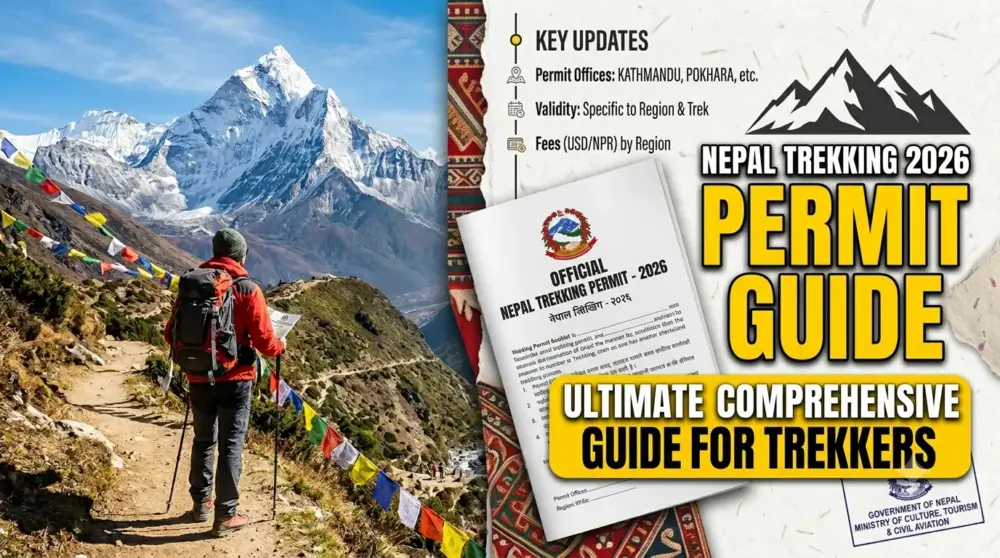
Nepal remains the ultimate crown jewel of global adventure tourism, beckoning thousands of trekkers each year to stand among the highest peaks on earth. From the legendary footsteps leading to Everest Base Camp to the high passes of the Annapurna Circuit, the cascading waterfalls of Langtang, and the forbidden landscapes of Upper Mustang, the country provides unparalleled wilderness experiences.
However, the regulatory landscape of the Himalayas has evolved dramatically. The days of simply buying a generic paper booklet, packing a map, and setting off completely independent into any mountain valley are gone. To protect fragile high-altitude ecosystems, support local indigenous economies, and mitigate safety risks, Nepal’s trekking permit policies, fees, and safety laws have undergone a massive digital and structural overhaul.
Many trekkers arrive in Kathmandu completely unaware of recent landmark legal amendments, updated fee structures, or changes at regional checkpoints. This frequently results in costly administrative delays, unexpected fines, or being turned back at trail gates.
This comprehensive, definitive guide provides everything you need to know about Nepal’s trekking permit updates for 2026, covering specific costs, digital application pipelines, newly modified safety mandates, and actionable strategies for a seamless Himalayan adventure.
Why Does Nepal Require Trekking Permits?
Trekking permits serve a far greater purpose than mere bureaucratic administration. They are a multifaceted tool designed to ensure sustainable tourism management and maximize field safety.
+-------------------------------------------------------------------------+
|                    THE MULTI-PURPOSE PERMIT SYSTEM                      |
|                                                                         |
|  [ Safety & Rescue ]   --> Logs route paths for helicopter dispatch.    |
|  [ Local Revenue ]     --> Direct cash flows to trail-side schools/care.|
|  [ Eco-Preservation ]  --> Funds park rangers & wildlife conservation.  |
+-------------------------------------------------------------------------+
When you purchase a permit, your data and funds directly help authorities:
-
Monitor Visitor Movements: Tracking accurate entry, exit, and real-time location metrics across massive wilderness zones.
-
Improve Trekker Safety: Maintaining highly synchronized databases to quickly locate and coordinate help during severe weather events, avalanches, or medical emergencies.
-
Support Search and Rescue Operations: Providing immediate, legally verified reference data to rescue teams, ground search units, and helicopter evacuation dispatch networks.
-
Protect National Parks and Conservation Areas: Enforcing environmental preservation policies and funding trail rangers to prevent illegal deforestation and poaching.
-
Preserve Cultural Heritage: Reinvesting revenues directly into restoring centuries-old Buddhist monasteries (gompas), ancient stone pathways, mani walls, and shrines.
-
Generate Revenue for Local Communities: Ensuring tourism capital bypasses centralized urban systems and flows straight into mountain villages to construct local medical clinics, manage waste, and fund schools.
What Permits Are Required for Trekking in Nepal?
The permits you need depend entirely on your precise trekking destination, trail junctions, and duration of stay. Generally, an international trekker will require a customized combination of at least two of the following documents:
-
National Park Entry Permit: Mandatory if your trail cuts through legally protected national boundaries (e.g., Sagarmatha, Langtang, Rara, or Shey-Phoksundo).
-
Conservation Area Permit: Required for sustainably co-managed regional eco-zones (e.g., Annapurna, Manaslu, Gaurishankar, or Kanchenjunga).
-
Restricted Area Permit (RAP): A highly regulated, premium-tier authorization card mandatory for remote border-adjacent or culturally sensitive areas.
-
Local Municipality Entry Permit: Independent regional taxes managed directly by local governing councils rather than central tourism boards.
The Historic March 2026 Legal Update: Solo Permits Allowed in Restricted Areas
For over a decade, one of the most frustrating barriers for solo travelers visiting Nepal was the rigid “Minimum 2 Trekkers” rule for Restricted Area Permits (RAP). If you wanted to explore Upper Mustang, the Manaslu Circuit, or Dolpo, you were legally forced to find an additional foreign partner or purchase a fraudulent “ghost permit” just to satisfy a bureaucratic quota.
On March 22, 2026, the Department of Immigration (DoI), acting on strategic policy briefs from the Trekking Agencies’ Association of Nepal (TAAN), officially transformed this policy.
                    +------------------------------------+
                    |    THE 2026 SOLO RESTRICTED RULE   |
                    +------------------------------------+
                                      |
         +----------------------------+----------------------------+
         |                                                         |
         v                                                         v
[ True Independence ]                                    [ Non-Negotiable Guide ]
  - Single/Solo foreign trekkers                           - Guide mandatory at all times
  - No partner or group required                           - Must book through a
  - Personalized RAP issued                                  TAAN-registered agency
What Changed in 2026?
-
Solo Restricted Area Permits Are Now Active: A single foreign trekker can now apply for and receive a Restricted Area Permit in their own name. You no longer need a second traveler in your party.
-
Pre-Arrival Digital Processing: Trekkers can now complete their permit applications completely in advance from their home country using their Nepal Tourist Visa Number or Visa Application Submission ID. This ensures all documentation is finalized before you arrive in Kathmandu.
-
The New 1:7 Guide-to-Trekker Ratio: For group travelers, the 2026 rules dictate that one licensed guide can accompany a maximum of 7 trekkers. If a group has 8 or more participants, the hosting agency must legally assign a second licensed guide to ensure maximum high-altitude safety.
Crucial Clarification: This update does not allow independent, guideless trekking. While you no longer need a second foreign companion, you are still legally required to hire a licensed local guide and process the permit through a TAAN-registered agency. Independent hiking in restricted zones remains strictly prohibited.
TIMS Card Update 2026: The Switch to E-TIMS
What Is a TIMS Card?
TIMS stands for Trekkers’ Information Management System. It acts as a central database to record itineraries, verify guide associations, and track real-time mountain safety metrics across the country.
Is TIMS Required in 2026?
The traditional, physical paper TIMS cards (the old independent green and group blue cards) have been completely phased out. In their place, Nepal has fully transitioned to a centralized, computerized E-TIMS (Electronic Trekkers’ Information Management System).
How E-TIMS Works in 2026
-
Mandatory Digital Registration: All foreign trekkers entering protected areas must be registered through the digital E-TIMS portal.
-
QR Code Scanners: The system generates a digital QR code linked directly to your passport, your travel insurance data, and your guide’s official license number. Real-time digital scanners are active at major checkpoints to verify your credentials.
-
The Price: The standard E-TIMS registration fee is NPR 2,000 (~$15 USD) per person.
-
The Structural Breakdown: Checkpoints in the Everest (Khumbu) and Annapurna regions do not enforce or check TIMS cards anymore, prioritizing their own conservation and municipality permits. However, E-TIMS remains strictly mandatory for Langtang, Manaslu, and far-western Nepal.
Breakdown of Key Trekking Regions & Permit Requirements
Nepal’s comprehensive “No Guide, No Trek” safety policy is fully active. Any foreign national hiking in a National Park, Conservation Area, or Restricted Zone must be accompanied by a licensed Nepali guide. Solo trekking without a guide on major trails is illegal and heavily monitored at checkpoints.
1. Annapurna Conservation Area (ACAP)
The Annapurna Conservation Area is Nepal’s largest protected sanctuary, encompassing world-famous routes like the Annapurna Circuit, Annapurna Base Camp (ABC), Mardi Himal, Khopra Ridge, and Ghorepani Poon Hill.
-
Permit Required: Annapurna Conservation Area Permit (ACAP).
-
Cost for Foreigners: NPR 3,000 (~$23 USD) + 13% VAT.
-
Where to Obtain: Tourism offices in Kathmandu or Pokhara, or via your registered trekking agency. It is valid for a single entry with no time limit.
-
Guide Rule: Strictly enforced. Checkpoints at trail entry points like Birethanti, Ghandruk, and Tatopani actively verify your guide’s credentials via the digital database.
2. Sagarmatha National Park & The Everest Region (Khumbu)
The Everest region operates independently of the central tourism office permit lines, utilizing a decentralized fee structure that directly benefits the local Sherpa communities.
-
Permit 1: Sagarmatha National Park Entry Permit
-
Required For: Everest Base Camp Trek, Gokyo Lakes, Three Passes Trek, and Everest Panorama.
-
Cost for Foreigners: NPR 3,000 (~$23 USD) + 13% VAT.
-
Where to Obtain: Can be bought at the park entrance gate in Monjo or online via the National Parks office interface.
-
-
Permit 2: Khumbu Pasang Lhamu Rural Municipality Permit
-
Required for: All trekkers entering the broader Khumbu region.
-
Cost for Foreigners: NPR 3,000 (~$23 USD) per person for the first 4 weeks.
-
Where to Obtain: This local entry token is paid directly in cash at local counters in Lukla or Monjo. It completely replaces the TIMS card in the Everest zone.
-
3. Langtang National Park
Boasting pristine alpine valleys, the holy waters of Gosaikunda Lake, and traditional Tamang cultural heritage, the Langtang region is highly accessible from Kathmandu.
-
Permit Required: Langtang National Park Permit + E-TIMS Registration.
-
Cost for Foreigners: NPR 3,000 (~$23 USD) + 13% VAT.
-
Where to Obtain: Processed via your agency or available at the park entrance checkpoint in Dhunche.
-
What it Supports: Wildlife protection, park ranger monitoring, and sustainable community development programs.
Restricted Area Permits (RAP) Detailed Index
If you intend to venture into the remote corners of the Himalayas that border Tibet, you must acquire a specialized Restricted Area Permit. Under the updated 2026 framework, remember that you can apply for these solo, but a licensed guide from a TAAN-registered agency is non-negotiable.
Here is the exact cost and duration structure for the most popular restricted zones:
Upper Mustang Permit
Often called the “Last Forbidden Kingdom,” Upper Mustang features striking semi-arid landscapes, ancient sky caves, and preserved Tibetan-Buddhist cultural sites.
-
Cost: $500 USD per person for the first 10 days.
-
Extended Stay: $50 USD per day for every day after the initial 10-day block.
Manaslu Circuit Permit
The Manaslu Circuit Trek has become one of Nepal’s fastest-growing deep mountain routes, prized as an authentic alternative to the busier Annapurna loops.
-
Autumn Peak Cost (September to November): $100 USD per person for the first 7 days ($15 USD per extra day).
-
Spring & Off-Peak Cost (December to August): $75 USD per person for the first 7 days ($10 USD per extra day).
-
Additional Requirements: Trekkers also need a Manaslu Conservation Area Permit (MCAP) for NPR 3,000 and an ACAP permit for NPR 3,000 to exit through Dharapani.
Upper Dolpo Permit
Immortalized by remote high-altitude lifestyles and the stunning turquoise expanse of Shey Phoksundo Lake, Upper Dolpo remains a pristine sanctuary.
-
Cost: $500 USD per person for the first 10 days.
-
Extended Stay: $50 USD per day for every day after the initial 10-day block.
Tsum Valley Permit
A sacred Himalayan valley tucked away in northern Gorkha, rich in ancient monasteries and meditation caves.
-
Autumn Peak Cost (September to November): $40 USD per person for the first week ($7 USD per extra day).
-
Off-Peak Cost (December to August): $30 USD per person for the first week ($7 USD per extra day).
Kanchenjunga & Taplejung Permits
Skirting the border of eastern Nepal and Sikkim, the base camp trails of Mt. Kanchenjunga (the world’s third-highest peak) offer incredible biodiversity.
-
Cost: $20 USD per person per week for the first 4 weeks ($25 USD per week thereafter).
Comprehensive Permit Cost Summary Table
| Trekking Region / Permit Type | Cost for Foreigners (Approx. USD) | Guide Required? | Primary Checkpoints |
| Annapurna (ACAP) | NPR 3,000 (~$23 USD) | Yes — Mandatory | Birethanti, Ghandruk, Tatopani |
| Sagarmatha (Everest National Park) | NPR 3,000 (~$23 USD) | Yes — Mandatory | Monjo Gate |
| Khumbu Municipality (Everest Local) | NPR 3,000 (~$23 USD) | Yes — Mandatory | Lukla, Monjo |
| Langtang National Park Permit | NPR 3,000 (~$23 USD) | Yes — Mandatory | Dhunche |
| E-TIMS Card (Non-Everest Zones) | NPR 2,000 (~$15 USD) | Yes — Mandatory | System Scanned Online |
| Upper Mustang RAP | $500 USD (for 10 days) | Yes — Mandatory | Kagbeni |
| Manaslu Circuit RAP (Peak Autumn) | $100 USD (for 7 days) | Yes — Mandatory | Jagat |
| Upper Dolpo RAP | $500 USD (for 10 days) | Yes — Mandatory | Suligad |
| Kanchenjunga RAP | $20 USD (per week) | Yes — Mandatory | Taplejung |
Guide Certification Levels Matching Your Route
Under the strict 2026 administrative safety guidelines, it is no longer enough to just hire any guide on the street. The Department of Immigration monitors guide certifications relative to the maximum altitude of your chosen trekking route:
-
Basic Certification: Authorized for lower-altitude cultural routes and panoramic trails up to 4,000 meters (e.g., Ghorepani Poon Hill, short Langtang routes).
-
Advanced Certification: Mandatory for high-altitude passes and base camps sitting between 4,000 meters and 5,500 meters (e.g., Everest Base Camp, Annapurna Circuit via Thorong La, Manaslu Circuit via Larkya La).
-
Expedition Certification: Compulsory for technical alpine passes, peak climbing, and mountaineering expeditions operating above 5,500 meters (e.g., Island Peak, Mera Peak, Ama Dablam).
Pro-Tip: When booking your trek, do not simply choose an agency based on the cheapest price. Explicitly ask them to verify their guide’s TAAN registration and confirm that their certification level legally covers the maximum altitude of your itinerary.
Step-by-Step Guide: How to Obtain Your Permits
The 2026 digital overhaul has made the permit pipeline significantly cleaner, effectively eliminating the old, frustrating days of wasting your first morning in Kathmandu waiting in long queues at the government tourism offices.
+--------------------------------------------------------------------------+
|                       THE 2026 APPLICATION PIPELINE                      |
|                                                                          |
|  [ Gather Documents ] --> [ Submit to Agency ] --> [ Digital Approvals ]|
|  (Passport, Visa,          (TAAN-Registered)        (QR Code Issued       |
|   Photos, Insurance)                                 Before Arrival)     |
+--------------------------------------------------------------------------+
Step 1: Gather Your Vital Documents
Before applying, ensure you have clean, digital copies of the following:
-
Your physical passport (with a minimum of 6 months validity beyond your planned trek end date).
-
Your valid Nepal Tourist Visa number or your official Pre-Arrival Visa Submission ID.
-
2 to 4 recent passport-sized photographs (digital and physical prints).
-
A detailed day-by-day travel itinerary with exact entry/exit dates and trailhead points.
-
A comprehensive travel insurance certificate in English, stating explicit coverage for high-altitude trekking and emergency helicopter evacuation up to your maximum route elevation.
Step 2: Choose a TAAN-Registered Trekking Agency
Because individual travelers cannot upload files directly into the restricted area portal, you must contact a licensed local agency. Verify their status with the Trekking Agencies’ Association of Nepal (TAAN) and finalize your guide assignment.
Step 3: Online Submission and Vetting
Your agency will initiate the workflow through the Department of Immigration (DoI) portal at nepaliport.immigration.gov.np. They will upload your documentation, visa data, insurance records, and your assigned guide’s official credentials into the computerized immigration system.
Step 4: Collection and Trail Checkpoints
While you can track the approval progress online using your unique Application Submission ID, the final permit is not fully activated until your agency presents your physical passport for a security check at the immigration office in Kathmandu. Once verified, a physical permit sticker or printout with an integrated tracking QR code is issued. Collect this from your agency before leaving Kathmandu, as it must be scanned by electronic checkpoint officers along the trail.
Common Permit Mistakes Trekkers Make
-
Assuming One Permit Covers an Entire Circuit: Many popular trekking loops cross regional borders. If you choose to hike the Manaslu Circuit, you will walk out via Dharapani, which officially sits inside the Annapurna zone. This means you legally require a Manaslu RAP, a Manaslu Conservation Area Permit (MCAP), and an Annapurna Conservation Area Permit (ACAP).
-
Carrying Only Digital Copies on Your Phone: While the registration system is fully digitalized, power outages and cold can drain smartphone batteries instantly, and cellular service can drop entirely in deep river canyons. Checkpoint guards frequently demand physical paper documents to stamp. Always carry high-quality printed copies of all permits.
-
Failing to Read the Insurance Fine Print: Nepal’s immigration department will reject permit applications if your travel insurance lacks explicit high-altitude clauses. Generic travel insurance policies often cap medical evacuation at 3,000 meters. Ensure your policy documents explicitly state coverage for helicopter rescue above 4,000 or 5,000 meters, depending on your trek.
-
Attempting to Evade Checkpoints: Trying to bypass official checkpoint gates via alternative side trails to avoid permit fees or mandatory guide rules is a serious legal offense. If caught, you face immediate fines (starting at NPR 12,000), permit confiscation, and being escorted back to the nearest road, while your insurance coverage becomes completely invalid.
Why You Must Book Through a Licensed Trekking Agency
The modern regulatory environment in Nepal makes a local, registered agency an essential partner for a successful expedition. Working with an accredited provider guarantees:
-
Legal Compliance: Seamless digital processing of complex national park, local municipality, and restricted area permits.
-
Safety Integration: Booking a first-aid trained, certified guide who monitors your health, tracks Acute Mountain Sickness (AMS) symptoms, and understands local weather patterns.
-
Logistical Management: Securing coveted teahouse rooms during the chaotic peak months (October/April) when popular lodges fill up completely by 2:00 PM.
-
Emergency Response: Under 2026 laws, emergency search and rescue coordination is a strict legal responsibility of your hosting agency. If an emergency arises, your agency can dispatch a rescue helicopter within minutes.
Frequently Asked Questions (FAQs)
Do I need a permit for every single hike in Nepal?
No. Short day hikes outside of protected park boundaries (such as walking along the immediate Kathmandu Valley rim trails like Nagarkot or Champadevi) do not require specialized national permits or E-TIMS registration cards.
Can I do the Everest Base Camp trek completely on my own without a guide?
No, not anymore. Under the current safety policies enforced across Nepal, all major protected areas—including the Sagarmatha (Everest), Annapurna, and Langtang networks—mandate that foreign trekkers be accompanied by a licensed local guide hired through an approved agency.
Can I apply for a Restricted Area Permit on my own?
While the landmark March 2026 update allows solo travelers to visit restricted regions without needing a second foreign companion, you still cannot apply directly over the counter yourself. The application must be filed on your behalf by a TAAN-registered local agency, and a licensed guide must accompany you throughout the restricted zone.
What happens if my flight to Lukla is delayed and my permit dates change?
Local checkpoint guards understand that mountain weather is highly unpredictable. For standard national park and municipality permits, minor schedule adjustments due to flight delays or health issues are easily accommodated at the trail gates. However, if you are changing your dates inside a highly restricted zone (like Upper Mustang), your guiding agency must update the immigration system portal to adjust your timeline.
Final Thoughts
Nepal’s trekking permit system plays a crucial role in protecting the country’s extraordinary mountain landscapes while ensuring visitor safety and supporting local communities. Whether you’re planning the legendary Everest Base Camp Trek, exploring the Annapurna region, discovering the beauty of Langtang, or venturing into remote destinations like Mustang and Dolpo, understanding permit requirements is essential for a smooth trekking experience.
Regulations can evolve from year to year, making it important to stay informed and work with trusted local experts whenever possible. By obtaining the correct permits and following responsible trekking practices, you’ll not only enjoy a safer journey but also contribute to the preservation of Nepal’s natural and cultural treasures for future generations.
Need Help Arranging Trekking Permits in Nepal?
Our dedicated local trekking specialists are ready to handle the administrative logistics so you can focus entirely on your physical preparation. Let our professional team assist you with:
-
Flawless processing of National Park, Municipality, and E-TIMS documentation
-
Advanced Restricted Area Permit (RAP) pre-arrival clearance
-
Sourcing top-tier, certified, first-aid trained mountain guides and porters
-
Managing domestic mountain flights (Kathmandu/Ramechhap to Lukla) and ground logistics
-
Booking prime teahouse accommodations during peak seasons
-
Designing fully customized, perfectly acclimatized Himalayan itineraries
Contact us today to begin planning a seamless, legally compliant, and unforgettable Himalayan adventure in Nepal!


How to book a trip?

make free inquiry

confirm the trip
