


Nine Days in Nepal: The Ultimate 9-Day Itinerary for an Unforgettable Himalayan Adventure
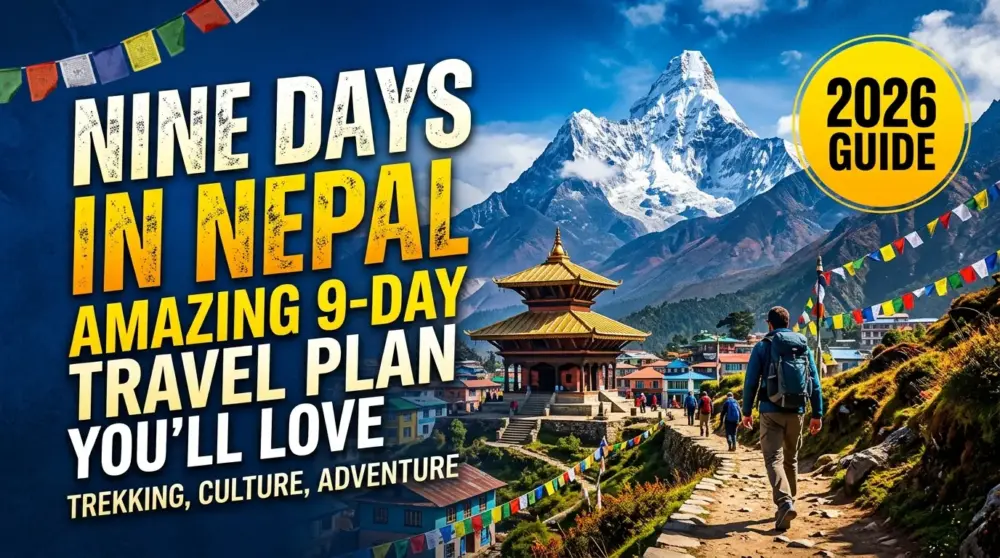
Kathmandu -Chitwan -Lumbini- Pokhara
A Complete 9-Day Nepal Tour Itinerary
Spending nine days in Nepal is the perfect way to explore himalaya landscapes, ancient temples, and vibrant culture.
“Nepal doesn’t greet you softly. It hits you before you’re ready and somehow, that’s exactly right.”
There are trips you plan carefully and still feel unprepared for. Nepal is one of them. You read the guides, you pack the right layers, you know Kathmandu will be chaotic, and Pokhara will be calm, and Chitwan will involve early mornings in jeeps. And yet, when you land, when the airport doors slide open, and the smell of diesel and marigolds hits you at the same time, you realize the research didn’t quite capture it. Nothing does, really. That’s not a complaint. That’s the point.
This is a nine-day Nepal tour itinerary that covers the country’s cultural heartland, its wildlife lowlands, the birthplace of the Buddha, and the most dramatic mountain backdrop you’ll find outside of a screensaver. It’s the kind of trip that works because of how different each place is from the last and how, somehow, they all belong to the same country.
Day 1 — Arrival in Kathmandu
Airport arrival · Thamel walk · First impressions
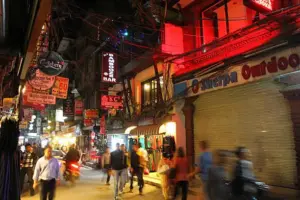
The moment the airport doors slide open, Kathmandu announces itself. Diesel fumes, marigold garlands, and a man holding a sign with a name spelled slightly wrong. My driver, a quiet man named Ramesh who barely said ten words the entire ride, navigated through traffic that operated on some invisible logic, motorcycles threading between buses, horns used not in anger but as a kind of language. By the time we reached Thamel, I’d already started adjusting.
Thamel in the evening is its own creature. The narrow lanes glow with shopfront lights, prayer flags strung between buildings like some kind of permanent festival. I walked without much of a plan, ducked into a bakery that smelled of cinnamon and yak cheese, ordered a lemon ginger tea I didn’t really need, and sat watching the street. A group of trekkers compared boot sizes outside a gear shop. A dog, completely unbothered by everything, slept in the middle of the lane.
This is the thing about Thamel: it’s touristy, yes, undeniably so, but there’s a genuineness underneath it. People actually live here. Kids do homework in the back of shops. The tourism is layered on top of a real neighborhood, not the other way around. After the long flight, that distinction matters. You’re not stepping into a theme park. You’re stepping into a city that’s been going about its business for centuries.
Check in, drop the bags, walk until your feet say enough. That’s all Day 1 asks of you.
Day 2 — Kathmandu Sightseeing
Pashupatinath · Boudhanath · Swayambhunath · Durbar Square
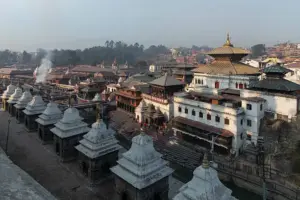
Kathmandu wakes up before sunrise, whether you want it to or not. Temple bells, street vendors, the low hum of the city unkinking itself after sleep. The next morning started early, partly because of the time difference, partly because lying in bed listening to that sound felt like the wrong choice.
Pashupatinath was the first stop, and nothing quite prepares you for it. This is one of Hinduism’s holiest sites, a sprawling complex on the banks of the Bagmati River, dedicated to Shiva, and very much alive with ritual. Sadhus in saffron robes sat for photographs near the main entrance, their faces painted in ash and ochre. Some were clearly performing for tourists, sure.
But move deeper into the complex, away from the main ghats, and you find something rawer. Cremation fires burn openly on the stone platforms by the river. Families gathered, priests chanted, and the smoke drifted upward. It’s confronting, especially if you’re not from a culture that treats death as a public, communal act. But it’s also oddly peaceful. I stood there longer than I expected to.
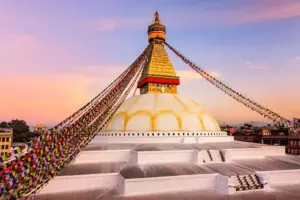
Boudhanath came next, and the contrast was immediate. Where Pashupatinath is dense and layered, and Hindu, Boudhanath is open, circular, and Buddhist. The stupa, one of the largest in the world, rises from the center of a wide plaza, its painted eyes looking out in all four directions. People circumambulate it clockwise, as they have for centuries: monks in maroon robes, elderly women spinning prayer wheels, tourists trying not to walk the wrong way.
I fell into the rhythm of it. Round and round. The smell of juniper incense was everywhere. I bought a small singing bowl from a shop on the outer ring. A woman demonstrated it patiently, showing me how to circle the rim slowly, waiting for the sound to build.
Swayambhunath, the Monkey Temple, required a climb. About 365 steps, and on a warm November morning, that’s enough to arrive breathless. But the view from the top is the payoff: Kathmandu spread out below in every direction, brown and green and hazy, the valley ringed by hills. The monkeys here are entirely at home. One snatched a plastic bag from a tourist near the base; another watched proceedings from a stone wall with the expression of someone who has seen it all. The stupa itself, prayer flags radiating from its pinnacle, is smaller than Boudhanath but older-feeling somehow. More worn. More intimate.
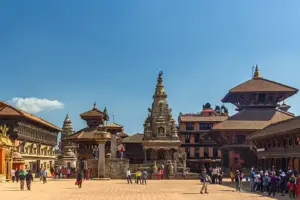
Kathmandu Durbar Square is closed on the day. The old royal palace complex is a UNESCO site, and you feel the weight of history walking through it, with pagoda rooftops layered like wedding cakes, stone carvings so detailed you stop to look twice. Some structures still show earthquake damage from 2015. Wooden beams are holding up walls, scaffolding around temple spires. The restoration is ongoing. It gives the place a living, unfinished quality that a fully preserved site might have lost. And honestly, that feels more honest than perfection.
Day 3 — Kathmandu to Chitwan
5–6 hrs drive · Jungle resort check-in · Tharu village walk · Cultural show
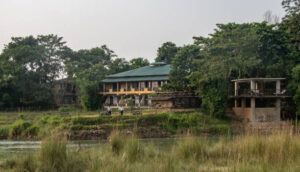
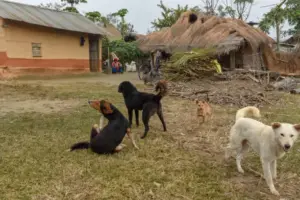
The drive to Chitwan takes five to six hours, depending on traffic out of Kathmandu and the state of the Prithvi Highway. Ours took closer to seven. There were roadworks somewhere after Mugling, a long standstill where I got out and bought tea from a woman with a thermos strapped to a cart. The tea was too sweet, milky, scalding, exactly right. Fields of mustard on either side. The mountains somewhere behind the haze.
Conversations with our guide, Bikash, about cricket and rice prices, and whether tourism would recover to pre-pandemic levels. He was cautiously optimistic. The road itself is simultaneously an engineering marvel and a white-knuckle experience cut into hillsides, occasionally single-lane, with trucks coming the other way with a confidence that feels either practiced or reckless.
Chitwan arrives differently from how you expect. You cross the Rapti River and suddenly the landscape shifts: flatter, greener, the air heavier and more humid. The jungle presses in from the edges. Our resort was built close to the park boundary, a collection of low thatched cottages under sal trees, a firepit at the center of the compound. After the dust and density of Kathmandu, the quiet was almost disorienting.
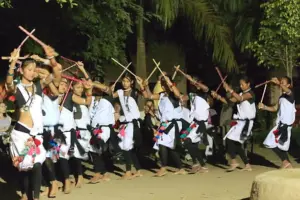
That evening, there was a Tharu cultural show, torches lit around an open courtyard. The Tharu are the indigenous people of the Terai lowlands, and they’ve lived alongside this jungle for centuries, long before there was a national park or any conservation infrastructure. The dance, especially the stick dance, in which performers moved in complex synchronized patterns, was something I stayed for longer than planned. It didn’t feel staged the way these things sometimes do. The kids watching from the edges were too genuinely entertained for it to be performative.
Day 4 — Chitwan Jungle Activities
Chitwan National Park · Jeep safari · Canoe ride · Jungle walk · Bird watching
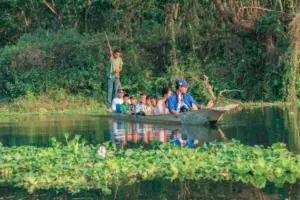
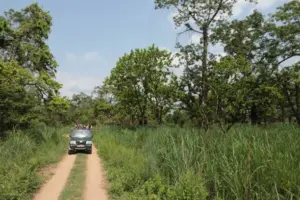
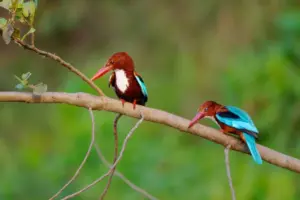
The jungle activities across this full day at Chitwan moved at a different pace than anything else in the itinerary. The jeep safari started before dawn, the vehicle threading through forest tracks while a naturalist named Dipen scanned the undergrowth with a quiet intensity. We saw rhinos, a mother and calf in tall grass, close enough to feel the scale of them. A deer frozen at a clearing’s edge. Dozens of birds, Dipen, were identified by sound before we ever saw them.
The park is home to Bengal tigers, though sightings are rare; we didn’t see one, and I’m not sure whether to call that luck or simply the way wild things are. What Chitwan gives you instead is patience, the kind you’d forgotten you had. You slow down. You look. You stop reaching for your phone every four minutes. That’s worth something.
The canoe ride on the Rapti was quieter. A dugout boat, smooth water, egrets lifting off the far bank. A marsh mugger crocodile parked itself on a sandbar ten meters away and did absolutely nothing. An enormous, scaled, living thing, utterly indifferent to our presence. There’s something oddly calming about being ignored by a crocodile.
The jungle walk in the afternoon with another guide, walking single file, boots collecting mud. The sounds layered: insects, wind in the canopy, occasionally something moving in the brush you’d rather not think too hard about. I kept closer to the guide than was probably dignified. Bird watching wrapped up the day; Chitwan has over 500 recorded species, and even a casual observer leaves with a list longer than expected. The rhinoceros hornbill, when it finally flew across our sightline, was one of those moments you file away and return to later.
Day 5 — Chitwan to Lumbini
4–5 hrs drive · Arrival · Evening rest and local exploration
The road from Chitwan to Lumbini cuts southwest through the Terai. Flat agricultural land, sugarcane fields, brick factories. Less dramatic than the mountain highway, but with its own rhythm. We stopped for dal bhat at a roadside dhaba, a basic place with plastic chairs and a cooking fire visible through the doorway. Dal bhat is Nepal’s default meal, and there’s a reason for that: lentil soup, rice, vegetable curry, sometimes pickles, and a piece of papad, all served on a steel plate. The cook replenished the dal without being asked. This is the tradition of unlimited refills, because a working person needs to eat enough to work.
Lumbini was quiet in a way that surprised me. I didn’t expect that. I’d read that it was UNESCO-listed, significant, and a pilgrimage site for millions of Buddhists. I expected infrastructure, crowds, and noise. And there are some of those near the entrance of the buses for pilgrims, souvenir stands. But something settles over you as you get closer to the center. The air feels different. Maybe that’s projection. Maybe it’s real. Hard to say.
The evening was loose. A walk around the guesthouse neighborhood, a conversation with a monk from Sri Lanka who was staying two rooms down, a meal of vegetable curry and chapati eaten slowly on a rooftop. That’s all. Sometimes the drive days are recovery days, and that’s fine. Not every evening needs to be an event.
Day 6 — Lumbini Sightseeing, then Drive to Pokhara
Maya Devi Temple · Lumbini Garden · 6–7 hrs drive · Lakeside evening
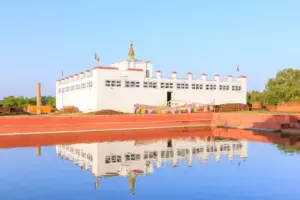
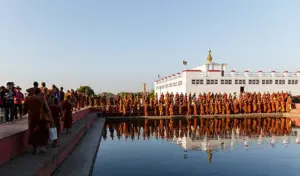
The Sacred Garden, where the Maya Devi Temple stands at the site of the Buddha’s birth, has a stillness that the surroundings haven’t managed to disturb. The temple is built over excavated ruins that go back to the third century BCE. A Marker Stone, believed to pinpoint the exact birth spot, sits behind protective glass. You file past slowly. People touch the glass. Some people are crying quietly. It’s not performative. These are people for whom this place is the most significant ground on earth.
The Lumbini Garden, the broader complex surrounding the temple, was designed by a Japanese architect in the 1970s and contains monasteries and temples built by Buddhist communities from across the world. Thai, Sri Lankan, Korean, Chinese, Vietnamese, and Tibetan each one expressing its own architectural tradition on adjacent plots of land. It makes for a strange but moving walk. The World Peace Pagoda gleamed white against a grey sky. Monks swept temple steps.
I sat by the central canal for a while before leaving. Thought about what makes a place feel sacred. It’s not always the architecture, or the history, or even the belief. Sometimes it’s accumulated human attention. Millions of people have found this corner of flat Nepalese farmland important enough to cross continents for. That weight of meaning does something to the air. Or maybe it just does something to you.
The drive to Pokhara from Lumbini is six to seven hours, going through Butwal and then climbing back into the hill country. The road narrows and winds after Palpa. We passed a wedding procession somewhere outside Waling: a brass band, a horse, dozens of people in red and gold. The driver slowed to watch. Everyone in the car watched. Then the procession was behind us, and the road continued. Pokhara’s Lakeside district materialized after dark restaurant lights, the shimmer of the lake, and the sense of something larger waiting just beyond what you could currently see.
Day 7 — Pokhara Sightseeing
Sarangkot sunrise · Phewa Lake boating · Davis Falls · Gupteshwor Cave · World Peace Pagoda
Sarangkot meant a 4 AM wake-up. And honestly, 4 AM anywhere requires some private negotiation with yourself. The drive up to the viewpoint was in darkness, headlights on hairpin bends, other vehicles already heading up ahead of us. The summit was crowded by the time we arrived, dozens of people huddled in jackets, facing northeast, waiting. The Himalayas before sunrise are barely distinguishable from cloud. Then, slowly, the light changes. Pale pink first, then orange, then a hard gold that moves across the peaks from east to west. Annapurna South. Hiunchuli. Machapuchare is sharpening out of the dark like something being carved in real time.
A man beside me said something in Japanese to his friend. His friend photographed it continuously. I just looked. That’s when it hits you why people travel thousands of miles to stand in the cold at four in the morning. Not to photograph it. To be present at this particular light on this particular range, just once.
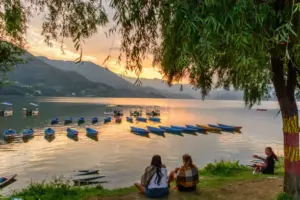
Phewa Lake by boat was the afternoon counterpart, gentle, slow, the water reflecting the mountains and the boats and the occasional cloud. We rowed to the Tal Barahi Temple, a small island shrine, and sat for a while. Vendors paddled out in small boats selling corn and roasted soybeans. I bought a bag of soybeans, and we stayed out longer than scheduled.
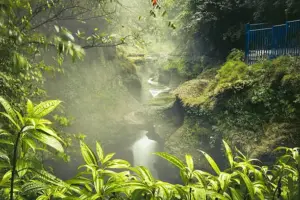
Devis Falls, where a stream plunges directly into a sinkhole with a force that’s genuinely startling for such a compact waterfall, is the kind of place you visit not because it’s grand but because it’s strange and specific. The roar of it fills the viewing platform. Across the road, Gupteshwor Mahadev Cave runs back into the hillside, a passage through limestone formations to a chamber where a Shivalinga sits permanently wet from underground water. The cave smells of incense and cold stone.
The World Peace Pagoda sat at the far end of a short hike, high on a ridge above the southern shore of the lake. The pagoda is perfectly white, Japanese-built, and the view from its base in the late afternoon, Phewa Lake below, the Annapurnas above, Pokhara’s rooftops in between, is the kind of visual that makes you understand why people return to a place repeatedly. This whole day is the best argument for spending at least three nights in Pokhara on any Nepal 9-day tour. Two isn’t quite enough.
Day 8 — Pokhara Back to Kathmandu
Flight or 6–7 hrs drive · Free time · Shopping
The return to Kathmandu. We flew, which takes thirty minutes and costs the better part of a full day’s driving. The flight path crosses foothills, and then there’s Kathmandu Valley below you, the brown expanse of the city ringed by green hills, and it looks impossibly large for a mountain valley. Landing back feels like closing a loop.
The free afternoon was spent in Thamel, revisiting the same lanes with the now-familiar comfort of someone who at least knows which alleys lead where. I bought gifts: small singing bowls, locally made paper notebooks, dried spices from a shop where the owner remembered me from the first day. I don’t know if he actually remembered or was being kind. In Nepal, the line between those two things is often deliberately blurred.
There’s a specific pleasure in returning to a place you know slightly. Thamel on Day 8 is not Thamel on Day 1. You walk it differently. You stop at different places. You notice the stray cat that lives behind the gear shop. You find the narrow bakery you’d walked past before and finally go in. The city hasn’t changed, but your relationship to it has, and that small shift is one of the things travel is actually for.
That evening, over dinner at a rooftop restaurant, dal bhat again, because why wouldn’t it be, I thought about what had accumulated over the past eight days. The cremation fires at Pashupatinath and the peaceful circumambulation at Boudha were held on the same day. The rhino in the tall grass and the dugout canoe on the river. The flatness of Lumbini’s sacred ground and the specific quality of silence that had settled over it. Sarangkot at sunrise, and the tired but satisfied feeling on the ride back down.
Day 9 — Departure
Final morning · Airport drop · The long goodbye
The departure was the usual slight chaos of early alarms and packed bags and a final cup of tea in a hotel lobby that was already busy with new arrivals checking in, their expressions still processing the airport doors sliding open, the diesel fumes, the marigolds. I recognized that look. It was mine, eight days ago.
Nepal is not a country that tries to explain itself to you. It doesn’t perform for visitors. It simply continues its rituals, its agriculture, its complex relationship with gods and mountains, and the inconveniences of modernization, and you are either paying attention or you aren’t. Nine days is enough to begin paying attention. It’s nowhere near enough to understand it. That gap between the two is, I think, precisely why people come back.
Ramesh drove me back to the airport. Still quiet. Still navigating through the same invisible logic of Kathmandu traffic. He asked if I’d enjoyed it. I said yes, which felt inadequate. He nodded, which felt like enough.




How to book a trip?

make free inquiry

confirm the trip
