


Why Nepal Is One of the World’s Best Countries for Stargazing: The Ultimate Himalayan Night Sky Guide
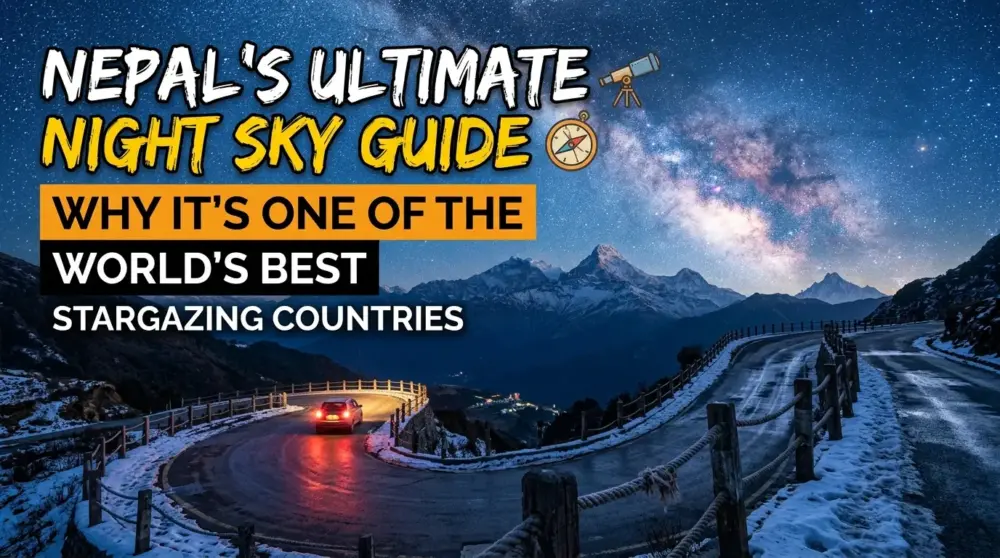
Cosmic Horizons: The Ultimate Guide to Stargazing and Astrophotography in Nepal
When the last rays of sunlight disappear behind the towering Himalayan peaks, Nepal reveals a second world—one that many travelers never expect. During the day, the country’s snow-covered summits, glacial valleys, alpine meadows, and ancient monasteries capture every visitor’s attention. But after sunset, the real spectacle begins.
Above the Himalayas stretches one of the darkest and clearest night skies on Earth. Thousands of stars emerge with astonishing brilliance, the Milky Way arches across the mountains, and distant galaxies become visible to the naked eye from many high-altitude locations.
While destinations such as Chile’s Atacama Desert, New Zealand’s Aoraki Mackenzie International Dark Sky Reserve, and Iceland are celebrated for astro-tourism, Nepal is quietly becoming one of the world’s most extraordinary places for stargazing. Here, travelers can combine world-class trekking, breathtaking mountain landscapes, rich Himalayan culture, and exceptional night skies into a single adventure.
Whether you are a casual traveler, an astronomy enthusiast, or a professional astrophotographer, Nepal offers an experience unlike anywhere else.
Why Nepal Offers Some of the World’s Darkest Skies
Exceptional stargazing depends on much more than simply escaping city lights. Nepal’s geography, climate, and altitude create an almost perfect environment for astronomical observation.
High Altitude Means Less Atmosphere
The Earth’s atmosphere acts like a thick blanket between us and the stars. Dust, moisture, pollution, and constantly moving air scatter and distort incoming starlight.
As you climb higher into the Himalayas, that atmospheric blanket becomes dramatically thinner.
Popular trekking destinations such as Namche Bazaar, Manang, Dingboche, Gokyo, Annapurna Base Camp, and Upper Mustang all sit between 3,000 and 5,000 meters above sea level. At these elevations, observers are literally standing above a significant portion of Earth’s atmosphere.
The result is:
- Sharper stars
- Better visibility
- Reduced atmospheric distortion
- Exceptional transparency
- Richer Milky Way detail
Astronomers describe this improvement as better astronomical seeing.
The Rain Shadow Advantage
Nepal’s geography creates another remarkable advantage.
Moist air from the Bay of Bengal rises against the Himalayan wall, where it cools and releases most of its moisture as rain or snow. Once those air masses cross the highest peaks into northern Nepal, they become extremely dry.
Regions such as Upper Mustang, Dolpo, and northern Manang lie within this Himalayan rain shadow.
Dry air contains far less water vapor—the biggest enemy of astronomical observation. Less moisture means greater contrast, sharper stars, and clearer long-exposure photographs.
Minimal Light Pollution
One of Nepal’s greatest advantages is what it doesn’t have.
Unlike many developed countries, large sections of Nepal’s mountain regions remain free from extensive urban development and artificial lighting.
Most Himalayan villages rely on small-scale solar power or micro-hydroelectric systems rather than bright commercial lighting.
The surrounding mountains also block distant skyglow from lower valleys and cities, preserving remarkably dark skies.
Many remote trekking regions approach Bortle Class 1 or Class 2, among the darkest sky classifications available.
Nepal’s Best Stargazing Destinations
Upper Mustang – Nepal’s Desert Observatory
Upper Mustang is arguably Nepal’s finest destination for serious stargazing.
Sheltered by the Annapurna and Dhaulagiri ranges, this trans-Himalayan desert experiences exceptionally low humidity and remarkably stable weather.
Highlights include:
- Lo Manthang
- Chhoser Cave Valley
- Ghami Ridge
- Dhakmar
Its dramatic red cliffs, centuries-old monasteries, and wide-open horizons create spectacular astrophotography compositions.
Everest Region
Few places on Earth combine extreme altitude with iconic mountain scenery quite like the Khumbu.
Imagine standing outside a tea house in Dingboche as the Milky Way rises above Ama Dablam, or photographing the stars reflected in Gokyo Lakes beneath towering glaciers.
Top viewing locations include:
- Namche Bazaar
- Tengboche Monastery
- Dingboche
- Gokyo Lakes
- Gorak Shep
Annapurna Region
The Annapurna region offers incredible diversity.
Within a single trek, visitors can experience lush forests, dry alpine valleys, glacial basins, and high mountain passes.
Outstanding locations include:
- Annapurna Base Camp
- Poon Hill
- Tilicho Lake
- Manang
- Thorong Phedi
Inside the Annapurna Sanctuary, towering peaks create a natural amphitheater beneath an immense canopy of stars.
Rara Lake
Far from Nepal’s busiest trekking routes lies one of the country’s greatest hidden treasures.
Rara Lake’s calm waters often mirror thousands of stars, creating unforgettable reflections of the Milky Way across Nepal’s largest lake.
Murma Top provides one of the finest panoramic viewpoints for night photography.
Langtang Valley
Just north of Kathmandu, Langtang offers excellent accessibility while maintaining relatively dark skies.
Its combination of alpine meadows, snow-covered peaks, and traditional villages makes it ideal for travelers seeking a shorter Himalayan stargazing adventure.
The Best Time for Stargazing in Nepal
Autumn (October–November)
Widely considered the finest season.
Why?
- Crystal-clear skies
- Stable weather
- Low humidity
- Excellent mountain visibility
- Comfortable trekking conditions
Winter (December–February)
Cold but spectacular.
Benefits include:
- Extremely dry atmosphere
- Outstanding visibility
- Brilliant winter constellations
- Minimal haze
Expect freezing nights above 3,500 meters.
Spring (March–May)
The Milky Way season begins.
Astrophotographers especially love spring because the galactic core rises before dawn.
Rhododendron forests also bloom during this period, adding beautiful foregrounds to landscape photography.
Monsoon (June–September)
Generally not recommended due to persistent cloud cover.
However, Upper Mustang remains one of the few regions where trekking and occasional stargazing remain possible because it lies in the Himalayan rain shadow.
Astrophotography in Nepal
Nepal is one of the few places where photographers can capture:
- The Milky Way above Everest
- Stars reflected in alpine lakes
- Ancient monasteries beneath constellations
- Prayer flags illuminated by starlight
- Himalayan glaciers under moonlight
Recommended equipment includes:
- Full-frame DSLR or mirrorless camera
- 14–24 mm wide-angle lens
- Fast aperture (f/1.8–f/2.8)
- Carbon-fiber tripod
- Remote shutter release
- Extra batteries
- Headlamp with red-light mode
Cold temperatures reduce battery performance, so always carry spare batteries inside your jacket.
Photography Settings
A useful starting point:
- Aperture: f/2.8
- ISO: 3200
- Shutter: 15–20 seconds
- Manual focus
- RAW image format
- Manual white balance
For higher-resolution cameras, consider using the NPF Rule instead of the traditional 500 Rule to minimize star trailing.
Responsible Stargazing
The Himalayas are environmentally and culturally sensitive.
Help preserve these landscapes by:
- Staying on designated trails
- Using red-light headlamps
- Avoiding unnecessary drone flights
- Respecting monasteries and sacred sites
- Supporting locally owned tea houses
- Carrying out all the waste
- Following Leave No Trace principles
Responsible travel ensures Nepal’s dark skies remain protected for future generations.
Frequently Asked Questions
Can you see the Milky Way in Nepal?
Yes. During moonless nights in spring and autumn, the Milky Way is clearly visible from many high-altitude trekking regions.
Which place has the darkest skies?
Upper Mustang, Rara Lake, Dolpo, Gokyo, and parts of the Annapurna and Everest regions offer some of Nepal’s darkest skies.
Do I need a telescope?
No. Nepal’s exceptionally dark skies allow travelers to enjoy thousands of stars, the Milky Way, and bright planets with the naked eye.
Is Nepal suitable for astrophotography?
Absolutely. The combination of high altitude, dramatic mountain scenery, low light pollution, and clear seasonal weather makes Nepal one of Asia’s best destinations for astrophotography.
Final Thoughts
Nepal has long inspired adventurers with its towering mountains, ancient trails, and vibrant cultures. Yet one of its greatest treasures only appears after sunset.
Far above the valleys, where the air is thin, the lights are few, and the mountains stand in silent silhouette, the night sky transforms into a breathtaking celestial panorama. Here, the Milky Way stretches across the Himalayas with extraordinary clarity, meteor showers illuminate remote alpine landscapes, and countless stars remind us of the vastness beyond our world.
Whether you are trekking to Everest Base Camp, exploring the hidden kingdom of Upper Mustang, camping beside Tilicho Lake, or watching the stars reflected across the tranquil waters of Rara Lake, Nepal offers an astronomical experience that is as unforgettable as its mountains.
As astro-tourism continues to grow worldwide, Nepal is emerging as one of the most remarkable destinations where adventure, nature, culture, and the cosmos converge. Plan your journey during a new moon, pack your camera and warm layers, and look beyond the summits—because some of Nepal’s greatest wonders begin only after darkness falls.


How to book a trip?

make free inquiry

confirm the trip
