


The Ultimate Guide to Saga Dawa in Nepal: Sacred Sites, Local Rituals, and the Month of Merits
What Is Saga Dawa?
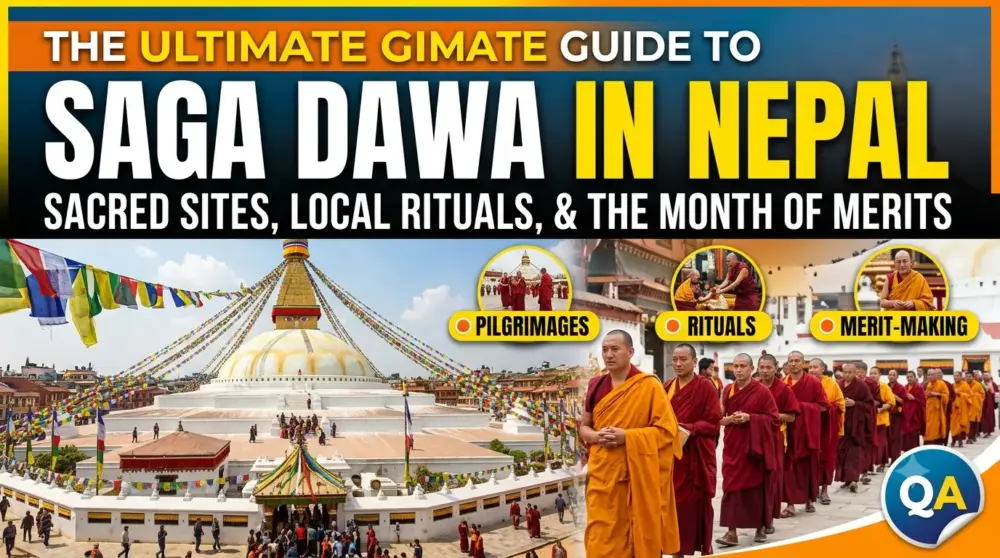
Saga Dawa is one of the most sacred months in Tibetan Buddhism. It commemorates the birth, enlightenment, and parinirvana (passing away) of Gautama Buddha. Observed during the fourth month of the Tibetan lunar calendar, Saga Dawa is a time of spiritual reflection, compassion, generosity, and religious devotion.
For Tibetan Buddhists around the world, Saga Dawa represents an opportunity to deepen spiritual practice and accumulate merit through positive actions.
Meaning of Saga Dawa
The term “Saga Dawa” comes from the Tibetan language:
- Saga refers to a star associated with the Virgo constellation.
- Dawa means “month.”
Together, Saga Dawa refers to the fourth month of the Tibetan lunar calendar, which is considered especially auspicious in Tibetan Buddhist tradition.
Why Is Saga Dawa Important?
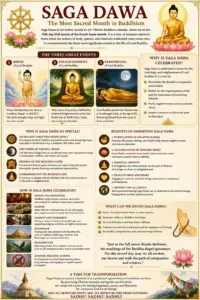
Saga Dawa is significant because it honors three pivotal events in the life of Gautama Buddha:
1. The Birth of Buddha
Buddhists celebrate the birth of Prince Siddhartha Gautama, who would later become the Buddha and the founder of Buddhism.
2. The Enlightenment of Buddha
After years of spiritual practice and meditation, Siddhartha attained enlightenment and became the Buddha, discovering the path to liberation from suffering.
3. The Parinirvana of Buddha
Saga Dawa also commemorates the Buddha’s final passing into parinirvana, marking the completion of his earthly journey.
What Is Saga Dawa Düchen?
The full moon day of Saga Dawa, known as Saga Dawa Düchen, is considered the holiest day of the month.
According to Tibetan Buddhist beliefs, the effects of both positive and negative actions are multiplied on this day. As a result, devotees place special emphasis on ethical conduct, prayer, and charitable activities.
How Is Saga Dawa Celebrated?
Throughout the month, Buddhists engage in various religious and community activities.
Prayer and Meditation
Many practitioners spend additional time in prayer, meditation, and recitation of sacred texts to cultivate wisdom and compassion.
Pilgrimage and Circumambulation
Devotees visit monasteries, temples, and sacred sites, often performing circumambulation (walking around a holy structure in a clockwise direction) as an act of devotion.
Acts of Generosity
Giving to the poor, supporting monasteries, and making offerings are common practices during Saga Dawa.
Vegetarianism and Compassion
Many Buddhists avoid eating meat during Saga Dawa as an expression of compassion toward all living beings.
Releasing Animals
Some devotees participate in symbolic animal-release ceremonies to promote kindness and respect for life.
Saga Dawa Celebrations in Nepal
Saga Dawa is widely observed in Nepal, particularly among Tibetan Buddhist communities.
Two of the most important religious sites where celebrations take place are:
- Boudhanath
- Swayambhunath
During Saga Dawa, thousands of devotees gather at these sacred sites to offer prayers, light butter lamps, spin prayer wheels, and participate in religious ceremonies.
Spiritual Practices During Saga Dawa
Many practitioners use this sacred month to strengthen their spiritual discipline through:
- Daily meditation
- Chanting mantras
- Reading Buddhist teachings
- Practicing generosity
- Observing ethical conduct
- Participating in community service
These practices are believed to generate positive karma and foster inner peace.
Lessons of Saga Dawa
Saga Dawa encourages individuals to reflect on the core teachings of Buddhism, including:
- Compassion for all living beings
- Mindfulness and self-awareness
- Generosity and kindness
- Non-violence
- Spiritual growth and wisdom
The month serves as a reminder of the Buddha’s teachings and the importance of living a meaningful and ethical life.
While the massive flagpole ritual at Tarboche in Tibet captures global headlines, you do not have to cross the northern border to feel the raw, transformative energy of the Saga Dawa Festival.
Right here in Nepal—the very birthplace of Siddhartha Gautama—the fourth month of the Tibetan lunar calendar turns local stupas, ancient meditation caves, and trans-Himalayan valleys into hotbeds of intense devotion. Known colloquially as the “Month of Merits,” Saga Dawa commemorates the birth, enlightenment, and parinirvana (passing) of Shakyamuni Buddha.
Because any virtuous deed performed during this month is believed to multiply its karmic return exponentially, the atmosphere in Nepal’s Buddhist hubs undergoes a profound shift. This guide explores exactly how Saga Dawa is uniquely celebrated across Nepal, detailing the profound importance of the Kora, the contrasting day-and-night energies of its primary sites, and why this current year represents a once-in-a-generation spiritual alignment.
1. 2026: The Rare Fire Horse Year Alignment (Once Every 60 Years)
If you are experiencing or planning for Saga Dawa this year, you are stepping into an incredibly rare astrological and spiritual convergence.
In the Tibetan and Himalayan lunisolar calendar, each year cycles through 12 zodiac animals and 5 cosmic elements. The Year of the Horse arrives only once every 12 years. However, the specific alignment of the Fire Horse Year is a true once-in-a-lifetime occurrence that happens only once every 60 years (the last one was in 1966).
THE 2026 SACRED KICK: A DOUBLE AMPLIFIER
[Saga Dawa Moon] ──► Multiplies merit millions of times on the Full Moon
         +
[Fire Horse Year] ──► Acts as a cosmic accelerator for spiritual progress
Why the Horse Year Changes Everything
In Himalayan Buddhist cosmology, the horse is a symbol of rapid spiritual progress, tireless energy, and untamed prana (life force). It is the vehicle of the mind and the core of the Lungta (Wind Horse) that carries prayers across the universe on the wind.
Furthermore, historical tradition dictates that Shakyamuni Buddha was born in a Horse Year, and completing a sacred pilgrimage or mountain Kora during a Horse Year is traditionally believed to grant spiritual merit equivalent to completing 13 ordinary circuits.
When you combine the merit-multiplying power of the Saga Dawa month with the fiery, transformative velocity of the 2026 Fire Horse, this year’s festival becomes an unprecedented window for burning away ancient negative karma and accelerating inner growth.
2. Understanding the Kora: The Act of Walking Meditation
At the absolute center of Saga Dawa is the practice of the Kora (sacred circumambulation). To the casual observer, a Kora looks like a massive crowd walking in a circle around a monument. To the practitioner, it is a physical and mental moving meditation.
THE THREEFOLD PURIFICATION OF KORA
Body (Walking the Path) + Speech (Mantra Chanting) + Mind (Devotion)
                                       │
                                       ▼
                       THE THREEFOLD PURIFICATION OF KORA
The Spiritual Mechanics of the Kora
The Direction
A Kora is always performed in a clockwise direction, keeping the sacred monument or mountain safely on your right-hand side. This honors the ancient tradition of keeping holy objects at one’s core.
The Threefold Devotion
A proper Kora engages the entire human instrument. The body purifies its karma by walking the grueling distance; the speech purifies itself by continuously chanting mantras (such as Om Mani Padme Hum); and the mind purifies itself by visualizing the Buddha and generating boundless compassion for all living beings.
The Cumulative Power
During Saga Dawa, completing multiple Koras is paramount. Pilgrims track their progress using Mala (108-bead prayer strings) or handheld wrist counters. It is believed that walking a Kora with a pure heart unties the knots of worldly attachment and realigns the practitioner with the Dharma.
3. The Rhythm of the Crowds: Day vs. Night Dynamics
The experience of performing Kora changes dramatically depending on the position of the sun. During Saga Dawa, Nepal’s three main Buddhist landmarks exhibit completely different daytime and nighttime personalities.
| Sacred Site | Daytime Crowd Vibe | Nighttime Crowd Vibe |
|---|---|---|
| Boudhanath | Intense, rhythmic, and bustling | Ethereal, glowing, and meditative |
| Swayambhunath | Festive, social, and widespread | Serene, cool, and introspective |
| Namobuddha | Monastic, ritualistic, scenic | Quiet, deeply personal, silent |
Boudhanath Stupa: The Dynamic Human Tide
Boudhanath is the undeniable focal point of Saga Dawa in Kathmandu, and its gates never truly seem to rest during the holy month.
The Day Crowd
As early as 3:30 AM, a tidal wave of humanity hits the inner circle. The daytime crowd is dense, fast-paced, and highly rhythmic. Elderly grandmothers in traditional Tibetan chubas anchor the inner track, moving with steady devotion, while younger practitioners weave through the outer edge. The air is warm, thick with the smell of burning juniper incense (Sang), and vibrant with the sound of clacking prayer beads and low-muttered mantras.
The Night Crowd
As dusk falls, the energy shifts from industrious to completely ethereal. The daytime dust settles, and tens of thousands of glowing yak-butter lamps are lit around the stupa’s base. The night crowd moves at a slower, more meditative pace. Bathed in a warm, flickering golden glow, the Kora turns into a silent, deeply spiritual procession beneath the illuminated eyes of the Buddha.
Swayambhunath Stupa: The Hillside Pilgrimage
Perched on a steep hilltop overlooking the valley, Swayambhunath divides its crowd naturally by altitude and time of day.
The Day Crowd
The daytime crowd participates in the sweeping, valley-level Saga Dawa Kortsay. Thousands of non-monastic devotees form an enormous circle that encompasses the entire base of the hill rather than just the upper platform. It is lively, social, and deeply community-oriented. Local families set up stalls under canvas tents to practice Dana (generosity)—handing out free glucose water, juice, and hot tea to sweaty pilgrims navigating the massive loop.
The Night Crowd
As the daytime heat fades, the action climbs up the 365 stone steps to the main platform. The night crowd at Swayambhunath is much cooler and quieter. With the entire Kathmandu Valley sparkling like a sea of lights below, night-time pilgrims perform their upper Kora in relative serenity, accompanied only by the soft chanting of monks from the adjacent monasteries and the rustle of wind through the prayer flags.
Thrangu Tashi Yangtse Monastery (Namobuddha): The Mountain Sanctuary
Located on a high ridge in Kavre, Namobuddha offers a stark contrast to the urban intensity of Kathmandu.
The Day Crowd
The daytime crowd consists of a mixture of local Tamang and Newar villagers, dedicated pilgrims from Kathmandu, and hundreds of resident young monks. The daytime Kora winds around the sacred hill where the Buddha famously offered his body to a starving tigress. The energy is highly ritualistic, punctuated by the sounds of traditional long horns (dungchen) echoing from the main monastery halls during midday prayer assemblies.
The Night Crowd
Once the day-tripping buses leave for Kathmandu, Namobuddha drops into profound Himalayan silence. The night crowd is small and intensely focused, made up mostly of overnight travelers and resident monastics. Under a clear, star-filled sky, a handful of pilgrims circumambulate the stupa illuminated by simple strings of lights and butter lamps. It is an ideal space for solo contemplation and deep, undistracted mantra recitation.
4. On-Page Utility: The “Month of Merits” Survival Checklist
If you are planning to join the Kora crowds during the peak of the festival, use this practical matrix to navigate the space safely and respectfully:
| Element | Best Practice / Action | Why It Matters |
|---|---|---|
| Direction of Kora | Always walk clockwise around stupas, shrines, mani walls, and prayer wheels. | Walking counter-clockwise disrupts the spiritual flow and is considered highly disrespectful. |
| Dietary Consciousness | Opt for strict vegetarianism when eating out near holy sites during the month. | Saga Dawa emphasizes Ahimsa (non-harm). Local restaurants around Boudha ban meat entirely during this time. |
| Photography Etiquette | Always ask permission before filming individual pilgrims, especially during night vigils. | Flash photography ruins the meditative ambiance of the butter-lamp lighting and intrudes on private prayers. |
| Footwear and Attire | Wear easily removable shoes; keep shoulders and knees fully covered. | You will be stepping in and out of active temple rooms and monastery halls constantly. |
| Navigating the Flow | If you need to rest, step completely out of the circular track toward the shop fronts. | Stopping abruptly in the middle of a dense daytime Kora at Boudha causes a human traffic jam. |
5. Frequently Asked Questions (FAQs) About Saga Dawa in Nepal
When exactly is Saga Dawa celebrated?
Saga Dawa spans the entire fourth month of the Tibetan lunar calendar, typically falling between mid-May and mid-June. The absolute peak day of the festival, called Saga Dawa Düchen (the Full Moon day), changes annually on the solar calendar.
Why is the Horse Year considered so special for this festival?
In Tibetan astrology, the Horse Year occurs only once every 12 years. According to tradition, Buddha was born in a Horse Year. Performing a pilgrimage or Kora during this astrological window causes spiritual actions to be dynamically amplified, traditionally yielding merit equivalent to 13 ordinary circuits. The rare Fire Horse Year configuration arrives only once every 60 years.
Can non-Buddhists or tourists participate in the Kora?
Yes, absolutely. The Kora lines are welcoming to anyone moving with a spirit of peace and respect. You do not need to be a practicing Buddhist to walk the circuit; simply step into the crowd, maintain a clockwise direction, match the walking pace of those around you, and experience the moving meditation.
Can I buy meat around Boudha or Swayambhu during Saga Dawa?
It is highly unlikely. Out of respect for Ahimsa (non-harming) during the holy month, the vast majority of local restaurants and butchers around major Buddhist enclaves close their meat sections completely. Expect delicious, hearty vegetarian and vegan options like mushroom momos, laphing, and traditional lentil-based dal bhat.
Which is better to visit: Boudhanath or Swayambhunath?
Both offer entirely different structural experiences. If you want to witness a massive, rolling human tide and a sea of evening butter lamps on flat ground, choose Boudhanath. If you prefer a hillside climb, panoramic views of Kathmandu, a vibrant community-led outer-hill loop, and a cooler evening breeze, head to Swayambhunath.
6. Practical Logistics for Travelers in Nepal
Beating the Heat
Because May/June marks the pre-monsoon summer season in Nepal, daytime temperatures in Kathmandu can easily climb above 30°C (86°F). To stay energized, emulate the locals: complete your active physical Koras during the cool morning hours (5:00 AM – 8:00 AM) or join the glowing lamp walks after 6:30 PM.
High-Altitude Trekking Connections
For adventure travelers, the 2026 Horse Year makes this the ultimate time to trek through high-altitude, culturally Tibetan Buddhist regions of Nepal like Upper Mustang, Dolpo, or the Manaslu Circuit. The local village monasteries along these routes host unique, isolated festival rituals and pristine mountain Koras that offer a rare glimpse into an ancient world, far away from city crowds.


How to book a trip?

make free inquiry

confirm the trip
