


Annapurna Helicopter Tour (1 Day): The Only Guide You Actually Need in 2026
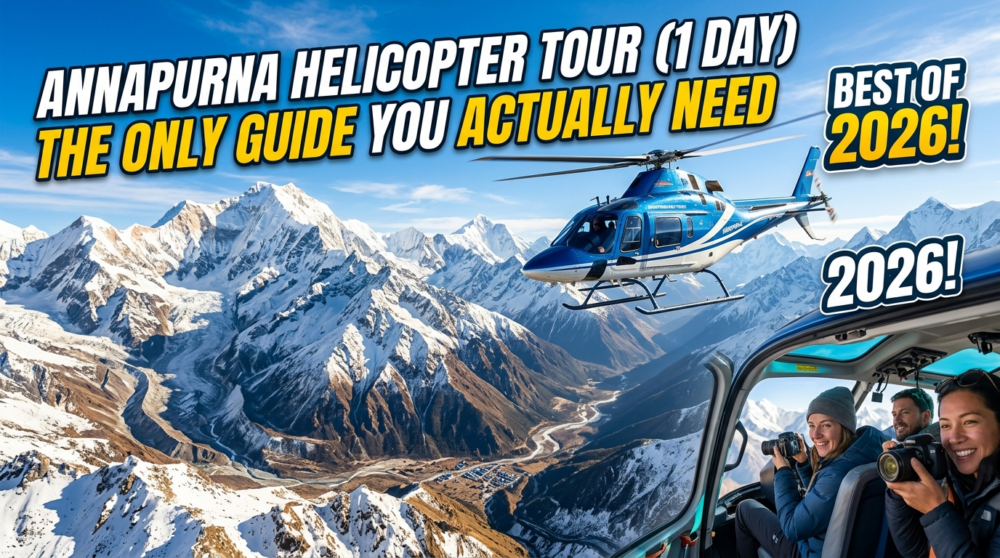
Annapurna Helicopter Tour is one of the fastest and most unforgettable ways to experience Annapurna Base Camp in 2026, allowing travelers to fly from Pokhara or Kathmandu, land at 4,130 meters inside the Annapurna Sanctuary, and return the same morning without any trekking experience required. I want to start with something that stopped me mid-scroll the first time I read it.
Someone on a Nepal travel forum wrote:
“I have bad knees, I’m 67, and I stood at Annapurna Base Camp last October. Flew in at sunrise, cried a little, flew back, had breakfast. Best morning of my life.”
That one comment did more for me than any travel brochure ever could. Because it told me exactly who this tour is for. It is for that guy. It is for the person who assumed Annapurna was out of reach for them. It is for the couple who only have four days in Nepal. It is for the trekker who already did the trail ten years ago and wants to see it again from above.
It is honestly for almost anyone.
Okay, so what is this tour?
You get on a helicopter in Pokhara, you fly into the Annapurna Sanctuary, you land at Annapurna Base Camp, you stand there with mountains on all sides at 4,130 meters above sea level, you get back on, and you are back in Pokhara before the city has even properly woken up.
That is it. That is the tour.
There is no fitness test, no gear list, no acclimatisation schedule. You just go.
The Annapurna Sanctuary is one of those places that genuinely earns the word dramatic. It is a bowl-shaped valley completely encircled by giants. Annapurna I at 8,091 meters is the tenth-highest mountain on Earth. Machhapuchhre, the Fishtail peak, is this impossibly shaped sacred mountain that has never been officially summited. Dhaulagiri is somewhere in the distance, looking enormous and unbothered. And you are standing in the middle of all of it at 7 in the morning.
People fly in from all over the world, specifically to trek to this base camp. It takes them seven to twelve days. You will be there and back before lunch.
The Day Itself, Step by Step
This is the Pokhara departure version, which is the most common way to do it.
5:30 AM — Hotel Pickup
Your hotel pickup comes. Dress properly warm. Pokhara at dawn can feel pleasant, but base camp is cold in a way that will surprise you if you show up in a light jacket.
6:00 AM — Arrival at the Airport
You reach the airport. Small airport, quick check-in. Weight check because helicopters care about that, a brief safety run-through, then you board. Four or five passengers usually.
6:30 AM — Takeoff
You are in the air. The first stretch is over Pokhara’s outskirts and the foothills, which are pretty in a normal way. Then, almost without warning, the terrain shifts completely. River gorges open up below you, the forests get thick and dark green, terraced fields cling to hillsides at angles that make no sense, and the white starts appearing on the high ridges ahead.
Around 7:00 AM — Landing at Annapurna Base Camp
And this is the part where I cannot really tell you what it feels like because everyone I have spoken to describes something slightly different. Some people cry. Some people just stand with their mouths open. One person told me she kept turning in circles because she could not figure out which direction to look first.
You have about twenty to thirty minutes. Use all of it.
7:25 AM — Return Flight
Back in the helicopter and heading home. The return flight hits differently because the morning light has moved, and you are seeing the same mountains from a new angle, and your brain has had a few minutes to catch up with what it saw.
By 8:30 AM — Back in Pokhara
Your whole day is still ahead of you. That is genuinely a strange feeling.
For anyone flying from Kathmandu, add about two hours each way. Some operators will route you from Kathmandu to Pokhara to ABC and back all in one long day if that is what your schedule needs.
What Does It Cost?
No point dancing around it, here are the real numbers for 2026:
| What You Are Booking | Flying From | Price |
|---|---|---|
| Shared group (4 to 5 people) | Pokhara | USD 250 to 300 per person |
| Shared group (4 to 5 people) | Kathmandu | USD 500 to 600 per person |
| Private helicopter | Pokhara | USD 1,000 to 1,200 total |
| Private helicopter | Kathmandu | USD 1,400 to 1,800 total |
Group sharing is how most solo travelers and couples do it. You split the helicopter with a small group, and the experience is completely identical to going private, just cheaper. I have heard from multiple people that the strangers they shared a helicopter with ended up joining them for breakfast. There is something about shared awe that makes people friendly.
What Should Be Included
- The flight
- The ACAP permit for the conservation area
- Fuel charges
- Your time at base camp
- Emergency oxygen onboard
- Hotel transfers from Pokhara
What Is Usually Not Included
- Personal travel insurance
- Tips for the crew
- Anything you eat or drink at base camp
If someone quotes you a number that seems too low by a big margin, just ask what the permit and fuel situation is. Sometimes those get added quietly later, and you do not want that surprise.
What You Are Going to See Up There
I am going to try to describe this properly, but I want to manage expectations first: it does not photograph the way it feels. You will take a hundred pictures on the helicopter, and maybe three of them will come anywhere close.
From the air, the transition happens faster than you expect. Pokhara is a lakeside city with roads, hotels, and motorbikes. Then, in about ten minutes, you are somewhere completely different.
The Modi Khola river cuts through the valley below you, looking silver and far away. Villages appear on ridgelines that should not be accessible. Then the forests go alpine and patchy, the snow lines come into view, and suddenly the mountains are not in front of you anymore, they are all around you.
Annapurna I, up close from a helicopter, does not look like the mountain photos you have seen. It looks like a physical barrier. A wall of white and grey is going up to a point that is somewhere in the sky. The scale is actually hard to process at first.
Machhapuchhre is the one that surprises most people who have not researched it. The twin-peaked Fishtail shape is genuinely that dramatic in person. And because it is considered sacred by the local community and climbing it has effectively been banned, there is this untouched feeling about it. Like it belongs to itself.
At base camp on the ground, you are inside the Sanctuary bowl. Mountains on every side, closing you in from all directions. The glacier is right there. The air at 4,130 meters has that thin, cold quality where you notice every breath just slightly more than usual.
The silence is real.
No engine noise from the helicopter for a few minutes, no wind, just cold and quiet and mountains.
The Altitude Thing, Honestly
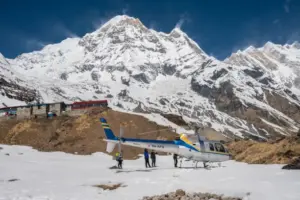
Four thousand one hundred and thirty meters is properly high. Do not let anyone brush that off. It is higher than any peak in the Alps, higher than anything in Europe, actually. The oxygen is noticeably thinner, and your body knows it.
But here is the practical reality: you are landing, spending twenty to thirty minutes, and leaving.
Altitude sickness is a time-dependent process. The people who have serious problems on the ABC trail are usually experiencing the accumulated effect of ascending over several days. You are not doing that. You are doing a brief visit and returning to a lower altitude before any significant physiological response kicks in.
Most healthy adults, including older travelers, handle the short stay fine. A slight headache, maybe some chest heaviness, normal. It passes fast on the way down.
If you have a serious heart condition or known respiratory issues, just run it past your doctor first. That is just sense. For the vast majority of people, this is not an obstacle; it just sounds like one before you understand how it actually works.
Is It Safe to Fly?
The legitimate version of this question is worth answering properly.
The pilots who fly these routes are not generic aviation pilots who sometimes do scenic tours on the side. They are Himalayan specialists. They hold CAAN certification from Nepal’s Civil Aviation Authority, and most of them have been flying these specific mountain routes for years.
Reading weather in the Annapurna corridor, understanding how valley winds behave, knowing when a flight needs to be called: that is their actual professional expertise.
Weather cancellations happen, and they are a feature, not a bug. A good operator will push your flight to the next clear morning without charging you. Any operator who tells you they always fly no matter what is someone to walk away from.
Licensed commercial Annapurna Base Camp helicopter tours have no recorded fatality. Worth knowing.
Book through a licensed CAAN-certified company. Give yourself one buffer day in your Nepal itinerary for the weather. And when the pilot makes a call, you trust it completely, because they know something you do not.
When to Go
March, April, and May
Peak season, and they earn that status. Morning skies are clear, the rhododendron forests in the valleys below are flowering in red and pink, and visibility is generally reliable. April is the single most consistent month of the whole year for this tour.
October and November
The other golden window. Post-monsoon air has this extraordinary clarity to it. October, especially, is the kind of month where the mountains look unreal because there is nothing in the atmosphere between you and them. Photographers plan entire trips around October visibility in Nepal.
December Through February
Possible. Cold at base camp, real cold, and rescheduling risk goes up because cloud cover is more frequent. But when you get a clear winter day up there with the snow and the light, it is something else. Just allow extra days for the weather.
June Through August
I would avoid if you have any choice at all. Monsoon clouds sit heavy over the mountains for weeks at a stretch, visibility is poor, and your odds of multiple cancellations are genuinely high. Not impossible, but not the best use of your time or money.
Best Months Overall
The two months to lock in if you can: April and October.
Helicopter vs Trekking: The Honest Take
| Helicopter Tour | ABC Trek on Foot |
|---|---|
| One day | Seven to twelve days |
| No physical fitness needed | Moderate to quite hard |
| USD 250 to 1,200 | USD 500 to 1,000 plus |
| Aerial perspective, base camp moment | Trail life, villages, the slow reveal |
| Right for time-limited, older, non-trekkers | Right for those who want the full thing |
Here is my honest take, having spoken to people who have done both: they are not competing with each other.
Trekkers describe something the helicopter cannot give you, which is the way the mountains reveal themselves slowly over days, getting bigger as you approach, the teahouse culture, and the physical satisfaction of having walked somewhere hard.
Helicopter visitors describe something trekking cannot give you, which is the aerial scale, the full Sanctuary from above, and the concentrated purity of having just that one base camp moment without the buildup.
A lot of people come back to Nepal and do the other one. Make of that what you will.
Permits: Quick and Simple
You need an ACAP permit to enter the Annapurna Conservation Area. It costs around NPR 3,000 for foreign visitors. A TIMS card may also apply depending on the operator and route.
Any good tour company handles all of this, and it should be in the price. Just confirm it when you book. If permits have not come up at all in their quote, ask directly.
Pokhara vs Kathmandu: Which Makes More Sense?
Pokhara
Pokhara is the right answer for most people. It is already the gateway to the Annapurna region, the flight to base camp is only about thirty minutes each way, and the cost is meaningfully lower.
If you are spending any time in Pokhara at all, which most Nepal travelers do, you just book from there.
Kathmandu
Kathmandu is the option when your itinerary genuinely does not allow a Pokhara leg. Longer flight, higher price, longer day, but absolutely doable if that is your situation.
What to Actually Pack
You are not going trekking, so keep it simple.
- Warm jacket or fleece because base camp is cold
- Sunglasses because UV intensity at that altitude is intense, and people always forget this
- Gloves
- Camera with a full charge
- Sunscreen
- A small bag for your jacket on the way back when the Pokhara heat returns
That is genuinely the whole list.
So, Is It Worth It?
Yes. Without much deliberation.
I keep coming back to that guy on the forum. Sixty-seven years old, bad knees, standing at Annapurna Base Camp at sunrise. There is no version of that story where the answer is no.
You are going to spend a few hundred dollars on one early morning. In return, you get a view that most people either spend twelve days trekking to earn or never see at all.
The mountains genuinely do not care how you arrived. The moment you are standing inside the Sanctuary is real regardless.
If you are in Nepal and you have a morning to spare, this is not a hard decision.
Green Horizon Tour offers fully licensed Annapurna Helicopter Tours departing from both Pokhara and Kathmandu. Proper permits, transparent pricing, and pilots who know these mountains.
Book or send an inquiry at greenhorizontour.com
The Questions People Always Ask
How long is the whole tour from Pokhara?
Three to four hours total, including transfers and your time on the ground at base camp. Most people are back at the hotel before 9:30 AM.
Can the helicopter actually land at base camp?
Yes, a proper landing at 4,130 meters with around twenty to thirty minutes on the ground. You are not just flying over it.
What is the 2026 price?
Shared group from Pokhara is around USD 250 to 300 per person. Private charter from Pokhara starts at around USD 1,000 total.
I have never trekked anywhere. Can I still do this?
Yes, completely. Zero fitness or experience required. Children do this. People in their seventies do this.
How high does the helicopter go?
The highest point is Annapurna Base Camp at 4,130 meters. That is where you land and spend your time before returning.
I am worried about safety. Is this actually okay?
With a licensed CAAN-certified operator, yes. Weather causes rescheduling sometimes, and that is correct pilot behavior. The safety record for licensed commercial ABC helicopter tours is clean.


How to book a trip?

make free inquiry

confirm the trip
