


Why Czecho-Slovakians Are More into Nepali Himalayas (7 Surprising Reasons Explained)
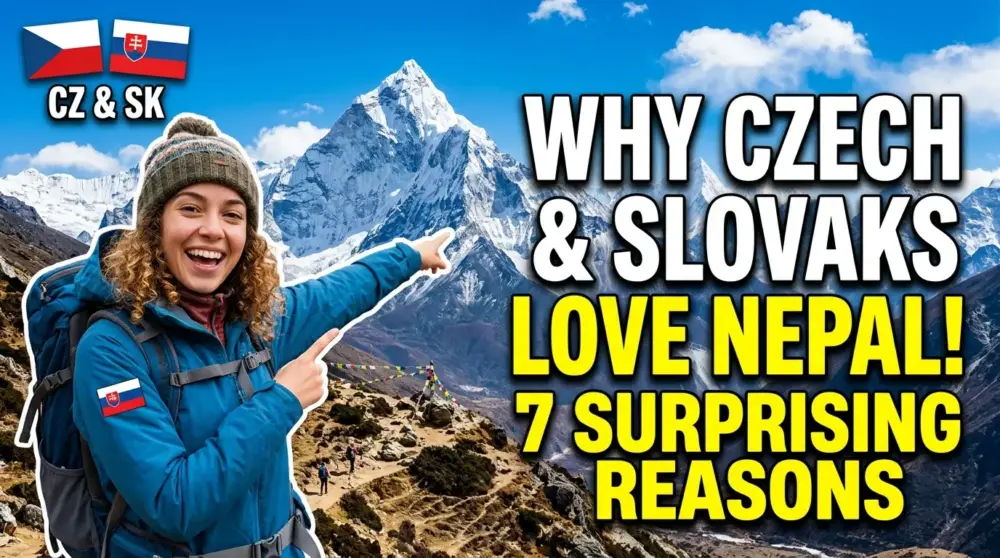
Spend a few days on the trail to Everest Base Camp, and something odd starts to happen. You stop hearing English as the dominant language at teahouses. Czech and Slovak start filling the gaps. At breakfast. At dinner. Around the stove at 4,300 meters, when nobody wants to go to sleep yet, because the conversation is too good.
It keeps happening. Trail after trail. Season after season.
Nepali guides notice it. Long-time teahouse owners notice it. Even other trekkers notice it after a while. For two countries that most people outside Europe would struggle to locate on a blank map, Czech and Slovak travelers show up in Nepal’s mountains with a consistency that is genuinely hard to explain until you understand the full story.
And the full story is something else.
Why Do Czech and Slovak People Visit Nepal So Much?
It goes back decades. National climbing heroes who died on Everest. A mountain culture that starts in childhood and never really switches off. A cost structure that makes Nepal dramatically more accessible than European alternatives. And a tight, vocal trekking community that has been passing Nepal around by word of mouth since before the internet existed.
First — Yes, They Really Are That Common on the Trails
This is not a stretch or a tourism board talking point. Senior guides who have worked the Khumbu region for ten, fifteen, or twenty years will tell you the same thing unprompted. Czech and Slovak trekkers are a known presence. They come prepared, they are physically capable, and they tend to be curious about the harder routes rather than the more comfortable ones.
For countries with a combined population of roughly 16 million, that presence is disproportionate. Worth understanding.
The 7 Reasons That Actually Explain It
1. They Grow Up in Mountains. Not Near Them. In Them.
Slovakia especially has a hiking culture that runs bone-deep. The High Tatras are not a destination that Slovak families visit on special occasions. They are just what weekends look like. School trips go into the mountains. Kids learn to read weather before they learn to drive. By the time a Slovak person is in their mid-twenties, they already know what their legs feel like on a long descent and how to pace themselves when the air gets thinner.
Czech people have a slightly different relationship with their landscape — the terrain is gentler at home — but they more than make up for it with sheer obsession. There is a reason the Czech Republic has specialized outdoor gear shops on what feels like every other street. The outdoor equipment culture there is serious. People invest in kits the way others invest in cars.
That kind of upbringing produces a specific hunger. You get competent in mountain environments, and then you start looking for bigger ones. The Tatras are brilliant. But once you know them well, you start wondering what the next level actually feels like. Nepal answers that question in a way nothing in Europe can.
2. Their Climbers Went to Everest and Never Came Home
This is the heart of the whole thing, and it never gets the attention it deserves outside Central Europe.
October 1984: Two Slovak climbers, Zoltán Demján and Jozef Psotka, reach the summit of Everest without supplemental oxygen. New route variant over the South Pillar. Psotka dies on the descent. His name goes into Slovak memory not just as a tragedy but as evidence of what ordinary people from a small landlocked country could attempt on the highest mountain on earth.
In 1988, four Slovak climbers — Dušan Becík, Peter Božík, Jaroslav Jaško, and Jozef Just — attempted Everest’s Southwest Face, the route Chris Bonington had called impossible to climb alpine-style, without oxygen, without Sherpas fixing ropes ahead. They were from the Tatra Mountains. Working men. A technician, a blacksmith, an engineer, a calm, steady climber.
They carried everything themselves. Becík and Just first summited Lhotse to acclimatize, then turned to the face. Just reached the Everest main summit alone on October 17th, reporting very strong wind in his radio call at 1:40 pm. By 4 pm, he had rejoined the group. At 5:30 pm, they made their last radio contact. By evening, there was nothing. No further calls. Americans who reached the South Col that night found no one. All four were gone, swept away by a storm, bodies never found.
Reinhold Messner called it one of the greatest Himalayan efforts he had ever witnessed. Chris Bonington, who had led the first ascent of that same route in 1975 using full expedition siege tactics, was astonished they had done it without oxygen at all. A 2020 documentary called Everest: The Hard Way tells their story. It still gets watched by Slovak climbing clubs today.
On the Czech side, Radek Jaroš started climbing sandstone cliffs in the Czech Highlands, moved on to the Alps, then the Himalayas. He eventually climbed all 14 eight-thousanders on earth without supplemental oxygen — K2 was the last, and he lost seven toes to frostbite in a previous attempt before completing it. Fifteenth person in history to achieve that. Two hundred people met him at the airport in Prague when he came home.
When those mountains produced your country’s greatest stories, you go see them yourself eventually. It is almost unavoidable.
3. Nepal Is a Fraction of the Cost of Trekking in Europe
This matters more than people admit. A guided week in the Swiss or Austrian Alps with mountain hut stays, guiding fees, equipment hire, and the rest of it costs serious money. The kind of money that takes months to save on an average Central European salary.
Nepal just does not work that way. Teahouse accommodation runs a few dollars per night. Meals — real, filling, hot meals — cost between three and eight dollars. A licensed guide is affordable. A porter who carries your bag while you actually enjoy the trail costs less than most people expect. Permits are real but manageable. And flights from Prague or Bratislava, while not cheap, have become more accessible over the years.
A three-week trekking expedition in Nepal can come in cheaper than a single week in the Alps when you add everything up. For people who want genuine mountains and not just a day hike with good infrastructure, that calculation is obvious.
4. The Himalayas Are Untamed in a Way Europe Forgot How to Be
The Tatras are beautiful. No argument there. But they are also entirely managed. Marked, signed, bound, predictable. You walk a trail in the Krkonoše or the Belianske Tatras, and the whole experience has been organized for you in advance by decades of hiking infrastructure.
Nepal is not like that. Villages sitting at 3,800 meters that look genuinely ancient because they are. Valleys so enormous that crossing the flat part alone takes most of a day. Passes at 5,000 meters, where the wind comes from directions that do not make sense, and prayer flags have been snapping in it for a hundred years. The scale is different. Not just bigger. Differently proportioned. Czech and Slovak trekkers feel it immediately, and many of them describe it as the first time they understood that some places on this earth are still genuinely wild.
5. Hard Routes Are Not a Problem. They Are the Whole Point.
Czech and Slovak trekkers are not browsing Nepal’s routes looking for the comfortable option. They are researching Manaslu Circuit permit requirements. They are asking which weeks the Larke Pass stays open in November. They are comparing Kanchenjunga Base Camp access points.
Guides who work regularly with Czech and Slovak groups say they show up fit, informed, and uninterested in shortcuts. They do not turn back easily. They ask where the trail goes past the usual turnaround point.
6. Buddhist Culture Gets Into You When You Are Not Paying Attention
Most Czech and Slovak trekkers will tell you honestly that they came for the physical challenge. The altitude. The distance. The specific goal. And then something else happens somewhere around day five or six.
Maybe it is the monastery at Tengboche on a cold morning, the sound of prayers drifting out of stone walls into thin mountain air. Maybe it is a mani wall along the trail — thousands of stones carved by hand, each one placed there by someone who believed it mattered. Maybe it is just the pace. Walking slowly, thinking slowly, living one valley at a time. People from countries with complicated modern histories — ideology, religion, decades of figuring out what to believe — often find that Nepal asks them questions they were not expecting. Many leave still thinking about the answers.
7. These Communities Talk to Each Other Constantly
Czech and Slovak hiking clubs are not casual organizations. They are active networks with years of shared trip reports, ongoing arguments about gear choices, and strong opinions about which teahouse in Manang has the best apple pie. Online forums in Czech and Slovak focused specifically on Nepal trekking have been running for well over a decade.
When a group from Brno or Žilina comes back from Annapurna, the photographs come out at the next club meeting, and five more people add Nepal to their list before the evening is over. Nepal has been circulating in these communities so long it has stopped feeling like a foreign destination and started feeling like something you do eventually. A given. An inevitability.
Which Trails Do They Actually Go To?
Everest Base Camp has an emotional pull for Czech and Slovak trekkers that is different from other nationalities. Given what Everest has meant in their national stories, reaching 5,364 meters and standing below that face is closer to a pilgrimage than a bucket list item.



How to book a trip?

make free inquiry

confirm the trip
