


Complete Guide to Trekking in Nepal for First-Time Europeans (2026 Beginner Guide)
Introduction
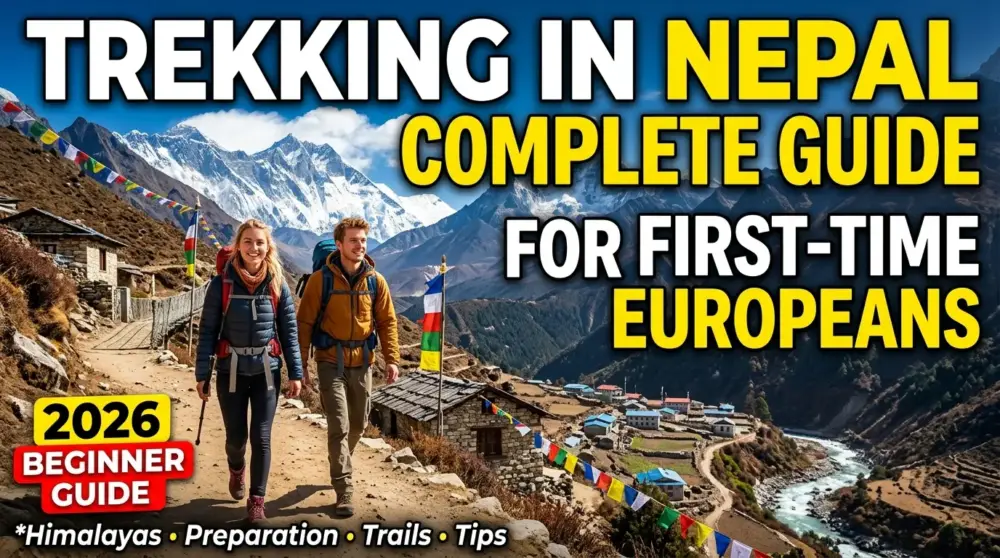
Trekking in Nepal is safe, affordable, and honestly, one of the best decisions a European can make. Local guides, teahouse food, well-worn trails — first-timers from Europe finish Everest Base Camp and Annapurna Circuit every single season without any mountaineering background whatsoever.
Okay, so here is the thing nobody tells you.
You are going to spend weeks researching this trip. You will read fifteen blog posts, watch twelve YouTube videos, and join two Facebook groups where strangers argue about boot brands. And after all of that, you will still feel underprepared. That is completely normal, and it does not mean you should not go.
My friend Julia booked her Poon Hill trek with about four days of research and a borrowed rain jacket. She came back talking about it like it had rearranged something in her head. That was three years ago. She has been back twice since.
Nepal does that to people. It is not a place you visit and tick off a list. It is a place that gets into you a little bit and does not entirely leave.
Why Nepal Works So Well for Europeans
Partly the cost. Let us be upfront about that. A full two weeks in Nepal, including return flights from anywhere in Europe, a licensed guide, teahouse accommodation, meals on the trail, and permits — you are looking at somewhere between €1,600 and €2,750 total. Compare that to a week of guided Alpine trekking in Switzerland, which costs €2,500 before you have even sorted flights. Nepal simply makes financial sense, and that gets people on the plane.
But then they arrive and realise the money was never really the point.
Nepal is the kind of place that makes Europeans feel like they have been living in a very small room their whole lives, and someone just opened a window. The trails pass through living villages where people farm, worship, raise children, and grow old at altitudes that would give most Europeans a headache just thinking about. A monastery at 3,800 metres that has been there for five hundred years. A grandmother sitting outside her stone house, watching you walk past with mild curiosity. A porter carrying a refrigerator up a mountain on a bamboo frame and somehow overtaking you on a steep section.
That texture is what makes Nepal different. The mountains are almost secondary to it.
When to Actually Go
October. If you can only go once, go in October.
The monsoon clears out in late September, and what follows is several weeks of the most consistently good trekking weather you will find anywhere on earth. Skies so clear that on certain ridgelines you can count individual peaks across a panorama stretching three hundred kilometres. Temperatures are comfortable for walking during the day, cold but manageable at night. Experienced trekkers plan entire years around getting to Nepal in October. There is a reason for that.
November works too, though nights get cold fast at altitude, and higher routes see snow from mid-month onwards.
Spring, March through May, is the other good window. The rhododendron forests below 3,500 metres are in full bloom in April, and the trails through those sections turn colours that feel almost aggressive. Pink and red everywhere. A lot of European families pick spring because it fits school schedules better.
June through August is monsoon season. Rain every afternoon, slippery trails, and cloud blocking views for days. Skip it for your first trip without overthinking it.
The Treks Worth Knowing About
Ghorepani Poon Hill Trek
Four to five days. Maximum altitude 3,210 metres. Teahouses the entire way.
This is the one to start with, and not because it is a consolation prize. Poon Hill at sunrise is one of those travel experiences that people describe badly for years because describing it well turns out to be impossible. You walk up in the dark with a headlamp, you stand on a small hill in the cold with a cup of tea, and then the sun comes up behind Annapurna and Dhaulagiri, and everything goes quiet for a minute.
Do this trek first. Get comfortable with multi-day walking, teahouse food, and trail rhythm. Then plan the bigger one.
Annapurna Base Camp Trek
Nine to twelve days. Reaches 4,130 metres at the camp itself.
The trail climbs through rhododendron forest and Gurung villages before arriving at a glacial bowl ringed by enormous mountains on all sides. Annapurna I. Machapuchare. Hiunchuli. The scale of it takes genuine time to absorb. You arrive, and you just stand there for a while doing the maths on how big everything is.
Natural hot springs at Jhinu Danda on the way down. After ten days of walking, this information becomes very important very quickly.
Langtang Valley Trek
Seven to ten days. Three hours from Kathmandu by road. About 3,870 metres maximum.
Langtang is for people who want the real experience without the crowds that come with the Everest and Annapurna routes. Tibetan-influenced Tamang villages, yak pastures, a glacier lake, and a cheese cooperative near Kyanjin Gompa that has been making hard cheese at altitude since the 1950s. The cheese sells out regularly. Plan accordingly.
Everest Base Camp Trek
Sixteen days. 5,364 metres.
Not a climb. No technical sections, no ropes, no crampons required. It is a long walk at a very high altitude, and the altitude is the only real challenge. Hundreds of first-time European trekkers complete it every single autumn.
The ones who make it versus the ones who turn back sick — it is rarely about fitness. It is about whether they took their acclimatisation days seriously in Namche Bazaar and Dingboche. The people who rush because they are worried about time end up helicoptered down from Lobuche. The people who rest on rest days stand at the base camp.
Choose sixteen days. Not twelve. Not fourteen. Sixteen. The extra days cost almost nothing, and they are the difference between finishing and not finishing.
Do You Need a Guide
Yes. Since April 2023 it is also a legal requirement on major trekking routes in Nepal. Solo independent trekking is no longer permitted.
But forget the legal side for a second. A good local guide changes the trip in ways that are difficult to fully explain before you have experienced it. Teahouse bookings in October when every place fills up by early afternoon. Early recognition of altitude sickness symptoms before you notice them yourself. The cultural context that turns a walk past a monastery into an actual understanding of what you are looking at.
You can trek without a guide in the sense that the trail exists and you could probably follow it. But you would miss half the trip.
Porters are optional. They carry your main bag while you carry a light daypack. Costs around $20 to $25 per day. On paper it sounds like a soft choice. At 4,200 metres on day nine with tired legs it sounds like the smartest $20 you ever spent. Most people who hire a porter say they wished they had decided sooner.
What This Trip Actually Costs — Real Numbers
| What You Are Paying For | What to Budget |
|---|---|
| Return flights from Europe | €500 to €800 |
| Nepal visa on arrival, 30 days | around €45 |
| Trek package with guide, meals, and accommodation | €900 to €1,600 |
| Travel insurance with helicopter rescue cover | €80 to €150 |
| Tips, personal spending, extras | €100 to €200 |
| Total for a full trip | €1,600 to €2,750 |
The insurance line. Please take this seriously.
A helicopter evacuation from altitude in Nepal without coverage costs between $5,000 and $8,000 USD. That is a real number, not a worst-case scenario. It happens to several trekkers every season who either skipped insurance or bought a policy that did not specifically cover high altitude and helicopter rescue. Check the policy wording before buying. Make sure it says above 5,000 metres. Make sure it says helicopter evacuation. Do not assume.
Permits — Genuinely Simple
Two documents cover the most popular routes.
TIMS card. About $7. Safety registration so authorities know where you are on the trail in case something goes wrong.
Conservation area or national park permit. Between $22 and $34. Annapurna routes need the ACAP permit. Everest routes need the Sagarmatha National Park permit.
Both were processed digitally through Nepal’s e-TIMS system from 2026 onwards. Any licensed trekking company, including Green Horizon Tour, handles both automatically as part of a standard package. You do not queue at any government office.
Is Nepal Actually Safe
Yes. Straight answer.
Violent crime against tourists in Nepal is genuinely rare. The communities along trekking routes have built their entire livelihoods around treating visitors well for generations and that shows every single day on the trail.
The real risks are altitude and weather, not people.
Altitude sickness does not care about fitness levels. It hits marathon runners and people who have not exercised in years with equal indifference. Above 3,000 metres watch for persistent headache, nausea, dizziness. The response is always the same: stop ascending, rest, descend if no improvement within 24 hours. Your guide watches for this before you do. That is part of what you are paying for.
Mountain weather changes fast. A clear October morning can become cold and windy by early afternoon at elevation. Carry a warm layer every day. Regardless of the sky at breakfast.
What to Pack — The Practical List
Most gear can be rented cheaply in Thamel, Kathmandu’s main trekking neighbourhood. Down jackets, sleeping bags, trekking poles — all available for a fraction of buying new. Do not spend a fortune on gear before you arrive.
The one thing that must be yours and broken in before you land: hiking boots. Not new-from-the-shop broken in. Properly worn, walked in, your-feet-know-them broken in. Blisters at altitude end treks. This is not an exaggeration.
Everything else worth having: moisture-wicking base layers, a fleece mid-layer, down jacket for evenings above 3,000 metres, waterproof shell, warm hat and gloves, UV sunglasses, SPF 50 sunscreen, headlamp with spare batteries, enough hiking socks to rotate daily without washing every night.
Documents to print rather than just save on your phone: passport copy, insurance policy with emergency numbers on the front page, two passport photos for the visa on arrival at Kathmandu airport.
Culture — Four Things That Actually Matter
Shoes off before entering any temple, monastery or home. Every time without exception.
Walk clockwise around stupas and prayer wheels. Religious practice, not decoration. Locals notice when visitors do it correctly.
Namaste with both hands pressed together at chest height. Works everywhere, with everyone, at every altitude. Use it constantly. The response it generates from an elderly Sherpa woman on a mountain path at 4,000 metres is one of the quietly memorable moments of any Nepal trek.
Eat the dal bhat. Rice, lentil soup, vegetables, free refills. Costs almost nothing. Exactly what your body needs on long trekking days. Most trekkers say it becomes genuinely their favourite meal around day four or five. Not because there are no other options. Because it is actually that good after six hours of walking uphill.
Nepal vs the Alps — Side by Side
| What Matters | Nepal | European Alps |
|---|---|---|
| Full trip cost | €1,600 to €2,750 | €2,500 or more per week |
| Trail food and shelter | Teahouses every few hours | Mountain huts are more spread out |
| Cultural experience | High throughout the entire route | Low to moderate |
| Max altitude on beginner routes | 5,364 metres | Around 4,000 to 4,800 metres |
| English spoken on the trail | Widely | Varies by country |
| Peak season crowds | Moderate | Very high |
How to Plan It — Step by Step
Pick the trek that honestly fits your available time and current fitness. Poon Hill for five days. Annapurna Base Camp for twelve. EBC for sixteen. Choose the realistic one, not the impressive-sounding one.
Book flights targeting late September through early November arrival or mid-March through April for the spring season.
Buy travel insurance before anything else. Confirm the policy covers above 5,000 metres and helicopter evacuation. Get this confirmed in the policy document before purchasing.
Contact Green Horizon Tour to handle permits, guide booking, and teahouse reservations. Doing this yourself from Europe across multiple sources takes weeks and introduces unnecessary complications.
Build two to three days into the start of your trip in Kathmandu. The city is genuinely worth it, and your body needs adjustment time after a long-haul flight before you start climbing.
Pack three days before departure. Something will be missing. Three days give you time to actually fix it.
Mistakes That Derail First Trips
Not taking altitude seriously. This ends more Nepal treks than everything else combined. The people who ignore acclimatisation days because they are feeling fine in the moment are the same people who are not fine three days later at 4,800 metres. Your feeling fine today tells you nothing about tomorrow at altitude.
Choosing the short itinerary to save a few days. The extra days on an EBC trek cost almost nothing relative to flights from Europe. Skipping them and failing due to altitude sickness halfway costs you the entire trip.
Skipping the guide to cut costs. The guide is a small fraction of the total trip cost. What they provide has no substitute.
Overpacking. Your instinct is to bring everything that might be useful. Fight that instinct hard. Then fight it once more. Then pack.
Before You Close This Tab
Julia, my friend with the borrowed rain jacket — she described coming back from that first Poon Hill trek as feeling like she had been away for a year. Not because it was long. Because it was full. Every day had a beginning and an end, and something real that happened in between. No notifications. No half-finished to-do lists quietly stress her out at the edge of her attention. Just walking. Tea. Mountains. Sleep. Wake up and do it again.
She said she did not realise how much noise her regular life made until she was in a quiet enough place to hear the difference.
That is Nepal. And you do not need special skills or expensive equipment, or any prior experience to feel it. You need decent boots, a guide who knows these mountains, and a few weeks you are willing to hand over to something that will almost certainly surprise you.
Green Horizon Tour has been putting first-time European trekkers on Himalayan trails for years: licensed local guides, full packages, transparent pricing, no surprises.
Plan your trek at greenhorizontour.com — before you spend another year thinking about it.
Questions Europeans Always Ask
Is Nepal safe for first-time European trekkers?
Yes. Altitude and weather are the risks to manage, not crime. A licensed guide helps you handle both.
What does the whole trip cost from Europe?
Between €1,600 and €2,750 for a complete two-week trip with flights, guide, meals, accommodation and permits.
What is the easiest trek in Nepal?
Ghorepani Poon Hill. Four to five days, 3,210 metres maximum, teahouses throughout, and a sunrise that justifies the entire trip.
Do Europeans need a visa for Nepal?
Yes. Tourist visa on arrival at Kathmandu airport. Thirty days costs around $50 USD. Two passport photos required.
Can a total beginner do Everest Base Camp?
Yes. On a sixteen-day itinerary with proper acclimatisation days and a licensed guide. It is a long walk at altitude, not a technical climb. First-timers complete it every single season.


How to book a trip?

make free inquiry

confirm the trip
