


How to Choose a Trekking Company in Nepal (Without Getting Burned)
A trekking company can make or break your Himalayan adventure. Choosing the right trekking company in Nepal means better safety, transparent pricing, experienced guides, and a more enjoyable trekking experience. Most trekkers spend months training for Nepal. They research gear for weeks. Then they spend about 20 minutes picking the company that will actually keep them safe on the mountain.
That is backwards — and it gets people into serious trouble.
Nepal has over 3,000 registered trekking companies. Some are genuinely excellent. Some operate out of a rented desk in Thamel with no licensed guides, no safety equipment, and no real accountability. A few are outright scams.
Telling them apart before you hand over a deposit — that is what this guide is for. Run every check here on any operator you are considering, including us.
Quick answer: Verify their NTB, TAAN, or NATTA registration number yourself online. Read reviews on independent platforms — not just their website. Ask for a line-by-line cost breakdown. And make sure they answer your safety questions with specifics, not reassurances. The full checklist is below, along with the red flags that should end the conversation immediately.
Why Your Choice of Operator Matters More Than Your Fitness
Your guide’s judgement will protect you far more than your training will.
At 5,000 metres, altitude sickness can escalate from a headache to a life-threatening emergency within hours. The trails on Manaslu and Everest routes are remote — sometimes hours from the nearest road, no mobile signal, no hospital nearby. In that situation, you need someone who has managed real emergencies on this exact route before.
This is a safety decision first. A travel booking second.
Your operator is also your permit office, your cultural translator, your logistics team, and when things go wrong, your evacuation coordinator. A good one has practised every part of that. A bad one has not.
What a Trekking Company Actually Does for You
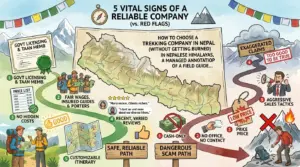
Most people underestimate how much is involved.
A licensed operator handles permits, safety, local logistics, and emergency coordination — all at once. For restricted areas like Manaslu, Upper Mustang, and Dolpo, they are also a legal requirement. There is no independent workaround for those permits.
Here is what a proper company takes off your plate:
- Permits and paperwork — TIMS card, national park entry, restricted area permits, each from a different government office. Handled before you land in Kathmandu.
- Altitude safety — Licensed guides are trained to catch altitude sickness early. They carry pulse oximeters on every trek. The call between “rest day” and “descend now” is not one you want to make without real experience.
- Local knowledge — Which teahouse has clean water at 4,200 metres? Which trail section floods in October? Which weather window closes by noon? This comes from seasons on a specific route, not from reading about it.
Legal Registration — The First Thing to Check
Ask for the number. Then look it up yourself.
Every legitimate Nepal trekking company is registered with at least one of these three bodies:
| Body | What it means | How to verify |
| NTB — Nepal Tourism Board | Government authority. Regulates all tourism businesses. | Nepal Tourism Board official portal |
| TAAN — Trekking Agencies’ Association of Nepal | Primary industry body for trekking operators specifically. | taan.org.np — publicly searchable |
| NATTA — Nepal Association of Tour & Travel Agents | Covers multi-activity and broader tour package operators. | NATTA member directory |
Two minutes of verification on any of these sites will immediately filter out anyone who should not be operating. If a company hesitates to share its number, or if it does not come up when you search, the conversation is over.
Also ask for their company registration number and PAN or VAT number. A real business has all three and shares them without making it feel like a difficult request.
💡 A note from us: Green Horizon Tours & Travels is a NATTA member 416/09, registered with both NTB and TAAN, and has been operating continuously since 1989. We were the first company to bring Czech and Slovak trekkers to Nepal. We are not a booking platform or reseller — we hire the guides, pack the oxygen, and pick up the phone when something goes wrong on the mountain. Please verify every number we have given you before trusting anyone, including us.
6 Red Flags That Should End the Conversation
🚩 1. Suspiciously low prices — with no explanation
A properly run Everest Base Camp trek costs USD 1,100 to 1,600 for 12 to 14 days. Annapurna Base Camp runs USD 700 to 1,100. If someone quotes significantly below those figures, something has been cut.
It is almost always guide quality, porter welfare, or safety equipment.
Ask directly: What specifically is not included at this price? If they cannot answer clearly, you have your answer.
🚩 2. Vague inclusions — “all inclusive” with no detail
A trustworthy operator sends you a line-by-line breakdown before you pay anything:
- Which permits, and the fee for each
- Which meals per day
- Accommodation grade
- Guide-to-trekker ratio
- Porter weight limits
- Airport pick-up
A company that says “all-inclusive” and promises to clarify in Kathmandu is setting you up for expensive surprises at the trailhead.
🚩 3. Safety questions answered with reassurances, not specifics
Ask: What is your acclimatization protocol for Everest Base Camp?
A solid answer names the schedule — rest days at Namche Bazaar (3,440m) and Dingboche (4,410m), pulse oximeter readings each morning, clear thresholds for turning back.
A red flag answer: “Our guides are very experienced and handle everything.”
That is a deflection, not a protocol. Push for specifics. If they cannot give them, they do not have a real safety system.
🚩 4. Slow or evasive replies before you even book
Message them. See how long it takes to get a real response to a specific question.
If a company takes three days to reply with a generic template now — when they want your money — think carefully about how they will respond when you are at 5,000 metres with a problem that needs a fast decision.
Response time is a genuine proxy for operational quality.
🚩 5. Reviews that only exist on their own website
Any company can write testimonials for its own homepage. What matters is what real trekkers say on platforms the company does not control.
Check Google, TripAdvisor, and Trustpilot. Look at:
- Volume first — 100+ reviews across independent platforms are meaningful. Under 20 is a flag.
- Recency — Weight the last 12 to 18 months more than older posts.
- The negatives — How a company responds to a bad review tells you more than a hundred five-star posts ever will.
🚩 6. Pressure to book immediately
“This price is only valid today” is a sales tactic. Not a trail condition.
Legitimate operators hold their prices, welcome careful comparison, and understand you are making a considered decision about your safety and your money. Pressure to commit quickly almost always means they do not want you looking more carefully at the details.
12 Things to Verify Before You Book
Run every item on this list before paying a deposit to anyone:
| What to check | What a good answer looks like |
| Government registration | NTB license + TAAN or NATTA number, both independently verifiable |
| Guide qualifications | NTB-licensed, first-aid certified, named seasons on this specific route |
| Package inclusions | Every permit itemised, meals per day named, accommodation grade stated |
| Guide-to-trekker ratio | 1 guide per 4 to 6 trekkers stated as a number |
| Safety equipment | Pulse oximeters on every trek, oxygen above 5,000m, emergency communication |
| Acclimatization protocol | Named rest day locations, daily altitude gain limits, and turnaround thresholds |
| Evacuation procedure | Step-by-step process, helicopter coordination, insurance requirements |
| Independent reviews | 100+ on external platforms, recent, negatives read |
| Full pricing transparency | Guide tips (USD 10–15/day) and porter tips (USD 6–8/day) disclosed upfront |
| Cancellation policy | Specific percentages at specific timelines — in writing, before deposit |
| Itinerary flexibility | Can they add a rest day? Private departures available? |
| Client references | Two past clients on this exact route, offered without hesitation |
One rule: if any of these get a vague answer or no answer — note it. A company that cannot be specific about the things that protect you on the mountain is telling you exactly what you need to know.
8 Questions to Copy Into Any Operator’s Inbox
Send these before paying anything to anyone.
- What is your registration number, and with which body? →You want a number you can look up yourself in under two minutes.
- Can you send a line-by-line breakdown of everything included? → Permits itemised with fees. Meals named per day. Accommodation grade stated. Guide ratio as a number.
- What are your guide’s qualifications, and how many seasons have you had on this exact route? → NTB license number. First aid certificate. Named seasons on this specific trek.
- What safety equipment do your guides carry? → Pulse oximeters on every trek. Supplemental oxygen above 5,000m. Emergency communication device.
- What is your acclimatization protocol? → Named rest day locations, altitude gain limits per day, oximeter thresholds for turning back.
- What happens if I develop altitude sickness above 4,500 metres? → Step-by-step: descent protocol, helicopter coordination, insurance requirements.
- What are your exact cancellation and refund terms? → Specific percentages at specific timelines. In writing. Before any deposit.
- Can you give me contact details for two past clients on this route? → A company with nothing to hide gives you this immediately.
A company that answers all eight clearly and quickly is worth taking seriously. One who struggles with any of them is telling you something important.
Planning this trek? Get a tailored quote from our team → Request a quote
Local Operator vs. International Booking Platform
Most people do not realise who they are actually paying.
When you book through a large international platform, here is what typically happens:
The platform takes your payment, subcontracts the actual trek to a local Nepali company, and keeps 20 to 40 percent as its margin. You pay more. If something goes wrong, you have two organisations to navigate instead of one.
To be fair — some international operators like Intrepid Travel and G Adventures run genuine ground operations in Nepal and are worth considering honestly. But for most international booking websites, you are paying a middleman to connect you with the company that will actually run your trek.
| Factor | Local operator | International platform |
| Price | Direct — no markup | 20 to 40% stays with the platform |
| Accountability | One company, one contract | Platform subcontracts to a local operator |
| Communication | Direct line to your guide’s team | Often routed through a sales layer |
| Emergency response | The operator coordinates directly | May involve relay through a third party |
| Flexibility | Changes resolved in one conversation | May require two organisations to agree |
Booking direct means your money goes to the people running your trek. Your contract is with the company managing your guides. Any issue — itinerary change or medical emergency — gets resolved in one conversation.
Green Horizon has operated as a direct-booking, local family company since 1989. We are not a reseller. We hire the guides, coordinate the permits, and pick up the phone when something happens on the mountain.
What Treks Actually Cost in 2026
| Trek | Typical duration | Approximate cost per person |
| Everest Base Camp | 12 to 14 days | USD 1,100 to 1,600 |
| Annapurna Base Camp | 10 to 12 days | USD 700 to 1,100 |
| Langtang Valley | 7 to 10 days | USD 600 to 900 |
| Manaslu Circuit | 14 to 17 days | USD 1,400 to 2,000 |
| Upper Mustang | 14 to 16 days | USD 2,000 to 2,800 |
Costs vary by group size, accommodation standard, and whether you choose a private or group departure. Manaslu and Upper Mustang carry government-fixed restricted area permit costs that no operator can reduce.
Always confirm: Is the quote based on double occupancy or single? Are tips for guides and porters included — or separate? They are almost always separate.
Mistakes First-Time Trekkers Consistently Make
Most of these are painfully common. All of them are avoidable.
- Choosing the lowest quote without asking what was removed from it
- Reading only the star rating without reading a single actual review
- Booking without verifying the registration number independently
- Not asking about guide experience on that exact route — not just “Nepal in general”
- Skipping travel insurance that covers emergency helicopter evacuation
- Leaving the cancellation policy until after the deposit has been transferred
Every single one of these is easy to fix before you book. None of them is easy to deal with on the trail.
Frequently Asked Questions
What registration should I check for a Nepal trekking company?
Start with TAAN membership — publicly searchable at taan.org.np. NTB registration is verifiable through the Nepal Tourism Board’s official portal. NATTA covers operators running broader tour packages. Ask for the specific number for each registration they claim, then check it yourself before paying anything.
How many reviews should a good operator have?
Volume matters more than score. A 4.7 rating from 500 verified reviews across Google and TripAdvisor means far more than a 5.0 from 18. Prioritise recency too — reviews from the past 12 to 18 months confirm the company is actively operating at its current standard.
Is it cheaper to book directly with a local operator?
Usually, yes, by 20 to 40 percent. That margin does not disappear when you book through a platform — it either comes out of your budget or out of what reaches the guides and porters running your trek. Booking direct also means one point of contact and one accountable party.
Can I trek in Nepal without a guide?
On open routes like Annapurna Circuit, Langtang Valley, and Poon Hill, independent trekking is legally possible with the right permits. For restricted areas, including Manaslu, Upper Mustang, and Dolpo, a registered operator is legally required. Beyond legality, most experienced trekkers would not go above 5,000 metres without a licensed guide regardless of their own experience level.
How early should I book?
For peak seasons — October and November, March and May — book at least three to four months ahead. October fills fast on Everest and Annapurna routes. Off-season travel allows more flexibility, but confirm guide and permit availability early regardless.
Are local trekking companies in Nepal safe?
A registered, licensed, TAAN-member local company is fully accountable to Nepali law and industry standards. The registration is what matters — not whether the company is local or international. Verify the numbers, read independent reviews with enough volume to be meaningful, and ask the safety questions in this guide. A company that passes all of those checks is worth trusting.
Final Thoughts
Every safe Nepal trek comes down to one decision made before you arrive: who you trust with the mountains.
Check registration first — and verify it yourself. Read independent reviews with real volume. Ask the safety questions and judge operators by how specifically they answer. Compare what is actually inside each package, not just the headline price. Get the cancellation policy in writing before transferring anything.
Run every one of those checks on us.
Green Horizon Tours & Travels has operated since 1989 — NATTA member 416/09, registered with NTB and TAAN. We were the first company to bring Czech and Slovak trekkers to Nepal, and we are still the people who hire the guides, pack the oxygen, and answer when something goes wrong on the mountain. Every number we have shared is publicly verifiable. We expect you to check.
Trek with the operator since 1989 — get a quote within 24 hours → Get a quote
Or talk to us directly on WhatsApp — no scripts, no pressure, just straight answers from the team that will actually run your trek.


How to book a trip?

make free inquiry

confirm the trip
