


Jugal Everest Viewpoint 2026: 5 Unbelievable Views That Rival Everest Base Camp
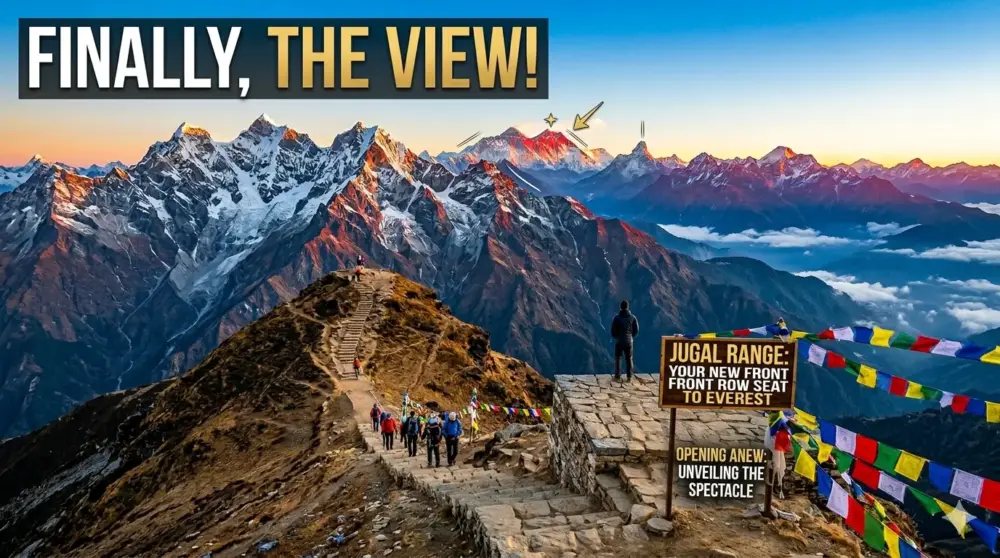
The Viewpoint Nobody Saw Coming
Jugal Himalayan Range Finally Gives the World a Front Row Seat to Everest
An Exclusive Travel Feature | Nepal Himalayan Discoveries, 2026
There is a moment that happens on very few trails in Nepal. You are walking through a rhododendron forest, your boots are damp from morning dew, and the path ahead gives no hint of anything remarkable. Then the trees pull back. The ground flattens. And there it is. Mount Everest, the highest point on this whole spinning planet, sits in front of you so close and so enormous that your brain genuinely struggles to understand what it is looking at.
That is not a description from Kala Patthar. That is not the famous Gokyo Ri ridge. That is the newly discovered Jugal Everest Viewpoint, tucked inside the Jugal Himalayan Range northeast of Kathmandu, and it has been quietly sitting there for centuries while the trekking world looked the other way.
A Range That Lived in Someone Else’s Shadow
Most people who visit Nepal and chase mountain views head straight for the Khumbu or the Annapurna region. That makes complete sense. The infrastructure is there, the lodges are warm, and the trails are mapped down to every switchback. The Jugal Range, meanwhile, sits quietly in Sindhupalchok and Dolakha districts, a wall of serious Himalayan peaks that most travelers pass through on a bus without a second glance.
That is about to change, and frankly, it was only a matter of time. Local guides and a handful of independent researchers, some from Nepal’s own tourism board and some working independently, had long suspected that certain ridgelines in the Jugal Range offered something unusual. The geometry of the terrain, the way those peaks angle themselves toward the east and northeast, created a sightline toward the Khumbu that almost nobody had tested on foot.
When a team of local Nepali mountaineers and trail scouts finally pushed through the upper Jugal last season and documented their findings with photographs and GPS coordinates, the trekking community had a quiet but genuine moment of surprise. The views were not just good. They were exceptional. Mount Everest was not some distant smudge on the horizon. It was right there, dramatic and unobstructed, flanked by Lhotse and Makalu in a panorama that rivals anything the Khumbu valley offers from its most celebrated ridges.
What Makes This Viewpoint Different
Here is the thing about famous Himalayan viewpoints. Many of them ask a lot of you. Kala Patthar sits at 5,545 metres, and you earn every inch of that altitude through days of acclimatisation, crowded tea houses, and a rather merciless final climb. The Jugal viewpoint is high enough to feel genuinely alpine and to put you well above the treeline, but it is not at the kind of altitude that demands weeks of preparation from a reasonably fit trekker.
The approach itself is part of what makes the whole experience feel different from the standard Himalayan trek. The trail winds through terraced farmland that still belongs entirely to local Tamang and Sherpa communities, who have not yet seen the kind of tourism footfall that changes a place. The villages are small, the teahouses are few and genuinely family run, and the people you meet on the trail are farmers and shepherds who are quietly amused and pleased to see anyone coming this way.
The landscape transitions over the course of the walk in a way that keeps you engaged rather than grinding through repetitive terrain. Lower elevations give you a subtropical forest full of ferns and birdsong. The middle section opens into pine and juniper. And then above that comes a stretch of high alpine meadow, locally called kharkas, where yaks graze in summer against a backdrop of permanent snowfields. By the time the viewpoint reveals itself, you have moved through what feels like three or four completely different worlds.
The View Itself, Honestly Described
Words do some work here, but not enough, which is true of most genuinely extraordinary views. What can be said is this. The Jugal Everest Viewpoint sits on a natural ridge platform that faces the eastern Himalayas with almost nothing between you and the peaks. On a clear morning, typically from November through early March, the visibility stretches across an arc of Himalayan giants that takes a few minutes just to properly scan.
Everest dominates the right portion of the panorama. It is distinctive even from here, its characteristic triangular pyramid and the dark Kangshung face catching the early light in a way that makes it unmistakable. Lhotse sits close and massive beside it. Makalu, often underappreciated from other viewpoints but fully visible here, adds its own bold presence to the left. Across the rest of the horizon, you get a rolling succession of Jugal Range peaks, Dorje Lakpa most notably, and on the clearest days, the white teeth of peaks reaching all the way toward the Langtang region.
What catches people off guard is the quiet. At sunrise on the Jugal ridge, with those peaks burning pink and then orange and then blazing white in the morning sun, there is a very good chance you will be the only person standing there. That is not a small thing. After years of photographs from Kala Patthar crowded with trekkers in matching down jackets, having that scene entirely to yourself changes the emotional quality of it completely.
Getting There: The Practical Reality
The Jugal viewpoint is accessible from Kathmandu, which is a great practical advantage of its location. The Jugal Range begins relatively close to the capital compared to the Khumbu, meaning you are not looking at a flight to Lukla and days of walking before you even reach interesting terrain. The trailhead is reachable by road from Kathmandu in three to five hours, depending on your starting point and road conditions.
From the trailhead, a fit and acclimatised trekker can reach the viewpoint area in three to four days of walking. This is not a casual day hike, and it should not be treated as one. The terrain is genuine mountain territory, trail conditions are not always well marked since the route is newly documented, and the weather in the high Himalayas deserves consistent respect. A local guide is strongly recommended both for navigation and for supporting the communities along the route.
Permits are required for trekking in the Jugal Himalayan Range area, administered under Nepal’s trekking permit system. As the route gains attention, it is expected that more formal infrastructure around permitting and trail marking will develop. For now, the advice from those who have done the route recently is to go with an agency or guide who has direct experience in the Jugal area specifically, not just general Himalayan trekking credentials.
Best Time to Go and What to Expect from the Weather
The Himalayan trekking seasons apply here much as they do elsewhere in Nepal, but with some nuances specific to the Jugal Range’s orientation and altitude. October and November are the classic choices. The monsoon is finished, the air has been washed clean, visibility is at its peak, and the rhododendron forests on the lower slopes have turned to autumn gold. These months also give you the coldest nights at altitude, so sleeping bag quality matters.
February and March are emerging as the secondary favourite season among those who have done the Jugal route recently. The days are clear and crisp, the snowpack on the high ridges is beautiful rather than treacherous, and the rhododendrons begin their famous Himalayan bloom on the way out. There is something about doing a high ridge walk in late winter with those red and pink flowers opening around you that feels particularly Nepali in the best possible way.
The monsoon months from June through September are best avoided for the viewpoint goal specifically. Low cloud and persistent rain make mountain views unreliable or impossible, trails turn muddy and slippery at high elevations, and leeches on the lower forested sections are a genuine nuisance rather than a minor inconvenience. The landscape is green and dramatic during the monsoon, and some trekkers love it for that, but the Everest panorama is largely hidden behind clouds for weeks at a time.
A Discovery That Belongs to Nepal First
It would be easy, and a little lazy, to frame this as a story about tourists discovering something. That is not quite right. The Jugal Range and its views have been known to local shepherds, village elders, and generations of Tamang communities for as long as those communities have lived there. What is new is not the place. What is new is the formal documentation of the viewpoint, the mapping of a trekking route that outsiders can follow, and the beginning of a conversation about how to share this landscape without destroying what makes it valuable.
Nepal’s trekking history has a complicated relationship with discovery narratives. The Annapurna Circuit was once described as an untouched wilderness. Langtang was a hidden gem. Now, both have paved stretches and jeep roads that were unimaginable two decades ago. The Jugal communities and Nepal’s tourism planners are aware of this pattern, and early conversations about the viewpoint’s development have included strong voices arguing for controlled visitor numbers, community benefit requirements, and strict rules around camping and waste in the high alpine zone.
If that model holds, the Jugal Everest Viewpoint has a genuine chance to be something different. Not a place that is loved to a familiar, comfortable, slightly hollow version of itself, but a place that stays genuinely wild, genuinely Nepali, and genuinely worthy of the long walk it takes to reach it.
Why This Matters Beyond the Instagram Frame
There is always a tension in writing about a new place. Write about it, and you contribute to the very footfall you are describing as a threat. Say nothing, and the discovery happens anyway, just without thoughtful voices in the conversation. The honest position here is that the Jugal Everest Viewpoint will attract attention because the views are genuinely world-class and the location is accessible. The question is whether that attention arrives in a way that the communities and the landscape can absorb.
For the individual traveler, this is also a moment worth thinking about. There are very few places left in the Himalayas where a genuinely spectacular mountain experience is still in its early, quiet phase. The Jugal route right now offers what the Everest Base Camp trek did in the 1980s. Not a worse version of the famous thing, but an earlier, quieter, more personal version of the same essential experience. The mountains are there. The silence is there. The path is largely your own.
Anyone who has stood on a Himalayan ridge at dawn and watched the world’s highest peak light up in the first sun of the day knows that it is not something you describe to people who have not felt it. You simply tell them to go. The Jugal Everest Viewpoint is worth going to. Go thoughtfully, go prepared, go with local guidance, and leave it as close to how you found it as is humanly possible.
Quick Reference for Prospective Trekkers
- Location: Jugal Himalayan Range, Sindhupalchok and Dolakha Districts, Nepal
- Distance from Kathmandu: 3 to 5 hours by road to the trailhead
- Trek Duration: Approximately 6 to 10 days round trip, depending on route and fitness
- Best Seasons: October to November and February to March
- Permits Required: Yes. Obtain through the Nepal Tourism Board or a registered trekking agency
- Guide Recommended: Strongly yes. Trail marking is still in early development
- Key Views: Mount Everest, Lhotse, Makalu, Dorje Lakpa, and the full Jugal Range arc
- Difficulty: Moderate to strenuous. No technical mountaineering required
- Crowd Level (as of 2025): Very low. One of the quietest major Himalayan viewpoints currently accessible
The mountains were always there. Now, finally, there is a path to see them.
Nepal Himalayan Travel Feature, 2026.


How to book a trip?

make free inquiry

confirm the trip
