


Is Nepal Safe to Travel in 2026? The Honest Answer
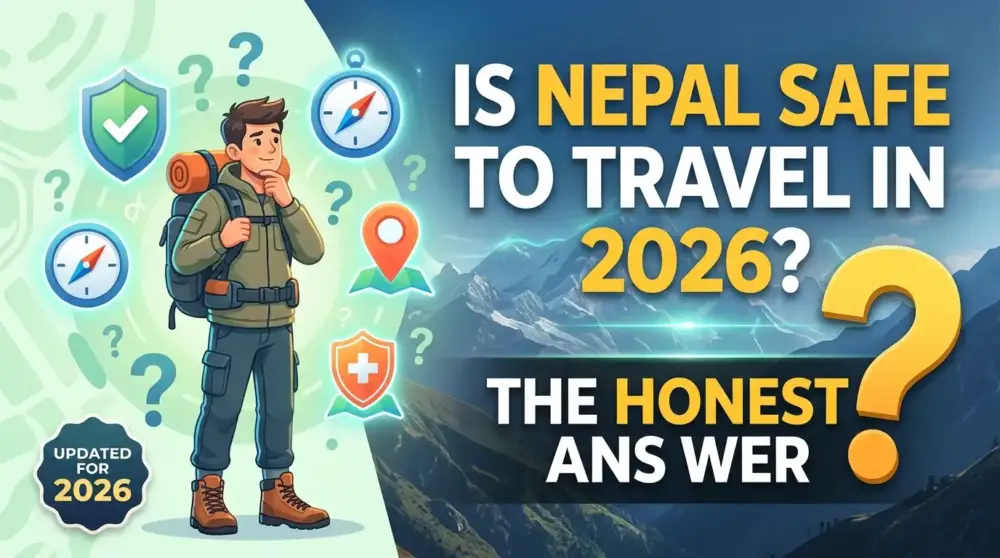
Is Nepal safe to travel in 2026? My cousin called me in April, half laughing, half serious, and asked if I’d lost my mind for still booking treks in Nepal this year. She’d seen the headlines from the previous September, the burning buildings in Kathmandu, the curfews, the death toll ticking up on the news crawl, and none of that had faded from her memory by the time spring rolled around.
I get why she asked. If your only window into a country is a handful of dramatic photos from one violent week, you’d want to ask too.
So here is the honest answer, not the brochure answer. Nepal in 2026 is generally safe for most travelers who take sensible precautions, but it is not a risk-free destination. The country you’re flying into is not the same one that existed in August of last year, and pretending otherwise does nobody any favors.
What actually happened, and why it matters to you now
In September 2025, Nepal went through the most violent week of unrest its democracy had seen in decades. The government banned two dozen social media platforms in what read to most young Nepalis as an attempt to silence criticism of political corruption and the so-called “nepo kid” culture, the flaunting of wealth by politicians’ children while youth unemployment sat above 20 percent. Protesters, many of them teenagers, poured into the streets.
September 8 turned into the deadliest single day of protest violence in the country’s modern history. Government buildings burned, including the parliament and the prime minister’s residence. Seventy-seven people were killed during the September uprising, according to Reuters. Prime Minister K.P. Sharma Oli resigned after the worst violence. Sushila Karki, a former chief justice with no party affiliation, was sworn in as interim prime minister on September 12, becoming the first woman to lead the country. The unrest itself was over within days. (Reuters)
I’m including this not to alarm you but because you deserve the full picture before someone tells you “it’s fine now.”
Karki’s caretaker government held its promise and ran fresh elections in March 2026. Balendra “Balen” Shah, a 35-year-old former rapper and civil engineer who had been mayor of Kathmandu, won in a landslide. He was sworn in as prime minister on March 27, 2026. (Reuters)
That’s the context that matters for your trip. This wasn’t a coup or a collapse into chaos. It was a protest movement that forced a political transition, an interim government that organized fresh elections, and an election that channeled much of that anger into parliament instead of into continuing nationwide violence.
But there is an important distinction: the political situation has stabilized considerably; that doesn’t mean protests have disappeared. Political protests, demonstrations and strikes remain fairly common in Nepal and can begin at short notice. They can disrupt transport and, in some circumstances, lead to clashes or curfews. (GOV.UK)
What the official advisories actually say
The U.S. State Department currently rates Nepal Level 2: Exercise Increased Caution, with the advisory dated March 31, 2026. Level 2 means travelers should be aware of increased safety and security risks; it does not mean the country is considered a destination where Americans should avoid travel. (Travel State)
That said, I wouldn’t use the U.S. rating to argue that Nepal is simply “as safe as France, Germany or the UK.” Travel-advisory levels are broad categories, and countries within the same level can have very different risk profiles.
Australia’s current Smartraveller advice is more cautious: it recommends exercising a high degree of caution in Nepal overall because of the risk of road accidents and natural disasters. (Smartraveller)
The UK Foreign, Commonwealth & Development Office likewise continues to warn about political protests and strikes, crime, road travel, natural disasters and trekking risks. (GOV.UK)
Level 2 doesn’t mean nothing can go wrong. And the Australian rating makes the point especially clearly: some of the biggest risks to visitors in Nepal have little to do with politics at all.
A crowded bus station, a dangerous mountain road, a landslide, altitude sickness, bad weather or a delayed flight can have a much greater effect on an ordinary trip than the political headlines do.
Kathmandu and Pokhara today
I’ve had friends who trekked through Nepal this spring, and what struck me in their photos wasn’t tension; it was ordinary chaos. Thamel packed with backpackers haggling over pashmina scarves. Lakeside in Pokhara lit up at night with restaurants spilling tourists onto the sidewalks. Temple bells. Buses honking. The stuff Nepal has always looked like.
Political demonstrations still happen, and they probably always will in a country that just proved to itself that protest can bring political change. But that doesn’t mean tourists should treat them as entertainment. Demonstrations can become confrontational, disrupt transport and lead authorities to impose restrictions or curfews. The safest approach is simple: stay away. (GOV.UK)
Bandhas, general strikes that can shut down shops and transport for a day, are part of the rhythm of Nepali political life and have been for decades. Ask your hotel the night before any important travel day whether one is scheduled. Check local news before setting out. A one-day disruption is annoying; discovering it after you’ve already headed toward a bus station is considerably less fun.
The advice that actually protects you here isn’t exotic. Stay away from anywhere protesters are gathered, even if it looks calm or even festive from a distance. Keep a printed copy of your passport and visa separate from the originals. Watch your bag in bus stations and any spot dense with tourists, since petty theft is a much more ordinary problem than political violence for most visitors.
None of this is Nepal-specific advice, honestly. It’s the advice you’d follow in plenty of major tourist destinations around the world.
Trekking safety is its own conversation
If you’re reading this because you’re planning Everest Base Camp, Annapurna, or one of the smaller routes like Nar Phu or Helambu, the political situation in Kathmandu is close to irrelevant to your actual risk profile. The mountains have their own hazards, and they haven’t changed because of an election.
Altitude sickness can affect experienced and inexperienced trekkers alike. Fitness does not make you immune to altitude illness, because acclimatization depends on how your body responds to reduced oxygen at elevation. Build acclimatization days into your itinerary rather than rushing to shave a day off the schedule.
Weather in the high passes can turn quickly. Trail conditions on routes prone to landslides can become genuinely dangerous during monsoon season, roughly June through September, when heavy rain increases the risk of landslides and flooding.
There is also an important regulatory point that travelers should not gloss over. Do not assume that “solo trekking” means you can simply head into any protected or restricted area alone. Current UK travel advice says travelers should not trek alone and notes requirements concerning local guides and protected areas. Check the rules for your specific route and permit before setting out rather than relying on an old blog post or forum comment. (GOV.UK)
And honestly, I’d recommend a good local guide even where the rules allow more flexibility. Local knowledge of trail conditions, weather, altitude and changing routes is worth far more than the money you’d save going completely alone.
The natural hazard side nobody wants to talk about
Nepal sits on one of the world’s most seismically active zones. The 2015 earthquake killed close to 9,000 people and is still, more than a decade later, part of how the country thinks about disaster preparedness.
This isn’t a 2026-specific risk. It’s a permanent feature of traveling here, and it’s worth knowing the basics: if you feel shaking indoors, get under something sturdy rather than immediately running outside where falling debris can be a danger; if you’re outdoors, move away from buildings and power lines.
Your guesthouse or trekking guide will almost certainly know the local protocol better than any packing list I could give you.
Monsoon brings its own set of problems
If you’re traveling to Nepal right now, in August 2026, this is the section I’d pay the most attention to.
Monsoon brings problems that are more mundane but more likely to actually affect your trip: flight delays and cancellations to and from mountain airstrips, road closures from landslides, flooding and rougher river crossings on trek routes. Current foreign-government advice continues to highlight natural disasters and road safety as significant risks in Nepal. (Smartraveller)
If your dates are flexible, the pre-monsoon window of March through May and the post-monsoon window of late September through November generally offer better trekking conditions, clearer skies and more reliable transport.
That doesn’t mean August is impossible. It means you should build considerably more flexibility into your plans.
Is Nepal Safe to Travel in 2026?
Yes, with the same caveat that applies to answering that question about almost anywhere.
Nepal in 2026 is not a warzone, not a country in political freefall, and not somewhere foreign visitors are generally being targeted because they are tourists.
The unrest of September 2025 was real and deadly, and it reshaped the country’s government within months. The subsequent election produced a new government under Balendra Shah, who remains prime minister as of August 2026. (Reuters)
What’s left in its wake is a young government trying to establish political stability, a tourism sector that remains central to the economy, and a set of ordinary but very real travel risks: theft, road accidents, altitude sickness, landslides, earthquakes and weather disruptions.
The important thing is not to replace one oversimplification with another. Nepal isn’t “dangerous because there were protests,” but neither is it a completely risk-free destination just because the protests ended.
What I’d actually tell my cousin
What I’d actually tell my cousin, and what I’ll tell you, is to build a little flexibility into your itinerary in case a bandha or a weather delay eats a day.
Stay away from political demonstrations. Check local conditions before important journeys. Travel carefully on the roads. Once you’re above the cities, use a qualified local guide where required and consider using one even where it isn’t. Get real travel insurance that covers trekking at your intended altitude and, if appropriate for your route, emergency mountain evacuation.
And check the current U.S. State Department, UK FCDO or your own government’s travel-advice page the week before you fly rather than trusting a blog post, mine included, to still be accurate by the time you land. Conditions on the ground do shift, and the operators and guesthouses that work there every day will always know more than a website. (GOV.UK)
None of that is a reason to automatically cancel.
It’s the same due diligence you’d do before any trip to a country you don’t know intimately. Nepal, for everything it went through last year, remains a destination that can be traveled responsibly in 2026.
So if you’re asking me the question my cousin asked me: “Have you lost your mind for still going?”
No. I’d go. I’d just go prepared.



How to book a trip?

make free inquiry

confirm the trip
