His friends said wait for October. His colleague showed him a photo of a flooded road somewhere near Pokhara. His mother asked why he couldn’t just go somewhere with a beach.
He went anyway. Spent twelve days between Kathmandu, Upper Mustang, and Chitwan. Came back saying it was the best trip of his life.
That’s not a guarantee. Monsoon Nepal will frustrate you if you go in expecting clear skies and mountain views. But if you go in knowing what it actually is? Different story.
Here’s the honest guide nobody else seems to want to write.
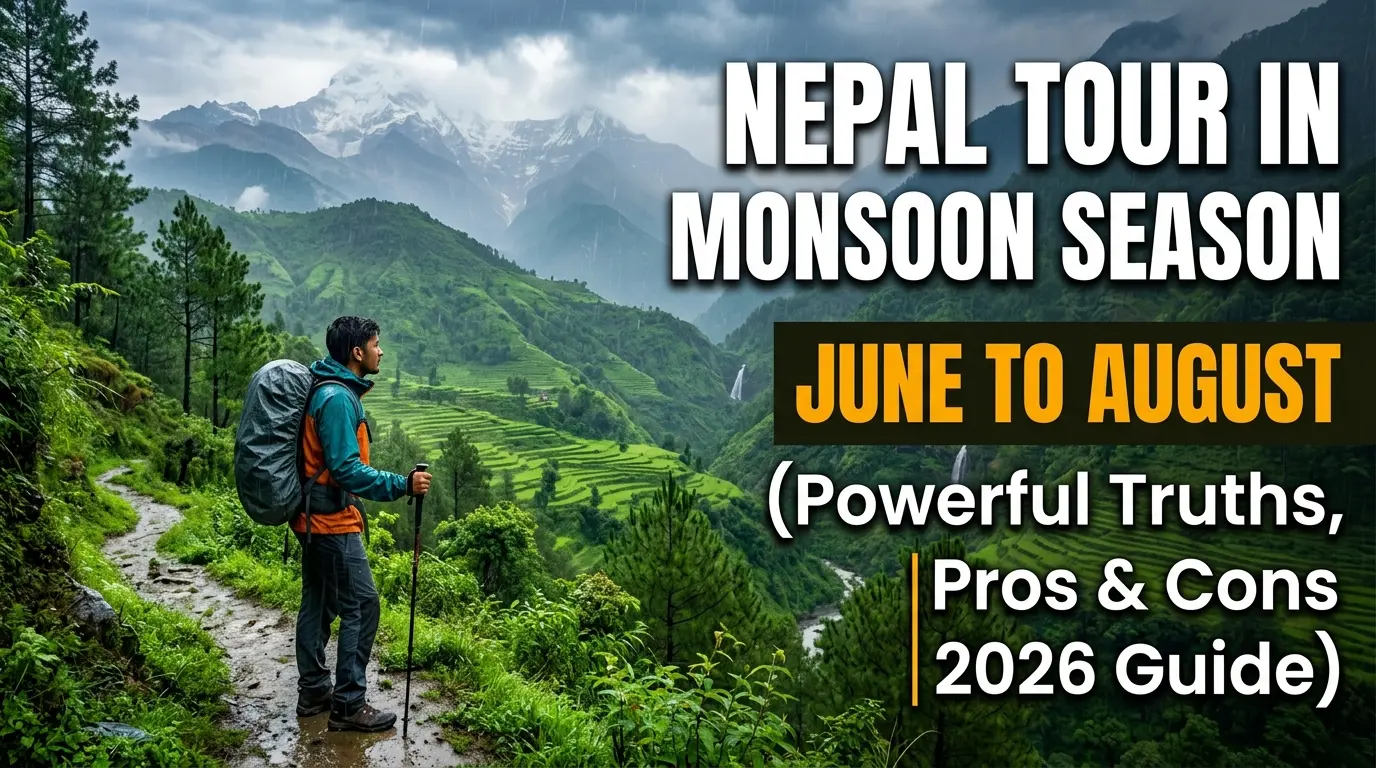
A Nepal tour in monsoon season — June through August — means lush green countryside, almost no other tourists, and noticeably cheaper costs. It also means rain, some flight delays, and the Himalayas mostly hiding behind clouds. Go to the right places with a flexible head, and it genuinely delivers.
What Monsoon Season in Nepal Is Actually Like
First thing to clear up: it doesn’t pour rain from sunrise to midnight every single day. Most of the time, you get a usable morning, clouds rolling in around midday, and then the real rain hits late afternoon into evening. Annoying? Sometimes. But manageable once you know the pattern and plan around it.
Second thing: Nepal is not one weather zone. The Terai plains in the south flood and get genuinely miserable. Kathmandu and Pokhara deal with regular showers but stay functional. Upper Mustang, which sits behind two of the biggest mountain ranges on earth, gets almost zero rain. The monsoon clouds physically cannot get over the Annapurna and Dhaulagiri walls. So while it’s pouring in Pokhara, people in Lo Manthang are having dry sunny days.
That geographical detail changes your entire trip planning once you understand it.
Why Monsoon Nepal Is Actually Worth Considering
The crowds vanish. In October, the Poon Hill trail looks like a morning commute. In July, you might walk for two hours and see four people. Tea house owners sit with you. Temple courtyards feel sacred rather than busy. You get the Nepal that people talk about wanting but rarely find during peak season because they’re sharing it with ten thousand other people who had the same idea.
Everything costs less. Hotels come down. Tour packages get discounted. Trekking companies want your business and will negotiate. For travellers watching their budget, this is a genuinely useful window.
Nothing looks like this any other time of year. Terraced fields that sit brown and dormant in autumn flood with water and turn the hills into layered mirrors. Waterfalls explode on cliffs you wouldn’t even notice were there in October. The air after morning rain smells cleaner than anything. People who photograph Nepal during the monsoon often struggle going back to autumn because the colour and drama just isn’t the same.
Festivals that actually belong to Nepal. Ropain, the rice planting festival, happens in late June or early July. Farmers in paddies, singing, mud flying everywhere, a kind of communal joy that has nothing to do with tourism. Gai Jatra takes over Kathmandu in August with processions, masks, and general chaos in the best sense. The Yartung horse racing festival runs in Mustang.
These happen whether tourists show up or not. Being there for them feels completely different from peak season, where everything starts to feel slightly performed.
The Parts Nobody Should Pretend Aren’t Real
Mountain views. Gone. Almost entirely from June through late August. If seeing Annapurna or the Everest range clearly is the core reason you’re going, do not travel in the monsoon. This isn’t an opinion, it’s just a fact. The peaks hide, and they don’t apologise for it.
Roads in hilly areas get cut by landslides. The stretch up toward many trekking starting points can close after a night of heavy rain. Sometimes for hours, sometimes longer. Road travel in these areas during peak July requires checking conditions and having backup plans.
Domestic flights get disrupted. Flights to Lukla, Jomsom, and Phaplu get delayed and cancelled more often during the monsoon than any other season. Weather windows are narrow, and pilots won’t fly blind. If you have a tight connection relying on one of these flights, add buffer days. Non-negotiable.
Leeches on forested trails. They’re there, they find warm bodies efficiently, and hikers who went unprepared have stories. Leech socks and salt handle them, but you should pack knowing they exist.
Humidity. At lower elevations, it’s thick and sticky. Chitwan and the Terai in July are genuinely hot. Plan accordingly.
Where to Actually Go in Nepal During Monsoon
Upper Mustang
Go here. Seriously. This is the answer to almost every monsoon problem. Dry. Open. Staggeringly beautiful in a completely different way from the rest of Nepal. Cave monasteries in ochre cliffs. The medieval walled city of Lo Manthang. Desert plateau landscapes that look more like Tibet than anything else in Nepal. Absolutely minimal other travellers.
You need a restricted area permit, you fly into Jomsom from Pokhara, and you skip the landslide roads entirely. It costs more than a standard trek, but the experience justifies it without any debate.
Kathmandu Valley
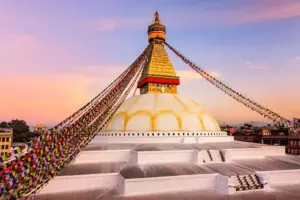
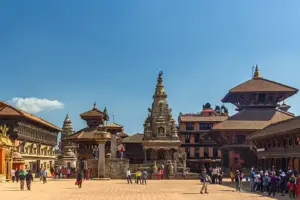
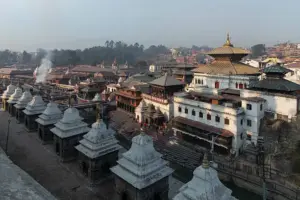
Kathmandu in monsoon is Kathmandu in a different mood. When the rain comes down on Boudhanath, water runs off the eyes of the Buddha painted on the stupa, and the whole thing looks like a painting. Patan Durbar Square empties, and you can actually stand there quietly and feel how old it is. Pashupatinath on a weekday morning in July has maybe thirty people in it.
Museums, hidden courtyards, Newari restaurants, rooftop cafes watching rain fall on old rooftiles. The valley earns its reputation more honestly in the monsoon than in the peak season.
Pokhara
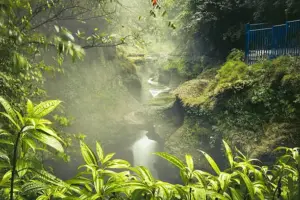
You won’t see the Annapurna range. Accept that early. What you get instead is a town that slows down, a lake that turns steel grey and moody and interesting to photograph, Devis Falls running at full volume as it means it, and prices that feel like a relief compared to what your friends paid in October.
Good base, good food, good for a few days of decompression between activities.
Chitwan National Park
Safari doesn’t stop for rain. Rhinos don’t care about your itinerary. Chitwan in monsoon is thick and green and almost claustrophobically alive. Tiger sightings happen. One-horned rhinos are frequently spotted. Birdwatching during the breeding season is exceptional.
It’s hot, and it’s humid, and you will sweat, but the jungle being in full monsoon mode makes it feel more wild rather than less.
Lumbini
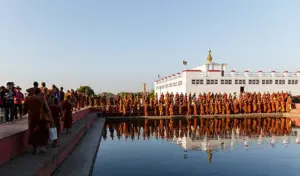
Calm, low-key, and mostly unaffected by the monsoon chaos happening elsewhere. Walking between monasteries representing Buddhist traditions from Sri Lanka, Japan, China, Germany, and a dozen other countries while it rains gently is genuinely peaceful.
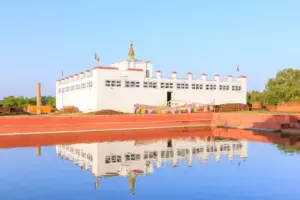
The Mayadevi Temple and sacred garden carry a quiet that peaks in the off-season, and crowds dilute significantly. Worth a few days if spiritual travel is part of what you’re looking for.
Safety in Monsoon Nepal: Straight Answer
Landslides on hilly roads are a genuine risk. Not dramatic, not overstated, just real. The solution is to check road conditions before you drive, fly where flying is an option, and not push through roads locals say to avoid.
Travel insurance matters more on a monsoon trip than at any other time of year in Nepal. Cancellations happen. Delays happen. Unplanned extra nights happen. Insurance removes the financial stress from those moments so you can handle them without spiraling.
Local guide. Worth it. Not because you can’t navigate Nepal independently, but because during the monsoon, a guide who knows the region will know things you can’t know from a planning app.
June, July, August: What Each Month Actually Gives You
June The manageable entry point. Rain is starting but hasn’t fully arrived. Early June mornings are often lovely. Cultural tours, Kathmandu, Upper Mustang, all work well. Prices are down, crowds are sparse, and conditions are still reasonable.
July The full monsoon. Heaviest rain. Most road disruptions. Most flight cancellations. Requires careful destination choice and flexibility. Mustang shines here.
August Similar to July but easing toward the end. Gai Jatra takes place. The final weeks often feel like the rain is starting to fade.
Month by Month Weather Quick Reference
Month
Temp in Kathmandu
Rain Level
Best For
June
~27°C
Building
Cultural tours, Mustang
July
28–33°C
Heaviest
Mustang, Chitwan, Kathmandu
August
28–32°C
Easing late month
Same as July, festivals
Monsoon vs Peak Season: The Honest Comparison
Factor
Monsoon (June–August)
Peak (Oct–Nov)
Crowds
Almost none
Very high
Costs
Lower
Expensive
Views
Mostly hidden
Clear
Trekking
Selective
Excellent
Culture
Rich, authentic
Standard
What to Pack and What Not to Forget
Rain jacket (proper waterproof), waterproof boots, quick-dry clothes, insect repellent, leech socks, dry bags, umbrella, flip flops. Don’t overpack. Things don’t dry fast. A smaller pack works better.
Practical Tips That Actually Help
Start outdoor activities before 8 am
Keep buffer days
Check road conditions locally
Allow flexibility around flights
Who Should Go to Nepal in Monsoon?
Budget travellers. Photographers. Repeat visitors. People who enjoy slow travel and fewer crowds. Curious travellers willing to experience Nepal differently.
Should You Actually Visit Nepal in Monsoon?
If your trip depends on mountain views and precise scheduling, go in October or November.
But if you want fewer crowds, lower costs, lush landscapes, and authentic cultural experiences, monsoon delivers.
The travellers who go with realistic expectations often come back surprised — not because everything went perfectly, but because Nepal in the rain feels rawer, quieter, and more itself than in peak season.
Sometimes that’s the better version.
Thinking about a Nepal monsoon trip? Green Horizon Tour has been helping travellers plan Nepal visits across every season. Reach out, and let’s figure out the right itinerary for when you’re going.
Frequently Asked Questions
Is June a good time to visit Nepal? Yes, especially early June.
Can I travel in July and August? Yes, with planning and flexibility.
Best places during monsoon? Upper Mustang, Kathmandu Valley, Pokhara, Chitwan, Lumbini.
Is it cheaper? Yes, noticeably.
Main risks? Landslides, delays, humidity, leeches.
Okay, so I’ll be honest with you. I almost didn’t do this trek. A friend mentioned it over dinner in Thamel one night, and I half-listened because I was already mentally committed to Langtang. Then he pulled up a photo on his phone of this dark, glassy lake sitting inside a ring of snow peaks, and I just stared at it for a while.
“Where is that?”
“Bhairabkunda. Four hours from here. Nobody goes.”
I went three weeks later, and I’ve been telling people about it ever since.
So here’s everything. The real stuff, not the copy-paste version you’ll find on a dozen other travel blogs that all seem to have been written by the same person who’s never actually left Thamel.
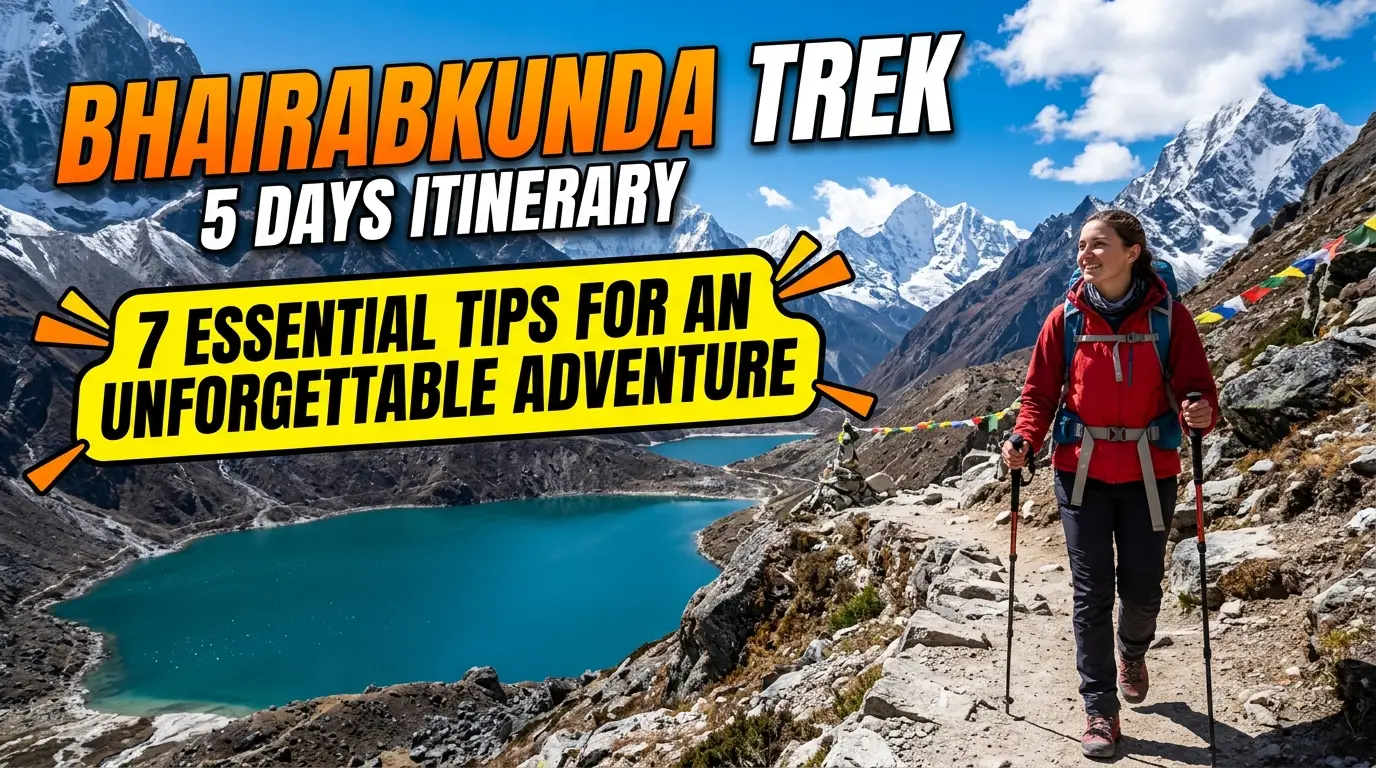
The Bhairabkunda trek is a short offbeat trekking route in Sindhupalchok district, northeast of Kathmandu, near the Nepal-Tibet border. It takes 4 to 5 days, reaches a sacred alpine lake at 4,250 metres, passes through Tamang villages and rhododendron forest, and sees almost no tourist traffic compared to the popular routes. If you’re looking for hidden treks in Nepal that actually deliver, this one’s it.
Where Exactly Is Bhairabkunda?
Sindhupalchok district, Bagmati Province. Northeast of Kathmandu, right up against the Tibetan border. That border proximity is part of why the upper section of the trek feels so different from the lush green lower valleys. The landscape shifts. Gets more stark and open. Almost Tibetan in character.
Trailhead is a village called Jalbire. About 85 to 94 kilometres from Kathmandu, depending on which road you take. Four hours in a private jeep, five or six by local bus. The lake sits at 4,250 metres above sea level, and that’s where you’re headed.
Why This Trek and Not One of the Famous Ones
I get this question a lot, actually.
And look, I love Langtang. Poon Hill at sunrise is genuinely beautiful. I’m not trying to talk anyone out of anything.
But here’s what nobody tells you about the really popular Nepal treks. By peak season, they’re packed. Like, properly packed. Poon Hill viewpoint on a clear October morning has elbow room roughly equivalent to a rush hour train. Everybody’s there. Everybody’s got the same camera angle. There’s a guy somewhere behind you with a Bluetooth speaker, and he’s not going to turn it down.
Bhairabkunda isn’t that. We walked for half a day once without seeing another trekker. The villages we passed through were actual villages, not tourism operations wearing the costume of a village. And when we got to the lake, there were maybe six other people there, all of them Nepali pilgrims who’d climbed up to pray.
That’s the other thing that makes this trek special. The lake isn’t just a pretty alpine lake; it’s a sacred site. Named after Bhairav, the fierce form of Lord Shiva. Pilgrims have been making this climb for centuries, and every August during the full moon, thousands of them come up to bathe in the water. If your timing lines up with that festival, what you witness there isn’t really a trekking experience anymore. It’s something harder to categorise.
Mountain views from the lake include Dorje Lakpa at 6,966 metres, Langtang Lirung at 7,227 metres, and the whole Jugal Himal range. On a clear morning, you can see deep into Tibet. Wildlife in the forests below includes red pandas and Himalayan black bears. Snow leopards have been spotted up high, though I personally haven’t seen one, and I’m not going to pretend otherwise.
The trek just delivers more than it promises. That’s genuinely rare.
Day by Day: Bhairabkunda Trek Itinerary
Quick note before we get into this. Bhairabkunda is a camping trek. No teahouses. No dorm beds. Your company brings the tents and a cook, or you bring your own gear. I know some people hear “camping” and immediately look for an alternative, but trust me on this one, the camping is actually part of what makes the experience.
Day 1: Drive to Jalbire, Trek to Chanaute (1,350 m)
Leave Kathmandu after breakfast. Araniko Highway heads northeast past Dhulikhel and down through the Bhotekoshi gorge, which is stunning even from the road, honestly. Jalbire is where the walking starts. The first day is easy, four to five hours, through Tamang villages and past a waterfall before reaching Chanaute. Good intro day. Sleep early.
Day 2: Chanaute to Khani Gaon (2,000 m)
Steeper today. The path climbs through terraced farmland, then into oak forest as you start gaining proper altitude. Khani Gaon is a Newari village at 2,000 metres with mountain views that kind of catch you off guard for the elevation. Six to seven hours of walking. Honest day on the legs.
Day 3: Khani Gaon to Forest Camp (3,150 m)
This is where the whole character of the trek changes. You’re into thick rhododendron and pine forest now, and in spring, the hillsides are just covered in red and pink blooms. Hard to describe properly, one of those things a photo doesn’t fully hold. Temperature drops noticeably. Wildlife gets more active. Forest Camp at 3,150 metres is a clearing in the trees, and it gets cold at night, properly cold, and lying there in a sleeping bag with the forest completely quiet around you is the kind of thing you came to Nepal for, whether you knew it or not.
Day 4: Forest Camp to Bhairabkunda Lake (4,250 m)
The day the whole trek is about.
Trail climbs past Pati with wide open Tibetan plateau views, then makes a steep final push to the lake. And then it just appears. No big dramatic moment. Dark still water sitting in a granite bowl, snow peaks rising up on every side, prayer flags at the edge, a small ancient Shiva temple by the shore.
You stop walking. You look at it. Don’t rush that part.
Camp at the lake. Get up before dawn the next morning for the sunrise over Jugal Himal. Do not skip this.
Day 5: Back to Kathmandu
Descend the same route to Jalbire, and drive back. Some itineraries split the return into two days, which your knees might prefer. Worth asking about when you book.
The Numbers: Distance, Duration, Altitude
The total trekking distance is roughly 40 to 50 kilometres round trip. Five days comfortable pace. Maximum altitude 4,250 metres at the lake. No glacier crossings, no technical terrain, no summit push. Just a proper mountain trek that earns its destination.
How Hard Is This Trek, Honestly?
Easy to moderate. That’s the real answer, not the one designed to sell you something.
No ropes, no crampons, no climbing. What makes it moderate rather than easy is the altitude gain on days three and four, and the fact that trail markings aren’t as clear as on the commercial routes. You can’t just follow the crowd here because there usually isn’t one.
For a beginner with decent walking fitness, this is absolutely doable. The things that matter above 3,500 metres are pace, water, and honesty with yourself. Walk slower than you think you need to. Drink more water than feels necessary. If you get a headache, don’t pretend it’ll go away. Those three things cover most altitude problems before they become serious.
When to Actually Go
Spring (March to May) That’s the best window, and I’ll stop hedging and just say it directly. Rhododendrons blooming, weather stable, mountain views clear, temperatures manageable during the day. If you can only go once, go in the spring.
Autumn (September to November) Equally good for the weather. Post-monsoon clarity is genuinely stunning, and the trails are dry. Slightly cooler than spring but excellent for trekking.
Monsoon (June to August) Rough. Leeches in the lower forest aren’t a minor inconvenience; they’re a real thing. Trails get slippery. The one exception is the August full moon pilgrimage at the lake, which some people think is worth the conditions. Each to their own on that one.
Winter Possible, but harsh. Minus 15°C at the lake overnight is not a bluff. Only experienced and properly equipped trekkers should attempt this in winter.
What Does Bhairabkunda Trek Cost
Real numbers. No ranges so wide they’re useless.
Local bus Kathmandu to Jalbire: NPR 500 to 700 per person
Private jeep hire: NPR 8,000 to 12,000 for the vehicle
Camping gear rental: NPR 500 to 1,500 per item per day
Food through camp cook package: NPR 800 to 1,500 per person per day
All-in cost (guided, 5 days): USD 300 to 600 per person, depending on group size
Getting to the Trailhead
Araniko Highway from Thamel northeast. Through Dhulikhel and the Bhotekoshi gorge to Jalbire, about 94 kilometres from the city. Local bus from Kathmandu main bus park leaves in the morning, takes five to six hours. Private jeep is four hours and considerably more comfortable on mountain roads. Most trekking companies include transport in the package price, worth confirming before you book.
Food and Accommodation on the Trail
No teahouses on this route past the first couple of villages. Camping is the arrangement. In Chanaute and Khani Gaon, there are basic homestay options if a tent really isn’t your thing. Higher than that are tents, sleeping bags, and camp kitchen cooking.
Food is simple and exactly right after a long day. Dal bhat, fried rice, noodle soup, eggs, and porridge. A good camp cook makes a bigger difference than most people expect. It’s worth asking your company directly who handles food before you commit.
Higher altitude than Poon Hill, a fraction of the crowds, and longer commitment than a day hike. That combination is genuinely hard to find on a short trek near Kathmandu.
Is it Worth It?
Yes. Clearly yes.
But worth being specific about who it’s for. If a hot shower and a real bed at the end of each day are a requirement, this isn’t your trek. Book Poon Hill and enjoy it, nothing wrong with that at all.
But if you want the kind of trekking experience that you’re still describing to people three years later, if you want a sacred lake near Tibet with almost nobody else there and mountain views that make everything back home feel temporarily irrelevant, then Bhairabkunda is exactly that thing.
People come back different from this one. Quieter. More settled. Hard to explain unless you’ve done it.
Go Before Everyone Else Finds It
Here’s the thing about places like Bhairabkunda.
They don’t stay hidden forever. Someone writes about them, a few photos get shared, a travel magazine picks it up, and then slowly the teahouses appear, and the signs go up, and the trail starts to look like everywhere else.
That hasn’t happened here yet. Right now, Bhairabkunda is still that thing, a trail that feels like a genuine find, a lake that feels genuinely sacred and genuinely remote, even though it’s four hours from the capital.
Go while that’s still true.
Green Horizon Tour runs guided Bhairabkunda treks with experienced local guides and a full camping setup. We know this trail properly. We’d like to take you there.
FAQs
How long is the Bhairabkunda trek? Five days standard, including transport from Kathmandu. Some people do it in three with private transport and a fast pace, though five days is the right way to experience it properly.
Is the Bhairabkunda trek difficult? Easy to moderate. No technical climbing. A beginner who walks regularly and takes altitude seriously can absolutely do this.
Do I need a guide for the Bhairabkunda trek? Yes, genuinely. Trail markings are inconsistent beyond the lower villages, and altitude above 3,500 metres isn’t where you want to be figuring out navigation for the first time.
What is Bhairabkunda Lake famous for? It’s one of Nepal’s most sacred Hindu pilgrimage sites, dedicated to Bhairav, the fierce form of Lord Shiva. Thousands of pilgrims climb to bathe in the lake each August during the full moon festival. It’s been a pilgrimage destination for centuries.
Can beginners do the Bhairabkunda trek? Yes. Prepare properly, get the right gear, hire a guide, and go at your own pace. Beginners do this trek regularly and come back glad they did.
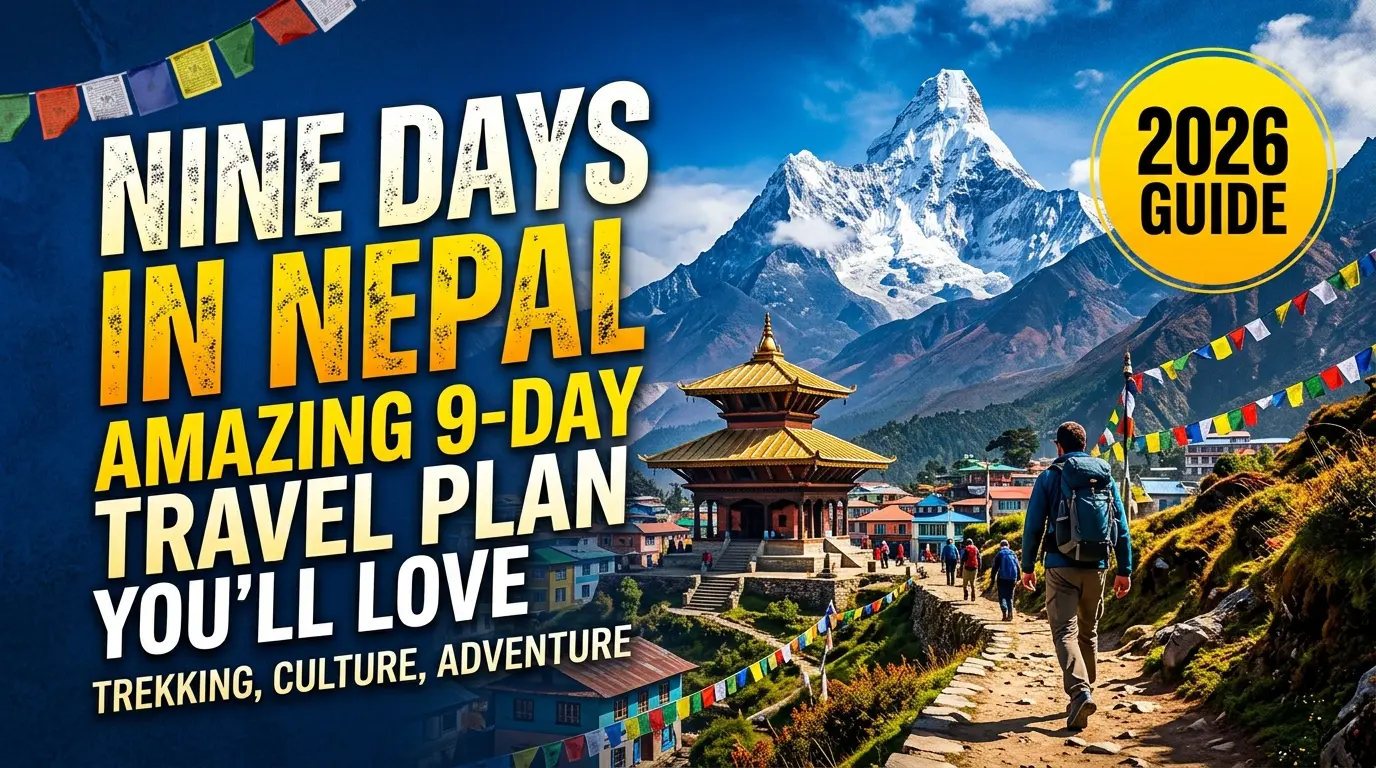
Spending nine days in Nepal is the perfect way to explore himalaya landscapes, ancient temples, and vibrant culture.
“Nepal doesn’t greet you softly. It hits you before you’re ready and somehow, that’s exactly right.”
There are trips you plan carefully and still feel unprepared for. Nepal is one of them. You read the guides, you pack the right layers, you know Kathmandu will be chaotic, and Pokhara will be calm, and Chitwan will involve early mornings in jeeps. And yet, when you land, when the airport doors slide open, and the smell of diesel and marigolds hits you at the same time, you realize the research didn’t quite capture it. Nothing does, really. That’s not a complaint. That’s the point.
This is a nine-day Nepal tour itinerary that covers the country’s cultural heartland, its wildlife lowlands, the birthplace of the Buddha, and the most dramatic mountain backdrop you’ll find outside of a screensaver. It’s the kind of trip that works because of how different each place is from the last and how, somehow, they all belong to the same country.
Day 1 — Arrival in Kathmandu
Airport arrival · Thamel walk · First impressions
The moment the airport doors slide open, Kathmandu announces itself. Diesel fumes, marigold garlands, and a man holding a sign with a name spelled slightly wrong. My driver, a quiet man named Ramesh who barely said ten words the entire ride, navigated through traffic that operated on some invisible logic, motorcycles threading between buses, horns used not in anger but as a kind of language. By the time we reached Thamel, I’d already started adjusting.
Thamel in the evening is its own creature. The narrow lanes glow with shopfront lights, prayer flags strung between buildings like some kind of permanent festival. I walked without much of a plan, ducked into a bakery that smelled of cinnamon and yak cheese, ordered a lemon ginger tea I didn’t really need, and sat watching the street. A group of trekkers compared boot sizes outside a gear shop. A dog, completely unbothered by everything, slept in the middle of the lane.
This is the thing about Thamel: it’s touristy, yes, undeniably so, but there’s a genuineness underneath it. People actually live here. Kids do homework in the back of shops. The tourism is layered on top of a real neighborhood, not the other way around. After the long flight, that distinction matters. You’re not stepping into a theme park. You’re stepping into a city that’s been going about its business for centuries.
Check in, drop the bags, walk until your feet say enough. That’s all Day 1 asks of you.
Kathmandu wakes up before sunrise, whether you want it to or not. Temple bells, street vendors, the low hum of the city unkinking itself after sleep. The next morning started early, partly because of the time difference, partly because lying in bed listening to that sound felt like the wrong choice.
Pashupatinath was the first stop, and nothing quite prepares you for it. This is one of Hinduism’s holiest sites, a sprawling complex on the banks of the Bagmati River, dedicated to Shiva, and very much alive with ritual. Sadhus in saffron robes sat for photographs near the main entrance, their faces painted in ash and ochre. Some were clearly performing for tourists, sure.
But move deeper into the complex, away from the main ghats, and you find something rawer. Cremation fires burn openly on the stone platforms by the river. Families gathered, priests chanted, and the smoke drifted upward. It’s confronting, especially if you’re not from a culture that treats death as a public, communal act. But it’s also oddly peaceful. I stood there longer than I expected to.
Boudhanath came next, and the contrast was immediate. Where Pashupatinath is dense and layered, and Hindu, Boudhanath is open, circular, and Buddhist. The stupa, one of the largest in the world, rises from the center of a wide plaza, its painted eyes looking out in all four directions. People circumambulate it clockwise, as they have for centuries: monks in maroon robes, elderly women spinning prayer wheels, tourists trying not to walk the wrong way.
I fell into the rhythm of it. Round and round. The smell of juniper incense was everywhere. I bought a small singing bowl from a shop on the outer ring. A woman demonstrated it patiently, showing me how to circle the rim slowly, waiting for the sound to build.
Swayambhunath, the Monkey Temple, required a climb. About 365 steps, and on a warm November morning, that’s enough to arrive breathless. But the view from the top is the payoff: Kathmandu spread out below in every direction, brown and green and hazy, the valley ringed by hills. The monkeys here are entirely at home. One snatched a plastic bag from a tourist near the base; another watched proceedings from a stone wall with the expression of someone who has seen it all. The stupa itself, prayer flags radiating from its pinnacle, is smaller than Boudhanath but older-feeling somehow. More worn. More intimate.
Kathmandu Durbar Square is closed on the day. The old royal palace complex is a UNESCO site, and you feel the weight of history walking through it, with pagoda rooftops layered like wedding cakes, stone carvings so detailed you stop to look twice. Some structures still show earthquake damage from 2015. Wooden beams are holding up walls, scaffolding around temple spires. The restoration is ongoing. It gives the place a living, unfinished quality that a fully preserved site might have lost. And honestly, that feels more honest than perfection.
Day 3 — Kathmandu to Chitwan
5–6 hrs drive · Jungle resort check-in · Tharu village walk · Cultural show
The drive to Chitwan takes five to six hours, depending on traffic out of Kathmandu and the state of the Prithvi Highway. Ours took closer to seven. There were roadworks somewhere after Mugling, a long standstill where I got out and bought tea from a woman with a thermos strapped to a cart. The tea was too sweet, milky, scalding, exactly right. Fields of mustard on either side. The mountains somewhere behind the haze.
Conversations with our guide, Bikash, about cricket and rice prices, and whether tourism would recover to pre-pandemic levels. He was cautiously optimistic. The road itself is simultaneously an engineering marvel and a white-knuckle experience cut into hillsides, occasionally single-lane, with trucks coming the other way with a confidence that feels either practiced or reckless.
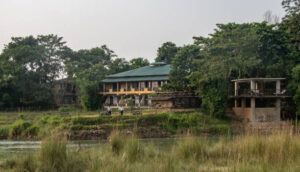
Chitwan arrives differently from how you expect. You cross the Rapti River and suddenly the landscape shifts: flatter, greener, the air heavier and more humid. The jungle presses in from the edges. Our resort was built close to the park boundary, a collection of low thatched cottages under sal trees, a firepit at the center of the compound. After the dust and density of Kathmandu, the quiet was almost disorienting.
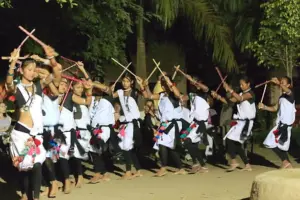
That evening, there was a Tharu cultural show, torches lit around an open courtyard. The Tharu are the indigenous people of the Terai lowlands, and they’ve lived alongside this jungle for centuries, long before there was a national park or any conservation infrastructure. The dance, especially the stick dance, in which performers moved in complex synchronized patterns, was something I stayed for longer than planned. It didn’t feel staged the way these things sometimes do. The kids watching from the edges were too genuinely entertained for it to be performative.
Day 4 — Chitwan Jungle Activities
Chitwan National Park · Jeep safari · Canoe ride · Jungle walk · Bird watching
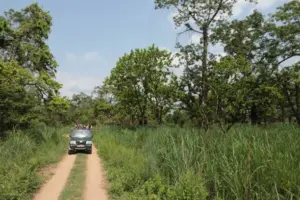
The jungle activities across this full day at Chitwan moved at a different pace than anything else in the itinerary. The jeep safari started before dawn, the vehicle threading through forest tracks while a naturalist named Dipen scanned the undergrowth with a quiet intensity. We saw rhinos, a mother and calf in tall grass, close enough to feel the scale of them. A deer frozen at a clearing’s edge. Dozens of birds, Dipen, were identified by sound before we ever saw them.
The park is home to Bengal tigers, though sightings are rare; we didn’t see one, and I’m not sure whether to call that luck or simply the way wild things are. What Chitwan gives you instead is patience, the kind you’d forgotten you had. You slow down. You look. You stop reaching for your phone every four minutes. That’s worth something.
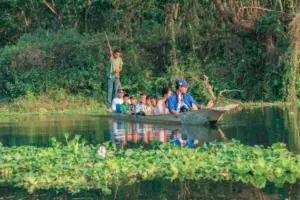
The canoe ride on the Rapti was quieter. A dugout boat, smooth water, egrets lifting off the far bank. A marsh mugger crocodile parked itself on a sandbar ten meters away and did absolutely nothing. An enormous, scaled, living thing, utterly indifferent to our presence. There’s something oddly calming about being ignored by a crocodile.
The jungle walk in the afternoon with another guide, walking single file, boots collecting mud. The sounds layered: insects, wind in the canopy, occasionally something moving in the brush you’d rather not think too hard about. I kept closer to the guide than was probably dignified. Bird watching wrapped up the day; Chitwan has over 500 recorded species, and even a casual observer leaves with a list longer than expected. The rhinoceros hornbill, when it finally flew across our sightline, was one of those moments you file away and return to later.
Day 5 — Chitwan to Lumbini
4–5 hrs drive · Arrival · Evening rest and local exploration
The road from Chitwan to Lumbini cuts southwest through the Terai. Flat agricultural land, sugarcane fields, brick factories. Less dramatic than the mountain highway, but with its own rhythm. We stopped for dal bhat at a roadside dhaba, a basic place with plastic chairs and a cooking fire visible through the doorway. Dal bhat is Nepal’s default meal, and there’s a reason for that: lentil soup, rice, vegetable curry, sometimes pickles, and a piece of papad, all served on a steel plate. The cook replenished the dal without being asked. This is the tradition of unlimited refills, because a working person needs to eat enough to work.
Lumbini was quiet in a way that surprised me. I didn’t expect that. I’d read that it was UNESCO-listed, significant, and a pilgrimage site for millions of Buddhists. I expected infrastructure, crowds, and noise. And there are some of those near the entrance of the buses for pilgrims, souvenir stands. But something settles over you as you get closer to the center. The air feels different. Maybe that’s projection. Maybe it’s real. Hard to say.
The evening was loose. A walk around the guesthouse neighborhood, a conversation with a monk from Sri Lanka who was staying two rooms down, a meal of vegetable curry and chapati eaten slowly on a rooftop. That’s all. Sometimes the drive days are recovery days, and that’s fine. Not every evening needs to be an event.
Day 6 — Lumbini Sightseeing, then Drive to Pokhara
The Sacred Garden, where the Maya Devi Temple stands at the site of the Buddha’s birth, has a stillness that the surroundings haven’t managed to disturb. The temple is built over excavated ruins that go back to the third century BCE. A Marker Stone, believed to pinpoint the exact birth spot, sits behind protective glass. You file past slowly. People touch the glass. Some people are crying quietly. It’s not performative. These are people for whom this place is the most significant ground on earth.
The Lumbini Garden, the broader complex surrounding the temple, was designed by a Japanese architect in the 1970s and contains monasteries and temples built by Buddhist communities from across the world. Thai, Sri Lankan, Korean, Chinese, Vietnamese, and Tibetan each one expressing its own architectural tradition on adjacent plots of land. It makes for a strange but moving walk. The World Peace Pagoda gleamed white against a grey sky. Monks swept temple steps.
I sat by the central canal for a while before leaving. Thought about what makes a place feel sacred. It’s not always the architecture, or the history, or even the belief. Sometimes it’s accumulated human attention. Millions of people have found this corner of flat Nepalese farmland important enough to cross continents for. That weight of meaning does something to the air. Or maybe it just does something to you.
The drive to Pokhara from Lumbini is six to seven hours, going through Butwal and then climbing back into the hill country. The road narrows and winds after Palpa. We passed a wedding procession somewhere outside Waling: a brass band, a horse, dozens of people in red and gold. The driver slowed to watch. Everyone in the car watched. Then the procession was behind us, and the road continued. Pokhara’s Lakeside district materialized after dark restaurant lights, the shimmer of the lake, and the sense of something larger waiting just beyond what you could currently see.
Day 7 — Pokhara Sightseeing
Sarangkot sunrise · Phewa Lake boating · Davis Falls · Gupteshwor Cave · World Peace Pagoda
Sarangkot meant a 4 AM wake-up. And honestly, 4 AM anywhere requires some private negotiation with yourself. The drive up to the viewpoint was in darkness, headlights on hairpin bends, other vehicles already heading up ahead of us. The summit was crowded by the time we arrived, dozens of people huddled in jackets, facing northeast, waiting. The Himalayas before sunrise are barely distinguishable from cloud. Then, slowly, the light changes. Pale pink first, then orange, then a hard gold that moves across the peaks from east to west. Annapurna South. Hiunchuli. Machapuchare is sharpening out of the dark like something being carved in real time.
A man beside me said something in Japanese to his friend. His friend photographed it continuously. I just looked. That’s when it hits you why people travel thousands of miles to stand in the cold at four in the morning. Not to photograph it. To be present at this particular light on this particular range, just once.
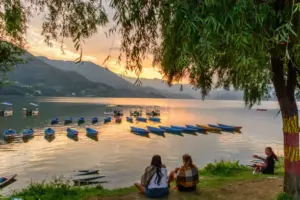
Phewa Lake by boat was the afternoon counterpart, gentle, slow, the water reflecting the mountains and the boats and the occasional cloud. We rowed to the Tal Barahi Temple, a small island shrine, and sat for a while. Vendors paddled out in small boats selling corn and roasted soybeans. I bought a bag of soybeans, and we stayed out longer than scheduled.
Devis Falls, where a stream plunges directly into a sinkhole with a force that’s genuinely startling for such a compact waterfall, is the kind of place you visit not because it’s grand but because it’s strange and specific. The roar of it fills the viewing platform. Across the road, Gupteshwor Mahadev Cave runs back into the hillside, a passage through limestone formations to a chamber where a Shivalinga sits permanently wet from underground water. The cave smells of incense and cold stone.
The World Peace Pagoda sat at the far end of a short hike, high on a ridge above the southern shore of the lake. The pagoda is perfectly white, Japanese-built, and the view from its base in the late afternoon, Phewa Lake below, the Annapurnas above, Pokhara’s rooftops in between, is the kind of visual that makes you understand why people return to a place repeatedly. This whole day is the best argument for spending at least three nights in Pokhara on any Nepal 9-day tour. Two isn’t quite enough.
Day 8 — Pokhara Back to Kathmandu
Flight or 6–7 hrs drive · Free time · Shopping
The return to Kathmandu. We flew, which takes thirty minutes and costs the better part of a full day’s driving. The flight path crosses foothills, and then there’s Kathmandu Valley below you, the brown expanse of the city ringed by green hills, and it looks impossibly large for a mountain valley. Landing back feels like closing a loop.
The free afternoon was spent in Thamel, revisiting the same lanes with the now-familiar comfort of someone who at least knows which alleys lead where. I bought gifts: small singing bowls, locally made paper notebooks, dried spices from a shop where the owner remembered me from the first day. I don’t know if he actually remembered or was being kind. In Nepal, the line between those two things is often deliberately blurred.
There’s a specific pleasure in returning to a place you know slightly. Thamel on Day 8 is not Thamel on Day 1. You walk it differently. You stop at different places. You notice the stray cat that lives behind the gear shop. You find the narrow bakery you’d walked past before and finally go in. The city hasn’t changed, but your relationship to it has, and that small shift is one of the things travel is actually for.
That evening, over dinner at a rooftop restaurant, dal bhat again, because why wouldn’t it be, I thought about what had accumulated over the past eight days. The cremation fires at Pashupatinath and the peaceful circumambulation at Boudha were held on the same day. The rhino in the tall grass and the dugout canoe on the river. The flatness of Lumbini’s sacred ground and the specific quality of silence that had settled over it. Sarangkot at sunrise, and the tired but satisfied feeling on the ride back down.
Day 9 — Departure
Final morning · Airport drop · The long goodbye
The departure was the usual slight chaos of early alarms and packed bags and a final cup of tea in a hotel lobby that was already busy with new arrivals checking in, their expressions still processing the airport doors sliding open, the diesel fumes, the marigolds. I recognized that look. It was mine, eight days ago.
Nepal is not a country that tries to explain itself to you. It doesn’t perform for visitors. It simply continues its rituals, its agriculture, its complex relationship with gods and mountains, and the inconveniences of modernization, and you are either paying attention or you aren’t. Nine days is enough to begin paying attention. It’s nowhere near enough to understand it. That gap between the two is, I think, precisely why people come back.
Ramesh drove me back to the airport. Still quiet. Still navigating through the same invisible logic of Kathmandu traffic. He asked if I’d enjoyed it. I said yes, which felt inadequate. He nodded, which felt like enough.
Who is Green Horizon Tours & Travels, and what destinations do you operate in?
Green Horizon started because a few of us who loved the mountains wanted to show people the right way. Not the rushed way, not the cookie-cutter way — the real way. We’re based in Nepal and have been running trips here for over 15 years. Nepal is our home base, but we also take people into Bhutan and Tibet, two places that need proper handling because of how their entry systems work. We know these regions well — not just the popular trails everyone goes on, but the lesser-known routes, the villages most tourists fly right past, the viewpoints nobody puts on Instagram yet. That local knowledge is honestly what sets us apart more than anything else.
Why trek with Green Horizon Tours & Travels?
Look, there are a lot of trekking companies in Nepal. We know that. But most of them are running the same routes, the same schedules, with guides who’ve memorized a script. That’s not what we do. We’ve been on these trails for over 15 years — not as outsiders looking in, but as locals who grew up here, who know the families running the teahouses, who’ve watched the mountains in every season. When you book with us, you’re not getting a tour package. You’re getting people who actually give a damn about your experience. That sounds like something every company says. The difference is we mean it, and our travelers come back year after year because they feel that.
How long has Green Horizon Tours been in business?
Fifteen years this year, and the truth is, it still feels like we’re learning something new every season. We started small — just a handful of people with a deep love for the Himalayas and a belief that travelers deserved better than generic itineraries. Word spread slowly at first, then faster. A lot of our clients today found us through someone who traveled with us three or four years ago. That kind of referral means more to us than any advertisement. We’ve seen a lot of changes in this industry over the years — the good and the bad — and through all of it, we’ve just tried to keep doing things the right way. Fifteen years in, that hasn’t changed.
How can I book a tour or trek with Green Horizon Tours & Travels?
Just reach out — seriously, that’s it. Drop us a message through the contact form on the website, send an email, or WhatsApp us directly. We try to reply within 24 hours, usually faster. From there, we just have a conversation. We’ll ask where you want to go, when you’re thinking of traveling, who’s coming with you, and what kind of experience you’re after. Some people come to us knowing exactly what they want. Others just have a rough feeling — “I want mountains, I want it to feel real” — and we help figure out the rest from there. Once we’ve put something together that feels right, we walk you through everything before anything gets confirmed. Spring and autumn fill up fast, so if you’re thinking about those seasons, earlier is always better.
What payment methods do you accept?
We work with bank transfers, credit and debit cards, and a couple of online payment options that are reliable for international travelers. When you confirm a booking, we ask for a deposit to lock everything in — that’s when we start securing your permits, accommodation, and guides. The remaining amount is settled before the trip kicks off. Every payment gets a proper receipt, no grey areas. If your circumstances make the standard setup tricky — maybe you’re booking months out and want to split things differently — just talk to us. We’ve worked with travelers from all over the world, and we’re flexible when there’s a genuine reason to be.
What types of tours and treks do you offer?
Trekking is what we’re known for and honestly what we love most — Everest Base Camp, Annapurna, Langtang, Manaslu, some really remote routes that don’t show up on the first page of Google. But we do a lot more than trekking. Luxury tours for people who want the Himalayan experience without sleeping in a sleeping bag. Family trips are built around what actually works when you’ve got kids in tow. Solo travel for people who want to explore without having to figure everything out alone. Cultural tours, wildlife trips into Chitwan or Bardia, pilgrimage routes, rafting, and paragliding over Pokhara. The range is pretty wide. And if something you’re imagining doesn’t fit neatly into any category, tell us anyway — we’ve put together some unusual trips over the years, and those are often the most memorable ones.
Do you provide airport pickup and drop-off services?
Yes, always. Arriving somewhere new after a long flight is already disorienting enough — the last thing you need is to be standing outside the airport trying to figure out transport. We have someone there to meet you, help with your bags, and get you to your hotel without any stress. Same on the way out — we make sure you’re dropped off with enough time, no matter what hour your flight leaves. It’s included in most of our packages as standard. If, for some reason, it’s not part of your specific booking, just ask, and we’ll sort it. Send us your flight details ahead of time and we’ll take care of the rest.
What are the physical difficulty levels of your treks?
We’re straight with people about this because there’s nothing worse than finding out halfway up a mountain that you’ve bitten off more than you can chew. Our easy treks work well for first-timers, families, older travelers, or anyone who wants to be in the mountains without pushing too hard — gentler terrain, shorter days, lower elevation. Moderate treks are for people who exercise regularly and are comfortable being on their feet for six or seven hours on uneven ground. And then there are the tough ones — Everest Base Camp, Three Passes, Manaslu — which genuinely require fitness, prior hiking experience, and a realistic mindset about hard days. If you’re unsure where you fall, just tell us a bit about your background, and we’ll be honest with you about what makes sense.
Can I customize my trek itinerary?
Yes, and half the trips we run these days are customized in some way. Some people want to go slower than the standard itinerary. Some want to add a side valley or a remote village that isn’t on the usual route. Families need shorter walking days. Solo travelers sometimes want something completely off the beaten track. We’ve had requests that started as “I don’t really know what I want, but I want it to feel different” and turned into some of the best trips we’ve ever put together. So yes — bring us your ideas, half-formed or fully formed, and we’ll build around them. That’s genuinely one of the parts of this job we enjoy most.
Do you provide guides and porters?
Both are included in our trekking packages, and both matter more than people realize before they actually get out there. Your guide isn’t just leading you along a path — they’re translating the culture, pointing out things you’d walk right past, making judgment calls when the weather turns, and genuinely looking out for you the whole way. Our guides are licensed, locally trained, English-speaking, and most of them have been with us for years. Porters take your main bag so you’re not grinding uphill under 15 kilos — trust us, that changes the whole experience. We pay our guides and porters properly, kit them out right, and make sure they’re insured. We’ve always felt strongly about that. These are the people who actually make the trip happen.
What safety measures do you have in place?
Safety isn’t a section in a brochure for us — it’s built into every decision we make when planning a trip. Our guides know how to spot altitude sickness early, before it gets serious, and they’re first-aid trained and experienced enough to act fast when needed. We never rush acclimatization days, even when clients feel fine and want to push on — that’s exactly when people get into trouble. We track weather conditions, stay in contact with ground teams, and always have a plan B for when things don’t go as expected. If a situation ever calls for pulling back or changing course, we do it. No hesitation. The summit or the destination isn’t worth more than your safety, and every guide on our team knows that.
What is included in the tour package?
Most of our packages cover the full picture — your guide, porter, accommodation throughout the trip, meals as laid out in the itinerary, all local ground transport, permit processing, and airport transfers. Some itineraries include welcome dinners, entrance fees, or cultural activities on top of that. Before you confirm anything, we send a detailed breakdown of exactly what’s in and what’s out. No vague language, no surprises once you’re on the road. If something isn’t included and you want it added, we tell you the cost upfront. We’ve been doing this long enough to know that hidden charges destroy trust, and trust is what our business actually runs on.
Are permits and trekking fees included?
For most of our packages, yes. The standard permits — TIMS card, national park fees, conservation area entry, restricted area permits where applicable — are all arranged by us and included in your cost. You won’t be queuing at a permit office or chasing down paperwork on your own. For Tibet and Bhutan specifically, the permits are more complex, and we handle those as part of the booking process. If your itinerary changes after you’ve confirmed and that affects permit costs, we’ll tell you straight away before anything extra gets charged. We’ve been burned by hidden fees ourselves as travelers — we’re not going to do that to the people who trust us.
What level of accommodation can I expect?
Depends on where you’re going and what you’ve booked. On the trekking trails, accommodation is teahouses — family-run places that are basic but genuinely warm and welcoming. A real bed, a hot meal, sometimes a wood stove in the dining room if it’s cold. It’s not luxury, but after a full day of walking, it’s exactly what you need, and there’s something about those evenings that stays with you. For city stays, we use clean, well-located hotels — mid-range as standard, with upgrades available depending on the package. Our luxury tours use proper high-end lodges and hotels, places we’ve personally stayed in and would recommend without hesitation. Whatever the level, we don’t book anywhere we haven’t vetted ourselves.
What happens if weather or altitude stops us from completing a trek?
It happens. Not on every trip, but it happens, and anyone who tells it to you who won’t is either inexperienced or not being straight with you. Mountain weather moves fast, and altitude hits people differently — fitness doesn’t protect you from it completely. When something comes up, your guide will sit down with you, explain the situation honestly, and walk through the options. Sometimes it’s an adjusted route. Sometimes it’s a rest day, and you push on the next morning. Sometimes the right call is coming down early. We build room for these situations into our itineraries because we’ve seen enough seasons to know you need it. If it ever reaches the point where evacuation is needed, we move immediately — we coordinate everything, and we stay with you until you’re safe.
Trekking in Nepal is safe, affordable, and honestly, one of the best decisions a European can make. Local guides, teahouse food, well-worn trails — first-timers from Europe finish Everest Base Camp and Annapurna Circuit every single season without any mountaineering background whatsoever.
Okay, so here is the thing nobody tells you.
You are going to spend weeks researching this trip. You will read fifteen blog posts, watch twelve YouTube videos, and join two Facebook groups where strangers argue about boot brands. And after all of that, you will still feel underprepared. That is completely normal, and it does not mean you should not go.
My friend Julia booked her Poon Hill trek with about four days of research and a borrowed rain jacket. She came back talking about it like it had rearranged something in her head. That was three years ago. She has been back twice since.
Nepal does that to people. It is not a place you visit and tick off a list. It is a place that gets into you a little bit and does not entirely leave.
Why Nepal Works So Well for Europeans
Partly the cost. Let us be upfront about that. A full two weeks in Nepal, including return flights from anywhere in Europe, a licensed guide, teahouse accommodation, meals on the trail, and permits — you are looking at somewhere between €1,600 and €2,750 total. Compare that to a week of guided Alpine trekking in Switzerland, which costs €2,500 before you have even sorted flights. Nepal simply makes financial sense, and that gets people on the plane.
But then they arrive and realise the money was never really the point.
Nepal is the kind of place that makes Europeans feel like they have been living in a very small room their whole lives, and someone just opened a window. The trails pass through living villages where people farm, worship, raise children, and grow old at altitudes that would give most Europeans a headache just thinking about. A monastery at 3,800 metres that has been there for five hundred years. A grandmother sitting outside her stone house, watching you walk past with mild curiosity. A porter carrying a refrigerator up a mountain on a bamboo frame and somehow overtaking you on a steep section.
That texture is what makes Nepal different. The mountains are almost secondary to it.
When to Actually Go
October. If you can only go once, go in October.
The monsoon clears out in late September, and what follows is several weeks of the most consistently good trekking weather you will find anywhere on earth. Skies so clear that on certain ridgelines you can count individual peaks across a panorama stretching three hundred kilometres. Temperatures are comfortable for walking during the day, cold but manageable at night. Experienced trekkers plan entire years around getting to Nepal in October. There is a reason for that.
November works too, though nights get cold fast at altitude, and higher routes see snow from mid-month onwards.
Spring, March through May, is the other good window. The rhododendron forests below 3,500 metres are in full bloom in April, and the trails through those sections turn colours that feel almost aggressive. Pink and red everywhere. A lot of European families pick spring because it fits school schedules better.
June through August is monsoon season. Rain every afternoon, slippery trails, and cloud blocking views for days. Skip it for your first trip without overthinking it.
The Treks Worth Knowing About
Ghorepani Poon Hill Trek
Four to five days. Maximum altitude 3,210 metres. Teahouses the entire way.
This is the one to start with, and not because it is a consolation prize. Poon Hill at sunrise is one of those travel experiences that people describe badly for years because describing it well turns out to be impossible. You walk up in the dark with a headlamp, you stand on a small hill in the cold with a cup of tea, and then the sun comes up behind Annapurna and Dhaulagiri, and everything goes quiet for a minute.
Do this trek first. Get comfortable with multi-day walking, teahouse food, and trail rhythm. Then plan the bigger one.
Annapurna Base Camp Trek
Nine to twelve days. Reaches 4,130 metres at the camp itself.
The trail climbs through rhododendron forest and Gurung villages before arriving at a glacial bowl ringed by enormous mountains on all sides. Annapurna I. Machapuchare. Hiunchuli. The scale of it takes genuine time to absorb. You arrive, and you just stand there for a while doing the maths on how big everything is.
Natural hot springs at Jhinu Danda on the way down. After ten days of walking, this information becomes very important very quickly.
Langtang Valley Trek
Seven to ten days. Three hours from Kathmandu by road. About 3,870 metres maximum.
Langtang is for people who want the real experience without the crowds that come with the Everest and Annapurna routes. Tibetan-influenced Tamang villages, yak pastures, a glacier lake, and a cheese cooperative near Kyanjin Gompa that has been making hard cheese at altitude since the 1950s. The cheese sells out regularly. Plan accordingly.
Everest Base Camp Trek
Sixteen days. 5,364 metres.
Not a climb. No technical sections, no ropes, no crampons required. It is a long walk at a very high altitude, and the altitude is the only real challenge. Hundreds of first-time European trekkers complete it every single autumn.
The ones who make it versus the ones who turn back sick — it is rarely about fitness. It is about whether they took their acclimatisation days seriously in Namche Bazaar and Dingboche. The people who rush because they are worried about time end up helicoptered down from Lobuche. The people who rest on rest days stand at the base camp.
Choose sixteen days. Not twelve. Not fourteen. Sixteen. The extra days cost almost nothing, and they are the difference between finishing and not finishing.
Do You Need a Guide
Yes. Since April 2023 it is also a legal requirement on major trekking routes in Nepal. Solo independent trekking is no longer permitted.
But forget the legal side for a second. A good local guide changes the trip in ways that are difficult to fully explain before you have experienced it. Teahouse bookings in October when every place fills up by early afternoon. Early recognition of altitude sickness symptoms before you notice them yourself. The cultural context that turns a walk past a monastery into an actual understanding of what you are looking at.
You can trek without a guide in the sense that the trail exists and you could probably follow it. But you would miss half the trip.
Porters are optional. They carry your main bag while you carry a light daypack. Costs around $20 to $25 per day. On paper it sounds like a soft choice. At 4,200 metres on day nine with tired legs it sounds like the smartest $20 you ever spent. Most people who hire a porter say they wished they had decided sooner.
What This Trip Actually Costs — Real Numbers
What You Are Paying For
What to Budget
Return flights from Europe
€500 to €800
Nepal visa on arrival, 30 days
around €45
Trek package with guide, meals, and accommodation
€900 to €1,600
Travel insurance with helicopter rescue cover
€80 to €150
Tips, personal spending, extras
€100 to €200
Total for a full trip
€1,600 to €2,750
The insurance line. Please take this seriously.
A helicopter evacuation from altitude in Nepal without coverage costs between $5,000 and $8,000 USD. That is a real number, not a worst-case scenario. It happens to several trekkers every season who either skipped insurance or bought a policy that did not specifically cover high altitude and helicopter rescue. Check the policy wording before buying. Make sure it says above 5,000 metres. Make sure it says helicopter evacuation. Do not assume.
Permits — Genuinely Simple
Two documents cover the most popular routes.
TIMS card. About $7. Safety registration so authorities know where you are on the trail in case something goes wrong.
Conservation area or national park permit. Between $22 and $34. Annapurna routes need the ACAP permit. Everest routes need the Sagarmatha National Park permit.
Both were processed digitally through Nepal’s e-TIMS system from 2026 onwards. Any licensed trekking company, including Green Horizon Tour, handles both automatically as part of a standard package. You do not queue at any government office.
Is Nepal Actually Safe
Yes. Straight answer.
Violent crime against tourists in Nepal is genuinely rare. The communities along trekking routes have built their entire livelihoods around treating visitors well for generations and that shows every single day on the trail.
The real risks are altitude and weather, not people.
Altitude sickness does not care about fitness levels. It hits marathon runners and people who have not exercised in years with equal indifference. Above 3,000 metres watch for persistent headache, nausea, dizziness. The response is always the same: stop ascending, rest, descend if no improvement within 24 hours. Your guide watches for this before you do. That is part of what you are paying for.
Mountain weather changes fast. A clear October morning can become cold and windy by early afternoon at elevation. Carry a warm layer every day. Regardless of the sky at breakfast.
What to Pack — The Practical List
Most gear can be rented cheaply in Thamel, Kathmandu’s main trekking neighbourhood. Down jackets, sleeping bags, trekking poles — all available for a fraction of buying new. Do not spend a fortune on gear before you arrive.
The one thing that must be yours and broken in before you land: hiking boots. Not new-from-the-shop broken in. Properly worn, walked in, your-feet-know-them broken in. Blisters at altitude end treks. This is not an exaggeration.
Everything else worth having: moisture-wicking base layers, a fleece mid-layer, down jacket for evenings above 3,000 metres, waterproof shell, warm hat and gloves, UV sunglasses, SPF 50 sunscreen, headlamp with spare batteries, enough hiking socks to rotate daily without washing every night.
Documents to print rather than just save on your phone: passport copy, insurance policy with emergency numbers on the front page, two passport photos for the visa on arrival at Kathmandu airport.
Culture — Four Things That Actually Matter
Shoes off before entering any temple, monastery or home. Every time without exception.
Walk clockwise around stupas and prayer wheels. Religious practice, not decoration. Locals notice when visitors do it correctly.
Namaste with both hands pressed together at chest height. Works everywhere, with everyone, at every altitude. Use it constantly. The response it generates from an elderly Sherpa woman on a mountain path at 4,000 metres is one of the quietly memorable moments of any Nepal trek.
Eat the dal bhat. Rice, lentil soup, vegetables, free refills. Costs almost nothing. Exactly what your body needs on long trekking days. Most trekkers say it becomes genuinely their favourite meal around day four or five. Not because there are no other options. Because it is actually that good after six hours of walking uphill.
Nepal vs the Alps — Side by Side
What Matters
Nepal
European Alps
Full trip cost
€1,600 to €2,750
€2,500 or more per week
Trail food and shelter
Teahouses every few hours
Mountain huts are more spread out
Cultural experience
High throughout the entire route
Low to moderate
Max altitude on beginner routes
5,364 metres
Around 4,000 to 4,800 metres
English spoken on the trail
Widely
Varies by country
Peak season crowds
Moderate
Very high
How to Plan It — Step by Step
Pick the trek that honestly fits your available time and current fitness. Poon Hill for five days. Annapurna Base Camp for twelve. EBC for sixteen. Choose the realistic one, not the impressive-sounding one.
Book flights targeting late September through early November arrival or mid-March through April for the spring season.
Buy travel insurance before anything else. Confirm the policy covers above 5,000 metres and helicopter evacuation. Get this confirmed in the policy document before purchasing.
Contact Green Horizon Tour to handle permits, guide booking, and teahouse reservations. Doing this yourself from Europe across multiple sources takes weeks and introduces unnecessary complications.
Build two to three days into the start of your trip in Kathmandu. The city is genuinely worth it, and your body needs adjustment time after a long-haul flight before you start climbing.
Pack three days before departure. Something will be missing. Three days give you time to actually fix it.
Mistakes That Derail First Trips
Not taking altitude seriously. This ends more Nepal treks than everything else combined. The people who ignore acclimatisation days because they are feeling fine in the moment are the same people who are not fine three days later at 4,800 metres. Your feeling fine today tells you nothing about tomorrow at altitude.
Choosing the short itinerary to save a few days. The extra days on an EBC trek cost almost nothing relative to flights from Europe. Skipping them and failing due to altitude sickness halfway costs you the entire trip.
Skipping the guide to cut costs. The guide is a small fraction of the total trip cost. What they provide has no substitute.
Overpacking. Your instinct is to bring everything that might be useful. Fight that instinct hard. Then fight it once more. Then pack.
Before You Close This Tab
Julia, my friend with the borrowed rain jacket — she described coming back from that first Poon Hill trek as feeling like she had been away for a year. Not because it was long. Because it was full. Every day had a beginning and an end, and something real that happened in between. No notifications. No half-finished to-do lists quietly stress her out at the edge of her attention. Just walking. Tea. Mountains. Sleep. Wake up and do it again.
She said she did not realise how much noise her regular life made until she was in a quiet enough place to hear the difference.
That is Nepal. And you do not need special skills or expensive equipment, or any prior experience to feel it. You need decent boots, a guide who knows these mountains, and a few weeks you are willing to hand over to something that will almost certainly surprise you.
Green Horizon Tour has been putting first-time European trekkers on Himalayan trails for years: licensed local guides, full packages, transparent pricing, no surprises.
Plan your trek at greenhorizontour.com — before you spend another year thinking about it.
Questions Europeans Always Ask
Is Nepal safe for first-time European trekkers?
Yes. Altitude and weather are the risks to manage, not crime. A licensed guide helps you handle both.
What does the whole trip cost from Europe?
Between €1,600 and €2,750 for a complete two-week trip with flights, guide, meals, accommodation and permits.
What is the easiest trek in Nepal?
Ghorepani Poon Hill. Four to five days, 3,210 metres maximum, teahouses throughout, and a sunrise that justifies the entire trip.
Do Europeans need a visa for Nepal?
Yes. Tourist visa on arrival at Kathmandu airport. Thirty days costs around $50 USD. Two passport photos required.
Can a total beginner do Everest Base Camp?
Yes. On a sixteen-day itinerary with proper acclimatisation days and a licensed guide. It is a long walk at altitude, not a technical climb. First-timers complete it every single season.
In 2026, Nepal witnessed a rare and powerful moment where spirituality and politics came together in perfect harmony. The auspicious celebration of Ram Navami, one of the most revered Hindu festivals, coincided with a historic political milestone—the oath-taking ceremony of the newly appointed Prime Minister and Council of Ministers.
What made this day even more remarkable was the political transformation behind it. The new government was formed after a strong wave of youth-led Gen Z protests demanding accountability, transparency, and change. This movement reshaped Nepal’s political landscape and led to a historic victory by the Rastriya Swatantra Party (RSP), which secured an overwhelming 182 seats.
This unique convergence turned Ram Navami 2026 into more than just a religious festival—it became a symbol of hope, renewal, and a bright new beginning for Nepal.
The Deep Spiritual Essence of Ram Navami
Ram Navami celebrates the birth of Lord Rama, the seventh incarnation of Lord Vishnu and the embodiment of righteousness (dharma), truth, and ideal leadership. His life, as narrated in the epic Ramayana, continues to guide millions in matters of morality, duty, and justice.
Observed on the ninth day (Navami) of the bright half of the Chaitra month in the Hindu calendar, Ram Navami holds immense importance in Nepal, a country where Hindu traditions are deeply woven into everyday life. Devotees fast, visit temples, chant prayers, and participate in religious gatherings to honor Lord Rama’s birth.
The values associated with Lord Rama—honesty, sacrifice, compassion, and leadership—are not only spiritual ideals but also principles that resonate strongly in governance and public life.
Celebrations Across Nepal
From the ancient temples of Kathmandu to the sacred plains of the Terai, Ram Navami is celebrated with immense devotion and grandeur.
In Janakpur, the spiritual capital associated with Sita, thousands of pilgrims gather to celebrate the festival. The Janaki Mandir becomes the focal point of festivities, adorned with lights and flowers, echoing with devotional songs and prayers.
Similarly, in Kathmandu, the historic Ram Mandir attracts devotees who come to offer prayers and seek blessings. The atmosphere is filled with bhajans (devotional songs), recitations of the Ramayana, and a sense of peace and unity.
Homes are cleaned and decorated, families gather for special meals, and communities organize cultural programs that reflect the richness of Nepalese traditions.
The Historic Oath Ceremony: A New Chapter in Governance
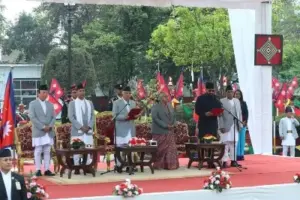
Alongside the spiritual celebrations, Nepal witnessed a major political turning point. The oath-taking ceremony of the Prime Minister and ministers marked the beginning of a new government formed after significant public demand for change.
The rise of this government is deeply connected to the Gen Z protest movement, where young citizens voiced their frustration with traditional politics and called for a new era of governance.
This public momentum led to the remarkable success of the Rastriya Swatantra Party (RSP), which won 182 seats, signaling a strong mandate for transformation.
The oath ceremony, conducted by the Office of the President of Nepal, symbolized not just a change in leadership but a shift in public expectations—toward transparency, accountability, and effective governance.
A Powerful Symbolism: Dharma Meets Democracy
The coincidence of Ram Navami and the oath ceremony created a powerful narrative—one where the ideals of dharma (righteousness) align with the responsibilities of governance.
Lord Rama is often regarded as the perfect king—“Maryada Purushottam”—who ruled with justice, compassion, and unwavering commitment to truth. His leadership style, often referred to as “Ram Rajya,” represents an ideal state where citizens live in harmony, justice prevails, and leaders act selflessly.
By taking the oath on this auspicious day, Nepal’s leaders symbolically connected themselves to these timeless values. It served as a reminder that leadership is not just about power, but about responsibility, ethics, and service.
For citizens, this alignment brought a renewed sense of optimism. It suggested that the new government could embody the virtues of Lord Rama—leading the nation toward stability, prosperity, and unity.
Public Sentiment: A Day of Hope and Pride
Across Nepal, people experienced a unique blend of spiritual fulfillment and civic pride. The streets were filled with festival celebrations, while homes and public spaces buzzed with discussions about the new government.
For many, this day represented:
A fresh start for the nation
A hopeful future under new leadership
A reaffirmation of cultural and spiritual identity
Social media platforms were flooded with messages celebrating both Ram Navami and the new government. Citizens expressed their aspirations for progress, good governance, and national unity.
The Role of Culture in Shaping National Identity
Nepal is a country where culture and politics often intersect in meaningful ways. Festivals like Ram Navami are not just religious observances—they are expressions of national identity and collective values.
The events of 2026 highlighted how cultural traditions can reinforce political moments, giving them deeper meaning and resonance. The oath ceremony, when viewed through the lens of Ram Navami, became more than a constitutional requirement—it became a moral commitment.
This fusion of culture and governance is what makes Nepal unique. It reflects a society where spiritual values continue to influence public life and decision-making.
Tourism Perspective: A Unique Opportunity
For the tourism industry, this rare convergence presented a powerful narrative. Nepal, already known for its spiritual heritage and natural beauty, showcased an inspiring story of unity and renewal.
Travelers visiting during this time experienced:
Vibrant festival celebrations
Sacred rituals and temple visits
A historic political moment
Destinations like Janakpur and Kathmandu offered a rich cultural experience, making Nepal an even more attractive destination for spiritual and cultural tourism.
For companies like Green Horizon Tours & Travels, this is an opportunity to promote Nepal not just as a trekking destination, but as a land of deep cultural significance and meaningful experiences.
Looking Ahead: A Bright Future
As the celebrations concluded and the new government began its journey, Nepal stood at the threshold of a new chapter. The events of Ram Navami 2026 left a lasting impression—a reminder that the nation’s strength lies in its values, traditions, and unity.
The alignment of a sacred festival with a significant political transition sent a clear message: the future of Nepal can be guided by the principles of righteousness, integrity, and service.
Conclusion
Ram Navami 2026 will forever be remembered as a day when spirituality and statecraft came together in perfect harmony. The birth anniversary of Lord Rama inspired millions, while the oath ceremony of the Prime Minister Balendra Shah and ministers marked the beginning of a new era in governance.
Together, these events created a powerful symbol of hope—a reminder that with strong values and dedicated leadership, Nepal’s future is indeed bright.
As the nation moves forward, this historic day will stand as a beacon of inspiration, encouraging both leaders and citizens to uphold the ideals of dharma and work collectively toward a prosperous and harmonious Nepal.
Luxury treks in Nepal are not simply about comfort in the mountains—they are about experiencing the Himalayas with depth, access, and clarity. These journeys combine world-class landscapes with refined logistics, allowing you to focus entirely on the scale, culture, and silence that define Nepal’s greatest trekking regions. It’s 5:47 a.m., and your fingers are already cold even through the liner gloves.
The lodge is still half dark, the kitchen fire is only just waking up, and someone across the hall is pulling on gaiters with that particular rustling sound that only happens at altitude. You step outside, mug of black tea in hand, steam curling away faster than you’d expect, and the mountains do something they never quite do in photographs. They don’t just appear. They arrive.
The sky above Namche Bazaar goes from deep navy to a bruised rose to something between amber and fire, and for about four minutes no longer, Ama Dablam holds the last of the shadow on its southwest face while everything around it blazes. Nobody says anything. There’s nothing worth saying.
That moment right there is Nepal. That specific, unrepeatable stillness at the edge of something enormous. And what more and more travelers are discovering, much to the slight annoyance of the old-school trekking purists, is that you don’t have to sleep on a foam mattress in a drafty teahouse to experience it.
The past decade has seen a quiet revolution in how Nepal receives its mountain visitors. A new category of traveler has emerged: people who want the raw emotional weight of high-altitude Himalayan landscapes but also expect a hot shower before dinner, a lodge that knows the difference between a Riesling and a Sauvignon Blanc, and a guide who has summited Everest twice and can explain Tibetan Buddhism with genuine depth. The infrastructure has responded.
From the heated stone lodges of the Khumbu to the ancient walled city of Lo Manthang in Upper Mustang, Nepal now offers a tier of trekking experience that sits comfortably alongside the great luxury outdoor journeys of the world. Patagonia, the Dolomites, the Canadian Rockies. The difference is that Nepal still has something the others don’t quite manage: genuine remoteness. A sense that the world you left behind isn’t just paused, it’s actually gone.
What Makes a Trek “Luxury”?
What makes a trek ‘luxury’ in this context? Not threadcount alone. It’s the combination of private or semi-private lodges with real beds and working heating systems, guides who are trained not just in mountain safety but in cultural and ecological depth, helicopter access for those who want to skip the lower approach valleys, porter and equipment ratios that mean you’re never carrying more than a daypack, and meals that actually fuel the body properly rather than the somewhat repetitive dal bhat only rotation that defines budget trekking.
It also means thoughtfulness, a guide who notices you’re struggling with altitude and quietly adjusts the day’s schedule, a lodge manager who brings you ginger honey tea without being asked, a route that is paced around experience rather than distance.
These seven treks are not the only luxury routes in Nepal, but they are the seven that, in terms of scenery, infrastructure, cultural depth, and sheer emotional return on investment, justify the price of the flight to Kathmandu. Each one is different in tone, terrain, and what it asks of you. Choose wisely
1. Everest Base Camp Luxury Trek
The One That Started It All
There is a particular arrogance to saying you’ve trekked to Everest Base Camp, and it’s entirely earned. Even on a luxury itinerary, which is really saying something. This route demands everything you have on certain days. The Khumbu is not a forgiving landscape. It is cold, steep, high, and uncompromising. But it is also one of the most visually and emotionally loaded corridors on earth, and the luxury operators who have set up here have understood that their job is not to make it easy. Their job is to make it worthy
The Journey
You fly into Lukla. That much is non-negotiable. The Tenzing-Hillary Airport is one of the world’s most discussed runways, a short strip perched on a ridge at 2,845 meters, with a drop at one end and a rockface at the other. The Twin Otter banks hard over the valley, the pilot drops the nose with a confidence that takes your breath, and then you’re on the ground, and porters are already materializing around you. It starts immediately.
The first two days along the Dudh Koshi river are deceivingly gentle. The trail winds through rhododendron forest in April, when the blooms are full, it looks genuinely unreal, deep crimson against the grey stone walls passing through Phakding and the swaying suspension bridges strung between cliff faces. Your guide will point out the sound of the river below, which changes register as you ascend, from a roar to a hiss to something almost gentle by Namche.
Namche Bazaar is where the Khumbu announces itself. The Saturday market still draws Tibetan salt traders on the old routes, and the town itself, terraced into a natural amphitheater above the river confluence, has become the de facto capital of Himalayan luxury. The Yeti Mountain Home here is the benchmark: rooms with valley-facing windows framed in stone and timber, underfloor heating, and a kitchen that produces yak cheese boards, Himalayan pasta, and apple crumble that would not embarrass a European mountain restaurant.
Above Namche, the trail climbs to Tengboche monastery, which is the most photographed in Nepal, with Ama Dablam rising directly behind it in that almost theatrical composition, and then continues through Dingboche, Lobuche, and Gorak Shep. The air gets thinner. Conversations get shorter. The landscape strips back to rock and ice and sky. On the final approach to Base Camp, you walk the lateral moraine of the Khumbu Glacier, looking down into a chaos of seracs and blue ice towers. It looks like the surface of another planet.
Base Camp itself, at 5,364 meters, is not beautiful in the conventional sense. It’s a boulder field, usually littered with expedition tents and prayer flags. But the view up the Khumbu Icefall, to the Western Cwm and the South Col beyond, stops every single person who gets there. Without exception. Because what you’re looking at is the route to the summit of the world, and the scale of it makes something shift inside you that you won’t quite be able to explain when you get home.
Luxury Elements
The Yeti Mountain Home group of lodges offers the gold standard along this route. Phakding, Namche, Tengboche, Dingboche, and Lobuche each have heated rooms, hot showers, Western-style beds, and menus that change based on altitude (lighter, more digestible food above 4,000m). The Everest View Hotel above Namche is another option, accessible by helicopter if the approach trails feel too slow.
Private helicopter transfers between Lukla and Kathmandu can be arranged for both arrival and departure, cutting the total logistics and giving you an unforgettable aerial perspective on the Khumbu as you leave. Many luxury operators also include a dedicated altitude doctor or high altitude trained paramedic on the team.
Highlights
Ama Dablam from Tengboche is possibly the most photogenic mountain on earth. The Hillary Monument at Namche. The Khumbu Glacier up close. Everest from Kala Patthar at dawn, when the summit pyramid catches the first light and everything below is still dark.
Difficulty & Duration
Strenuous. You will have hard days, especially above Dingboche. Fitness matters, but acclimatization matters more. A proper luxury itinerary builds in rest days at Namche and Dingboche. Don’t let anyone rush you through this. 14–16 days is the right length. Anything shorter compromises acclimatization.
Best Time to Visit
October and November are the classic post-monsoon window, during which skies are scrubbed clean, mountains are sharp as cut glass, and the Buddhist festival of Mani Rimdu at Tengboche in November, if timing allows. April is the pre-monsoon season, when the rhododendrons are in full bloom, and the light has a particular warmth. Avoid December through February unless cold-weather camping is your definition of luxury.
Insider Tip
Ask your guide to take you up to the Everest View Hotel above Namche, even if you’re not staying there. The terrace at sunrise, Everest, Lhotse, and Ama Dablam all visible at once, is worth the forty-minute detour. Order the sherpa stew. It’s better than anything on the menu.
2. Annapurna Base Camp Luxury Trek
The Sanctuary That Earns Its Name
Some treks feel like an approach to something, and then some treks feel like a destination from the very first step. Annapurna Base Camp is the latter. The route into the Annapurna Sanctuary is that ancient glacial bowl ringed by thirteen peaks over seven thousand meters, which is the closest thing I know to walking into the interior of a mountain range rather than along its edges.
The Journey
The trek typically starts from Nayapul, a dusty roadhead south of Pokhara, though luxury operators sometimes use a jeep transfer or short helicopter hop to Ghandruk to skip the lower approach entirely. Ghandruk is a beautiful Gurung village of stone and slate, rhododendron forests spreading above it, and the first clear views of Annapurna South and Hiunchuli already commanding the northern skyline.
The trail climbs through Chhomrong, arguably the last real village before the sanctuary, with an excellent lodge at the top of the ridge where you can sit on a terrace and watch the afternoon light move across Annapurna South’s west face and then descends into the gorge of the Modi Khola. The bamboo forests here are extraordinary. Tall, dense, filtering the light into something green and underwater, and you’ll hear the river below you before you see it for hours.
The Modi Khola gorge is where weather enters the equation. The canyon funnels cloud and rain up from the south, and the luxury lodges in Dovan and Himalaya Hotel have all learned to build fires early. This section can be wet, moody, and occasionally spectacular in a gothic sort of way, with mist threading through the bamboo, water pouring off the stone walls, and leeches in monsoon season that will find you no matter what you do.
And then the gorge opens. The Annapurna Sanctuary announces itself with a visual release that is one of trekking’s great moments as you step out of the narrow, forested canyon into a vast, open glacial amphitheater, 360 degrees of Himalayan peaks, the air thin and cold and startlingly clean. Annapurna I, the 10th-highest mountain on earth, fills the north. Machhapuchchhre, the sacred, never-climbed fish-tail peak, guards the entrance behind you. It is, depending on the time of day and how the clouds are playing, either overwhelming or serene. Usually both at once.
Luxury Elements
The Sanctuary Lodges operated by Pavilions Himalayas set the standard here, particularly the lodge at Annapurna Base Camp itself, which offers heated stone rooms, a spa using Himalayan herb treatments, and a dining room with panoramic windows facing the amphitheater. Gourmet trekking menus include locally sourced buckwheat, millet, and organic highland produce. The lodge at Chhomrong is worth an extra night. The terrace at sunset is genuinely one of Nepal’s finest dining views.
Helicopter return from base camp to Pokhara is available and increasingly popular as it saves two days and gives you an aerial perspective on the sanctuary that ground-level simply cannot offer.
Highlights
The 360-degree panorama at Annapurna Base Camp. The Gurung cultural villages of Ghandruk and Chomrong. The Modi Khola gorge in morning mist. Machhapuchchhre at any hour, but especially by moonlight.
Difficulty & Duration
Moderate to strenuous. The altitude doesn’t reach the extremes of the Khumbu, but ABC sits at 4,130 meters, and the ascent and descent involve significant daily elevation gain. 10–12 days allows for a proper pace and optional side excursions. Good cardiovascular fitness is needed but no technical experience.
Best Time to Visit
October through November and March through May. The spring trek comes with rhododendron forests in full bloom along the lower sections. The trail through Ghorepani in April can feel like walking through a botanical garden that happens to have Dhaulagiri in the background. October brings crystalline skies and warm afternoons.
Insider Tip
Spend an extra night at Annapurna Base Camp if the forecast allows. The dawn light on Annapurna I at 5:30 a.m., before the cloud builds, when the summit is catching the first gold and the glacier below you is still in deep blue shadow, is something you will carry for years. Most trekkers turn around the same day they arrive. Don’t be most trekkers.
3. Everest Panorama Luxury Trek
All the Drama, Half the Altitude
Not everyone has two weeks and a willingness to push through nights at 5,000 meters. But almost everyone wants to see Everest. The Everest Panorama Trek was designed for exactly this tension. It delivers Himalayan grandeur at a pace and altitude that most fit travelers can handle comfortably, without the acclimatization stress of the full Base Camp route.
The Journey
The route reaches Tengboche monastery as its high point, 3,867 meters, fully manageable with a reasonable itinerary, and the views from here of Everest, Lhotse, Nuptse, Ama Dablam, and Thamserku constitute one of the great mountain panoramas in the world. No hyperbole. The monastery courtyard in the late afternoon, with those peaks arranged behind it and the smell of juniper incense drifting from the main prayer hall, is a moment that stops conversation.
The approach follows the same trail as the full EBC trek through Namche Bazaar, so the luxury infrastructure is identical. The Yeti Mountain Home lodges, the Sherpa culture, and the Saturday markets. The difference is that you turn back at Tengboche rather than continuing up the valley, and this shorter turnaround means the itinerary can be genuinely generous rest days, cultural visits, and optional hikes to viewpoints like Khumjung and the Hillary School.
The hike to Khumjung village is underrated. The village itself is a home to a scalp claimed to be a Yeti’s, which sits on a plateau above Namche with open views west toward Kwangde and east toward Ama Dablam. The potato farmers here still work the same terraced fields they’ve worked for centuries, and on a clear afternoon, it’s possible to sit on a stone wall and watch yaks moving along the ridge with Everest visible above them, and feel that the modern world has, for a moment, genuinely receded.
Luxury Elements
Because the altitude ceiling is lower, some operators offer lodges that would be impractical higher up, including Namche’s more hotel-like properties with proper bathrooms, room service, and even a massage facility. The Panorama trek benefits from the Khumbu’s best luxury infrastructure without the physical cost of going higher. Helicopter options include Kathmandu to Lukla and Lukla to Kathmandu, keeping the journey entirely private.
Highlights
Tengboche monastery, the views, the incense, the morning puja ceremony, if your guide can arrange access. Namche Bazaar is a destination in its own right. The Everest View Hotel terrace. The Khumjung plateau. Ama Dablam’s southwest face catches alpenglow on the return.
Difficulty & Duration
Moderate. The maximum altitude of 3,867m is manageable for anyone with reasonable fitness and a proper acclimatization day at Namche. 8–10 days. This is the route for people who want a genuine Himalayan experience without extreme physical commitment.
Best Time to Visit
Same windows as EBC October–November and March–May. The lower altitude means slightly more tolerant weather in shoulder months; even late September and early December can be excellent on this route.
Insider Tip
Request a room facing east in Namche, any of them, any lodge. The sunrise view from those windows across the valley toward Thamserku and Ama Dablam is worth more than almost anything else on the trek. Get up at 5:30 a.m. and don’t move for twenty minutes.
4. Upper Mustang Luxury Trek
The Kingdom at the End of the World
Upper Mustang is where Nepal stops feeling like Nepal and starts feeling like something that predates the concept of countries entirely. The ancient Kingdom of Lo officially absorbed into Nepal in 2008 but still presided over by the last king, Jigme Dorje Palbar Bista, who continues to live in his palace at Lo Manthang which sits in a rain shadow north of the Annapurna massif, its landscape a bleached, wind-carved wilderness of ochre cliffs, carved gompa caves, and medieval walled cities that look like they were built for a different civilization entirely. Which, in a sense, they were.
The Journey
Upper Mustang requires a special Restricted Area Permit that costs $500 per person for the first ten days. This exclusivity is intentional and essential. It keeps this extraordinary corridor from being overwhelmed, and it means that even in peak season, you’re unlikely to encounter crowds on the trail.
The region was entirely closed to outsiders until 1992, and that relative isolation has preserved something that has vanished almost everywhere else in Himalayan Nepal: an intact Tibetan Buddhist culture in its medieval form.
The trek usually begins in Jomsom, reached by a short flight from Pokhara that crosses the Annapurna range at a low altitude. A flight that produces some of the best mountain photography you’ll get without a summit permit. From Jomsom, the trail follows the Kali Gandaki river north, through Kagbeni, where the restricted area begins, marked by a police checkpoint and an immediate change in atmosphere, and into the wind-blasted plateau beyond.
The Kali Gandaki is the world’s deepest river gorge measured between flanking peaks, and the wind that races up it in the afternoons is legendary. It pushes at your chest, forces your chin down, fills every fold of clothing with grit. By early afternoon on most days between Kagbeni and Chele, you’re walking slightly sideways. Your guide will think this is funny. By the fourth day, you will too.
But the landscape. The cliffs above Chele are striped in layers of red, ochre, yellow, and cream sedimentary geology compressed by the collision of continents, now exposed and eroded into forms that look deliberately artistic. The caves cut into these cliffs, hundreds of them, some at heights that require ladders to reach, and once used as monastic retreats or burial chambers, pepper the faces for kilometers. In the evening light, the whole plateau takes on a color that feels warm despite the cold, like a fire burning inside the rock.
Lo Manthang, the walled capital, arrives after several days of plateau walking like a hallucination. A medieval city of whitewashed walls and flat-roofed houses, four significant gompa, including the 600-year-old Jampa Lhakhang, and a palace that still has a king. The streets are narrow and made of packed earth, prayer wheels spin along every wall, and the sound of chanting drifts from behind monastery doors at unexpected hours. It is unlike anywhere else.
Luxury Elements
The Lomanthang Himalayan Resort near the walled city offers the best accommodation in the region with heated rooms, Tibetan-influenced interiors with carved woodwork and thangka paintings, and a kitchen that manages to produce excellent meals despite being at 3,840 meters and several days’ walk from the nearest road. The Mustang Holiday Inn inside the walled city itself is smaller but offers a more immersive historic stay.
Helicopter transfers from Pokhara directly to Lo Manthang are available. This cuts the approach trek but gives up some of the plateau journey, which is, honestly, part of the point. A suggested approach: fly in, walk out. Or engage a fully outfitted jeep-and-lodge circuit for those who want the terrain without the daily trekking mileage.
Highlights
Lo Manthang’s walled old city. The Tiji Festival in May, which goes for three days of masked Buddhist dance that draws the entire regional population and is one of the most extraordinary cultural events in Asia. The sky caves at Chhoser. The Kali Gandaki cliff formations. Sunset from any rooftop in the capital.
Difficulty & Duration
Moderate. The altitude is significant to Lo Manthang sits at 3,840 meters, with several passes above 4,000 meters, but the terrain is mostly plateau walking rather than steep ascent. 12–14 days for the full circuit. The special permit means this requires planning.
Best Time to Visit
May for the Tiji Festival, for which you need to plan a year, fills up. September and October for clear skies and post-monsoon freshness. The rain shadow means this region is actually trekable during monsoon (July–August), when everywhere else in Nepal is soggy, an unusual and genuinely impressive advantage.
Insider Tip
Hire a local Lopa guide in Lo Manthang in addition to your main trekking guide. The Lopa people are the indigenous inhabitants of the kingdom, and a local guide will open doors literally and figuratively that a Kathmandu-based guide simply cannot. The monasteries, the king’s palace visits, and the private family homes served butter tea. Access that turns a remarkable trek into an unforgettable cultural experience.
5. Annapurna Circuit Luxury Trek
The Grand One
Ask anyone who did the Annapurna Circuit twenty years ago about their experience, and they’ll get a particular look, nostalgic, proprietary, slightly melancholy. The old circuit, before the roads carved deep into its lower sections, was considered one of the world’s greatest long-distance walks: 21 days, full circumnavigation of the Annapurna massif, climaxing at the Thorong La Pass at 5,416 meters with views in every direction that defined the word ‘panoramic.’
The roads took something. They took the lower valley sections, the long approaches through rice paddies and subtropical forest. But what remains, and what luxury operators have been smart enough to focus on, is still exceptional. The upper circuit, the sections above where the road ends, the crossing at Thorong La, the entry into the Mustang rain shadow above Manang, and the medieval town of Muktinath on the descent: this is still among the finest mountain journeys available anywhere.
The Journey
A modern luxury circuit typically begins with a jeep or helicopter transfer to skip the lowest road-affected sections, joining the trail at Jagat or Dharapani in the Marsyangdi Valley. From here, the route climbs steadily through the Manang district, a region of high, open valleys, glacier lakes, and Buddhist villages with a culture distinct from the Sherpa communities of the Khumbu. The people here are Nyeshang traders, historically known for their cross-continental commerce, and the prosperity it once brought is visible in the carved wooden windows and multi-story gompa of Braga and Manang village.
Manang at 3,519 meters is the traditional acclimatization stop, and it earns its pause. The town has a wonderful small museum of local culture, a daily altitude lecture from Himalayan Rescue Association doctors that is genuinely useful rather than merely precautionary, and the hike up to Ice Lake above the village gives a day’s preparation for Thorong La while delivering one of the circuit’s finest peripheral views the entire Annapurna range from its northern side, Gangapurna’s glacier tumbling almost to the trail.
The Thorong La crossing itself is a physical event that leaves a mark. You start at 3 a.m. from Thorong Phedi or High Camp, headlamps in the dark, the cold settling into your bones despite every layer you’ve packed. The trail switches back for hours. Your lungs work harder than they’re designed to at sea level. And then the pass arrives, marked by prayer flags shredded by years of Himalayan wind, and you look back east across the Manang valley to the peaks beyond, and west down into the brown plateau of Upper Mustang, and there is a very particular elation that has nothing to do with fitness and everything to do with having earned something.
The descent to Muktinath, a Hindu and Buddhist pilgrimage site with eternal natural gas flames burning at the sacred springs, is steep and long. But Muktinath itself, with its 108 sacred fountains and the monastery that serves both faiths simultaneously, is one of Nepal’s most moving religious sites and a perfect emotional landing point after the cross.
Luxury Elements
The luxury Annapurna Circuit relies on a combination of high-end lodges and, where none exist, properly outfitted camping. The Kantipur Temple House in Kathmandu bookends both ends of the trek in style. Along the route, the Yak Hotel in Manang and the Bob Marley Guesthouse are not to be put off by the name; it has the best kitchen between Chame and Muktinath, which are upgraded by luxury operators with supplementary bedding and catering. Helicopter transfer over Thorong La is available for those who want the view from above rather than the crossing itself, though this misses the point somewhat.
Highlights
Thorong La at dawn. The Pisang monastery above the valley. Tilicho Lake is an optional but extraordinary side trip at 4,919 meters, one of the world’s highest lakes. The Annapurna north face from Manang. Muktinath’s 108 fountains and the eternal flame.
Difficulty & Duration
Strenuous, particularly the Thorong La crossing. A minimum of 14 days is needed for safe acclimatization; 16–18 is better for a comprehensive luxury itinerary that includes Tilicho Lake. High physical fitness and no significant cardiovascular conditions are required.
Best Time to Visit
October–November for the post-monsoon classic season. The Thorong La can close with snowfall in November; check conditions carefully. March–May is excellent and offers the spring blooms through the lower sections. The circuit is not recommended in monsoon or midwinter.
Insider Tip
Do not skip Pisang. Both Lower and Upper Pisang are beautiful villages, but Upper Pisang, which is above the main trail, requires an extra forty minutes of climbing, and it has an ancient monastery with a rooftop terrace facing directly across to the Annapurna range’s northern faces. Almost no trekkers make the detour. It is significantly more beautiful than anything on the main trail at that section.
6. Langtang Valley Luxury Trek
The Valley That Came Back
You can’t write about Langtang without acknowledging what happened there. On April 25, 2015, the earthquake that shook Nepal triggered a catastrophic ice-rock avalanche off the flanks of Langtang Lirung. It buried the village of Langtang almost completely. Over 200 people died in seconds. The entire trekking infrastructure of the valley was destroyed.
What has happened since is one of the more quietly remarkable stories in Himalayan tourism. The valley has been rebuilt not just physically, but spiritually. The Tamang people who have lived in Langtang for generations returned, rebuilt their lodges and homes, and replanted their fields. The glaciers didn’t move. The peaks didn’t change. And the trekking community that had loved Langtang came back too, because the valley had always offered something slightly different from the other great Himalayan corridors: intimacy.
The Journey
Langtang is the closest significant trekking region to Kathmandu, roughly six to eight hours by road to the trailhead at Syabrubesi, or a short helicopter transfer. This proximity makes it underrated. People assume that anything this close to the capital can’t be serious wilderness. They are wrong.
The trail follows the Langtang River into the valley through forests of rhododendron and oak that in spring are genuinely extraordinary thick undergrowth, moss-covered boulders, and the sound of the river climbing in register as you ascend. The tree line breaks gradually, the valley widens, and then the scale of what you’re inside becomes clear: Langtang Lirung (7,227m) on the north, Gang Chhenpo and Naya Kanga on the south, the valley floor at 3,400 meters carpeted in alpine meadow.
Kyanjin Gompa, the main settlement at the valley’s upper end, is small and raw in the best way. A gompa of genuine antiquity, a cheese factory producing yak cheese that is excellent eaten directly with the local wheat bread, and a surrounding landscape that invites extended exploration. The hike to Kyanjin Ri (4,773m) above the village takes three to four hours and delivers one of Nepal’s finest accessible viewpoints: the entire Langtang range, the Gangchenpo glacier, and, on clear days, the Tibetan plateau visible beyond the northern ridge.
Luxury Elements
The Langtang Valley Lodge near Kyanjin Gompa is the flagship accommodation, which was rebuilt post-earthquake with better materials than before. It offers heated rooms, a proper dining room, and yak cheese and dairy products that come directly from the lodge’s own animals. The intimacy of the valley means luxury here is more about personalized guiding and cultural access than five-star facilities. A good operator will include a Tamang cultural guide and arrange visits to the gompa and the community reconstruction projects that are genuinely worth understanding.
Highlights
Kyanjin Ri at sunrise, the Langtang Lirung north face in alpenglow is one of the most underappreciated mountain views in Nepal. The yak cheese at Kyanjin. The Tamang Heritage Trail is an optional extension. The rebuilt Langtang village, walking through it, is emotionally weighted in a way that demands respect and attention.
Difficulty & Duration
Moderate. Maximum altitude around 4,773m on the Kyanjin Ri optional hike; the main valley trail stays around 3,400-3,800m. 8–10 days. Good for trekkers with limited time who want serious mountains without the logistical weight of the Khumbu or Annapurna routes.
Best Time to Visit
March–May for rhododendron blooms and warming temperatures. October–November for clear autumn skies. The valley is accessible year-round except in heavy snowfall periods of January and February.
Insider Tip
Buy yak cheese from the local cooperative at Kyanjin, not from the lodge shop. The cooperative distributes income directly to families affected by the 2015 earthquake and is rebuilding the local economy. The cheese is also better. Bring extra rupees and buy more than you think you need; it travels surprisingly well wrapped in cotton and wax cloth, and the hard-aged variety is outstanding.
7. Gokyo Lakes Luxury Trek
The Route That Quietly Wins
Ask a trekking guide who has done both routes which is more beautiful: Everest Base Camp or Gokyo Lakes. Nine times out of ten, they’ll pause, look away, and say Gokyo with a slight air of someone sharing a secret they’re not entirely sure they should be sharing.
The Gokyo Valley is the Khumbu’s quieter twin. Same entry point, same Sherpa culture, same extraordinary altitude infrastructure, but the trail diverges at Namche and climbs the western flank of the valley rather than the eastern, past a chain of glacier-fed lakes that sit between the peaks in colors that don’t seem possible for water at that altitude: deep turquoise, clear green, cold blue. The fifth lake, Ngozumpa Tso, is the largest glacier lake in the Himalayas.
The Journey
The route to Gokyo follows the Dudh Koshi valley from Lukla and then climbs alongside the Ngozumpa Glacier, the longest glacier in Nepal. Through a series of lakes that mark altitude gains. The first lake, Longponga, appears at 4,690 meters almost without warning. A still sheet of color between the moraine ridges, Cholatse reflected in the surface on calm mornings. Each subsequent lake reveals a longer view up the glacier toward Cho Oyu (8,201m, the sixth-highest mountain on earth), which fills the northern horizon with a mass of ice and rock that makes you instinctively stop walking.
Gokyo village sits beside the third lake at 4,790 meters. Small, clean, and cold at night, the stone lodges reflect in the water when the wind drops. The hike to Gokyo Ri above the village, a 1.5-3 hour climb to 5,357 meters, is the route’s signature moment. From the summit, you can see: Everest, Lhotse, Makalu, and Cho Oyu, four of the world’s six highest mountains simultaneously visible. It is, in terms of raw concentration of altitude, the finest viewpoint accessible without technical climbing equipment anywhere on earth.
The glacier walk is unusual even by Himalayan standards. Descending onto the Ngozumpa Glacier and walking across its ablation zone. A landscape of ice towers, frozen pools, and rock-studded ridges that shifts slowly south under its own weight is a reminder that you are in a landscape that is moving, changing, responding to forces that operate on geological time. The scale makes human concerns briefly absurd.
Luxury Elements
The Gokyo Resort near the third lake is the finest lodge in the valley faciliated with solar-heated rooms, expedition-grade sleeping bags in every room, a kitchen that serves excellent soup and pasta at altitude, and a terrace directly facing Cho Oyu across the lake surface. The Cho La Pass connection to the EBC route is possible for an ambitious combined itinerary, with luxury operators managing the logistics of the pass crossing and overnight at Dzongla.
Helicopter access from Lukla to Gokyo is available for those who want to enter the valley directly, and the aerial approach across the Ngozumpa Glacier provides one of the most dramatic flight approaches outside of the Alaska Range.
Highlights
Four 8,000m peaks are visible from Gokyo Ri. The fifth lake is Ngozumpa Tso, and its extraordinary color. Walking on the Ngozumpa Glacier. The reflection of Cholatse in the first lake at dawn. Gokyo village in early morning silence.
Difficulty & Duration
Strenuous. The altitude at Gokyo Ri (5,357m) is significant, and the glacier approaches require careful footing and proper guiding. 12–14 days for the standard Gokyo route; 16–18 days for the combined Gokyo-Cho La-EBC circuit.
Best Time to Visit
October–November and April–May. The same windows as EBC, but the Gokyo lakes are particularly extraordinary in October when the monsoon has just cleared. The water is at its most vivid, the snow fresh on the surrounding peaks, and the air has that particular post-rain clarity that makes the mountains look close enough to touch.
Insider Tip
On the morning of the Gokyo Ri climb, leave the lodge no later than 4:30 a.m. to be at the summit at first light. The pre-dawn climb in the headlamp is cold and steep and worth every step. The four-peak panorama in alpenglow. Everest catches the first gold while Cho Oyu is still in shadow, which lasts perhaps eight minutes before the day flattens the drama. Be there for those eight minutes.
How Do They Compare?
Choosing between these seven routes is not simply a matter of picking the most famous or the most dramatic. Each has a different personality, a different emotional register, and serves a different kind of traveler. Here is how they stack up across the key dimensions:
Trek
Difficulty
Luxury Level
Scenery
Crowd Level
Duration
Everest Base Camp
Strenuous
★★★★★
Alpine/Glacial
High
14–16 days
Annapurna Base Camp
Moderate
★★★★☆
Diverse/Lush
Moderate
10–12 days
Everest Panorama
Moderate
★★★★★
Himalayan peaks
Low–Med
8–10 days
Upper Mustang
Moderate
★★★★☆
Desert/Cultural
Very Low
12–14 days
Annapurna Circuit
Strenuous
★★★★☆
360° Himalayan
Moderate
14–18 days
Langtang Valley
Moderate
★★★☆☆
Glacial/Cultural
Low
8–10 days
Gokyo Lakes
Strenuous
★★★★★
Lakes/Glaciers
Moderate
12–14 days
The Everest routes, Base Camp, Panorama, and Gokyo share the same extraordinary cultural infrastructure of the Khumbu and the same signature Sherpa hospitality. The choice between them is really a question of ambition and available time. Upper Mustang stands entirely apart in cultural terms: it is the only route here where the primary draw is civilization rather than wilderness, and it requires the most advanced logistical planning. The Annapurna routes are the most geographically diverse of the Circuit, especially, and offer the best combination of cultural variety and mountain scenery per kilometer. Langtang is the choice for travelers who want genuine mountains, limited crowds, and a historical and human context that adds moral weight to the experience.
The Practical Guide
Permits Required
• Annapurna Conservation Area Permit (ACAP): Required for all Annapurna routes • Sagarmatha National Park Permit: Required for all Everest/Khumbu routes • Langtang National Park Permit: Required for Langtang Valley • Upper Mustang Restricted Area Permit: USD $500 for 10 days, must be arranged through a registered operator • TIMS Card: Required for most trekking routes in Nepal
All permits must be arranged through a registered Nepalese trekking operator, as individual permits cannot be obtained by foreign nationals walking in unguided. This requirement, frankly, protects the experience: unguided trekking in these regions carries genuine risks that experienced local guides mitigate consistently.
What to Pack (Luxury Edition)
Luxury trekking does not mean light packing. You will be operating at high altitude in variable weather, and the consequences of being under-equipped are real regardless of what lodge you sleep in. That said, the packing list for a luxury trek differs from a budget trek in emphasis rather than content:
• Down jacket rated to −15°C minimum. The lodges are warm, but the trails before sunrise are not • Merino wool base layers (2–3 sets) wool manages moisture and odor at altitude better than synthetics • Softshell trousers for trail use; waterproof hardshell for pass crossings and weather • Trekking poles, which are non-negotiable for knee health on long descents, regardless of fitness level • Altitude medication: acetazolamide (Diamox), discuss with your doctor, not an optional luxury • Electrolyte tablets and oral rehydration salts because dehydration at altitude is insidious and common • A compact satellite communicator if traveling with a smaller group • High-quality trekking boots, broken in, not new from the gear shop in Thamel • Camera equipment: the light in Nepal, particularly in October, is extraordinary. A quality mirrorless body and a 24–70mm equivalent lens will serve most situations • Cashmere or fine merino light layer for lodge evenings, dinner at a luxury Himalayan lodge deserves better than a fleece
Altitude and Safety
Altitude sickness is the single most important safety consideration on every trek in this guide above 3,000 meters. Acute Mountain Sickness (AMS) can affect anyone regardless of fitness level, age, or previous high-altitude experience. The standard rule ascends no more than 300–500 meters per day above 3,000m, with a rest day every third day, exists for physiological reasons that luxury will not override.
Symptoms of AMS include headache, nausea, fatigue, dizziness, and disturbed sleep. Symptoms of High-Altitude Pulmonary Edema (HAPE) and High-Altitude Cerebral Edema (HACE), the serious forms, include confusion, inability to walk a straight line, and a wet cough at altitude. The treatment for serious altitude illness is always the same: descend immediately. No view is worth a medical emergency.
Every reputable luxury operator will carry a pulse oximeter and supplemental oxygen, have a high-altitude-trained guide or medic on the team, and carry a Gamow bag on routes above 4,500 meters. Verify this before booking. Helicopter evacuation insurance is not optional. Ensure your policy specifically covers high-altitude helicopter evacuation in Nepal, which standard travel insurance often does not. World Nomads, Ripcord, and Global Rescue all offer appropriate coverage.
The Mountains Don’t Care About Your Budget
I’ve been back from the Gokyo Lakes for three weeks now. I’m still waking up in the early hours with a specific image: the fifth lake’s surface at 5 a.m., the color a shade between slate and green, the reflection of Cho Oyu perfectly still until a wind comes down the glacier and breaks it into a thousand moving pieces. I had a private room in a lodge that knew how to cook. I had a guide who had been to the top of Everest. I had hot water and good boots, and a sleeping bag that worked.
None of that is why I remember the lake.
I remember it because of what it is, because of what it means to stand at nearly 5,000 meters of altitude, surrounded by the highest mountains on earth, breathing air that feels borrowed rather than owned, and understanding for a brief, clear moment that the planet is operating on a scale that has nothing to do with anything you’ve ever worried about. The luxury made it possible to be present enough to receive that. It removed the distractions of discomfort, the anxiety of logistics, and the noise of managing the basics.
Nepal’s great paradox is that it is simultaneously one of the world’s poorest countries and one of its most extraordinary destinations. The mountains are not status symbols. The trails are not amenities. The culture is not a backdrop. The luxury operators who understand this and who build their experiences around access and depth rather than just comfort are doing something worth supporting.
Go in October, when the post-monsoon sky is a blue that doesn’t exist at lower altitudes. Go in April, when the rhododendrons make the approach forests look like they’re on fire. Go to Gokyo and stand on the Ri at dawn. Go to Lo Manthang and eat in a 600-year-old building. Go to Annapurna Base Camp and wake up to a circle of Himalayan giants.
Go, in short, because Nepal is one of the few places left where the ground itself demands that you pay attention. And the best luxury is always, in the end, just that: the attention you’re finally free to give.
Nobody puts Khumjung on their must-see list. And I get why — when you’re already doing the Everest Base Camp trek, your brain is full of checkpoints. Lukla. Namche. Tengboche. EBC. That’s the script. Khumjung isn’t in the script.
But here’s the thing. I almost didn’t go. My feet hurt, I had a headache that came and went all morning, and my rest day in Namche was supposed to involve horizontal time and possibly a second breakfast. My guide asked me the night before, real casual, barely even looking up from his dal bhat. “Tomorrow we go to Khumjung, yes?” I said yes. I don’t know why. Tired brain, I guess.
Best tired-brain decision I ever made.
Khumjung sits at 3,790 meters in Nepal’s Solukhumbu District, tucked in a wide valley just above Namche Bazaar, inside Sagarmatha National Park. About 3 km from Namche, 350 meters of climbing, 1.5 to 2 hours depending on how your body’s handling the altitude that day. It’s got an old monastery with what the monks genuinely believe is a Yeti scalp. It’s got a school Edmund Hillary built in 1961. It’s got Ama Dablam sitting right there in your face like it’s showing off. And it has almost no tourists in it, which, after several days on the main EBC trail, feels like finding a quiet room at a loud party.
Where Is Khumjung Village?
Northwest of Namche. You walk up past the Hillary Viewpoint and the Sherpa Museum, crest a ridge, and the valley just opens up below you. Stone houses. Potato fields. Khumbila is watching over the whole thing from the north at 5,761 meters.
The Sherpas have never climbed Khumbila. I want to sit with that for a second. People who have summited Everest hundreds of times, who know these mountains better than anyone alive, leave their own sacred peak completely alone. They consider it home to a protector deity and believe climbing it would bring harm to the whole region. That one fact changed how I thought about the entire village before I even arrived.
The Altitude — What Your Body Will Actually Feel
3,790 meters is nothing. If you had any symptoms in Namche — dull headache, weird sleep, general heaviness — stay put and let yourself properly adjust before adding another 350 meters. The village will still be there. Your lungs won’t forgive you for rushing.
I was fine going up, but I had done two full nights in Namche and walked slowly and drank water constantly like it was my job. Pasang made me stop three times on the climb for no reason other than to just stand there. I was impatient both times. He was right every time.
The valley is wide open, so wind finds you. I had my fleece at the bottom of my bag because the morning was warm. Spent the afternoon regretting that deeply.
Spring, March to May. Autumn, September to November. Those are your windows, and they’re your windows for good reason. October especially — the post-monsoon air makes the mountains look almost digital, too sharp and clear to be real. April gives you rhododendrons blooming red and pink all the way up the trail. Winter is cold and empty and beautiful if you’re properly geared. Monsoon is cloud and mud, and I wouldn’t choose it, but some people do, and some of them even enjoy it, apparently.
Why Khumjung Feels Completely Different From the Rest of the Trail
Here’s my problem with the main EBC trail, and I say this as someone who loves it — after enough days, it starts to feel managed. Same menus. Same clusters of international trekkers at the same teahouses in the same order. You start to feel like you’re being moved somewhere rather than going somewhere.
Khumjung doesn’t have that. Families grow potatoes and buckwheat because that’s what you grow there, not for any tourist reason. Kids walk to school in the morning, actual school, with bags and everything. Near the monastery, there was an older woman who crossed my path three times while I was wandering around. Spinning a prayer wheel each time. Looked in my direction zero times across all three encounters. Not unfriendly. Just genuinely not fussed about the foreigner with the camera. After days of being someone’s customer, that kind of non-attention felt like exhaling.
Things to Do in Khumjung Village
The Monastery and the Yeti Scalp
The Khumjung Gompa is about 400 years old, and it smells like it — butter lamps, incense, cold stone, something else underneath that I have no word for. It’s not restored or polished. The murals are worn in places. The whole building has the weight of a place people have actually been using for centuries, rather than preserving for visitors.
In the main prayer hall, there’s a locked glass cabinet. Inside is a dome-shaped scalp, dark brownish, covered in rough, coarse hair, roughly 20 centimeters tall. The monks say it’s from a Yeti. They’ve been saying that since before most nations existed.
In 1960, Edmund Hillary negotiated to borrow it. He donated money to the monastery and school as part of the arrangement, then took it on a world tour with a monk named Konchok Chumbi as its guardian. Scientists in Japan, the US, and the UK examined it. The general conclusion was that it was probably made from the skin of a serow, a Himalayan goat-antelope. Hillary accepted that explanation publicly.
Then someone asked Konchok Chumbi, the monk who had just spent months traveling the world with this thing, what he made of the scientists’ conclusion. He said, “We don’t believe in giraffes or lions in Nepal because there aren’t any here. Likewise, you do not believe in Yetis because you have none in your country.”
I think about that answer more than I probably should.
The scalp went back to Khumjung. It’s still in the cabinet. You pay a small donation, and a monk opens it. I stood there longer than felt reasonable. Serow hide or not, the room, the history, and that unanswered edge around the whole thing make it genuinely strange in a way I wasn’t expecting.
Hillary School
When Hillary came back from Everest and asked the Sherpa community what they needed, he expected them to say climbing equipment. Better gear, ropes, maybe money for expeditions. They asked for schools.
He built the first one here in 1961. Two classrooms. Now it runs from preschool through higher secondary, with around 300 students, 22 teachers, and board exam results that are strong by any standard. The Hillary Visitor Center next door has photos from 1953 that look like they were taken recently — something about standing in the village he kept coming back to makes those black and white images feel immediate rather than historical.
It’s just a school doing its job. Students walking between buildings, teachers inside with their classes, notebooks, bags, and all the normal stuff. At 3,800 meters in a village most of the world has never heard of. That combination is the thing that gets to you.
Ama Dablam — Different From Here Than Anywhere Else on the Trail
I had seen Ama Dablam from multiple points before Khumjung. The angle here is different enough that it almost registers as a separate mountain. Closer. More vertical. The morning light in October turned it gold, then orange, then a specific bright white that was painful to look at directly, even with sunglasses.
Wake up before sunrise. Be outside before the sun clears the ridgeline. Twenty minutes of light moving across those peaks in the cold and quiet — that’s the reason people come to the Himalayas. Bring your camera. Keep spare batteries inside your jacket, close to your body. Cold destroys battery life at altitude faster than you’d expect, and I learned that the hard way on day four.
Khunde and the Everest View Hotel
From Khumjung, forty minutes of easy walking gets you to Khunde village at about 3,840 meters. Hillary built a hospital there in 1966. Runs on limited resources, handles around 8,000 patients a year, including trekkers who get altitude sickness or are injured on the trail. Donation box at the entrance if you feel moved.
From Khunde, twenty more minutes uphill brings you to the Everest View Hotel. Guinness World Record, the highest hotel on earth. Coffee is overpriced. I ordered it without hesitation and would do it again because I was sitting on a terrace looking at Everest, Lhotse, and Ama Dablam at the same time, and there’s no price point where that math doesn’t work out in the coffee’s favor.
Wander. Seriously. No Plan.
I sat on a stone wall for an hour watching yaks move across a field below me. That hour is somewhere in my top ten memories of the whole trip, and I’ve thought about why a few times since getting home. I think it’s because everything on the trail has a purpose — you’re always walking toward something, always tracking elevation gain or distance or acclimatization days. That hour on the wall was just time. Nothing required of me. Enormous animals, enormous mountains, cold air, silence.
The Everest Bakery Cafe in the village is genuinely good. Order the apple pie if it’s available. They run out. Don’t deliberate.
Getting There From Kathmandu
Plane from Kathmandu to Lukla. About 35 minutes. Small propeller aircraft. Short uphill runway with a drop at one end. Perfectly safe and also one of the more memorable landings you’ll experience. From Lukla, day one is Phakding, day two is the long, steep climb to Namche Bazaar. You must spend at least one full rest day in Namche for acclimatization before going higher — that’s your Khumjung day. The trail starts at the northwest end of Namche, goes past the Hillary Viewpoint and Sherpa Museum, crests a ridge, and drops into the valley. You can come back the same way or loop through Khunde and the Everest View Hotel. Both routes are easy to follow.
Helicopter transfers from Lukla or Kathmandu direct to Khumjung exist for people with time constraints.
When to Go
October is the answer most of the time. Best visibility of the year, post-monsoon air, cold nights, but manageable days. The main trail is at its busiest, but Khumjung stays relatively quiet.
April is the other strong option. Rhododendrons on the lower trail, stable weather, good visibility.
December to February — cold, empty, occasionally stunning. Some teahouses reduce their service in winter. Need proper gear.
June to August — monsoon. Cloud, rain, and leeches lower down. Possible. Not ideal.
Khumjung Village vs Namche Bazaar
Category
Khumjung
Namche Bazaar
Crowds
Quiet,few tourists
Busy, especially mornings
Atmosphere
Real village life
Built around trekking
Mountain views
Open and panoramic
Good, but surrounded by hills
Food
Teahouses, one good bakery
Full cafes, pizza, espresso
ATMs
None
A few
Accommodation
Basic, family-run
Range of options
Best for
Culture, peace, photography
Rest, gear, resupply
Sleep in Namche. Spend the rest day in Khumjung. No need to pick.
Where to Sleep and What to Eat
Teahouses, family-run, clean and simple. Twin beds, thick blankets, shared bathrooms. Hot showers are solar-dependent and not guaranteed. Don’t hinge your mood on them.
Dal bhat is the right call and usually comes with seconds. Momos, thukpa, potato dishes, and buckwheat pancakes are also available. The Everest Bakery Cafe is the social center of the village.
Cash only. No ATMs in Khumjung. Bring enough from Namche. Budget 800 to 1,500 rupees per night for a room and 400 to 800 rupees per meal.
Quick Things Worth Knowing
Full rest day in Namche before going up. Minimum. Altitude doesn’t care about your schedule.
Layers. Temperatures at 8 am, 2 pm, and 6 pm are three different situations. I cannot stress the fleece thing enough.
Shoes off at the monastery entrance. Clockwise around stupas and mani walls, keeping them on your right. Ask before photographing anyone praying. Basic stuff, but worth saying.
More water than you think you need. More sunscreen than feels necessary. The sun at altitude on a clear day works quietly and fast.
Is It Worth Going?
Yes. Straight answer.
If you’re doing EBC already, your Namche rest day is already built into the itinerary. Going up to Khumjung instead of sitting in a bakery costs you nothing extra and adds something the main trail doesn’t have.
If you want the Everest region without committing to 5,364 meters, Khumjung via Namche is 6 to 7 days from Kathmandu, manageable for first-timers who are reasonably fit, and gives you the Himalayas properly.
Done EBC before and want something less packaged? Khumjung.
The Last Thing
There’s a specific feeling Khumjung gives you that I’ve tried explaining to people back home and mostly failed. It’s not the monastery or the school or even the mountains, though all of those are real and worth going for. It’s that the village doesn’t know you came. It doesn’t need you to have come. It was there before you, and it’ll be there long after, and it’s just doing its thing, growing potatoes, going to school, spinning prayer wheels, getting on with the centuries.
After days on a trail that’s organized around a human goal, a place that exists completely outside your goals is a strange and good thing to find.
Take the butter tea when someone offers it. Go slow on the climb. Stay longer than you planned.
Want Khumjung included properly in your Everest trip? Green Horizon Tour builds treks that treat it as a real destination. Talk to us here.
FAQs
What is Khumjung Village known for? The Khumjung Monastery and its supposed Yeti scalp, which was tested in 1960 and determined to be likely serow hide, but was never fully explained away. The Hillary School was built in 1961 and is still running. And among people who’ve actually been, the feeling of a Sherpa village that still exists mostly for its own reasons rather than for trekkers.
How far is Khumjung from Namche Bazaar? About 3 km, 350 meters of climbing. One and a half to two hours uphill. Faster coming back down.
What is the altitude of Khumjung Village? 3,790 meters, roughly 12,434 feet.
Can first-time trekkers visit? Yes, after a proper acclimatization day in Namche. Not technically difficult. Altitude is the only real thing to watch.
Is Khumjung on the EBC route? Not the main trail. It’s a side trip from the Namche acclimatization day, which responsible itineraries already include. Adding it costs nothing extra.
Spend a few days on the trail to Everest Base Camp, and something odd starts to happen. You stop hearing English as the dominant language at teahouses. Czech and Slovak start filling the gaps. At breakfast. At dinner. Around the stove at 4,300 meters, when nobody wants to go to sleep yet, because the conversation is too good.
It keeps happening. Trail after trail. Season after season.
Nepali guides notice it. Long-time teahouse owners notice it. Even other trekkers notice it after a while. For two countries that most people outside Europe would struggle to locate on a blank map, Czech and Slovak travelers show up in Nepal’s mountains with a consistency that is genuinely hard to explain until you understand the full story.
And the full story is something else.
Why Do Czech and Slovak People Visit Nepal So Much?
It goes back decades. National climbing heroes who died on Everest. A mountain culture that starts in childhood and never really switches off. A cost structure that makes Nepal dramatically more accessible than European alternatives. And a tight, vocal trekking community that has been passing Nepal around by word of mouth since before the internet existed.
First — Yes, They Really Are That Common on the Trails
This is not a stretch or a tourism board talking point. Senior guides who have worked the Khumbu region for ten, fifteen, or twenty years will tell you the same thing unprompted. Czech and Slovak trekkers are a known presence. They come prepared, they are physically capable, and they tend to be curious about the harder routes rather than the more comfortable ones.
For countries with a combined population of roughly 16 million, that presence is disproportionate. Worth understanding.
The 7 Reasons That Actually Explain It
1. They Grow Up in Mountains. Not Near Them. In Them.
Slovakia especially has a hiking culture that runs bone-deep. The High Tatras are not a destination that Slovak families visit on special occasions. They are just what weekends look like. School trips go into the mountains. Kids learn to read weather before they learn to drive. By the time a Slovak person is in their mid-twenties, they already know what their legs feel like on a long descent and how to pace themselves when the air gets thinner.
Czech people have a slightly different relationship with their landscape — the terrain is gentler at home — but they more than make up for it with sheer obsession. There is a reason the Czech Republic has specialized outdoor gear shops on what feels like every other street. The outdoor equipment culture there is serious. People invest in kits the way others invest in cars.
That kind of upbringing produces a specific hunger. You get competent in mountain environments, and then you start looking for bigger ones. The Tatras are brilliant. But once you know them well, you start wondering what the next level actually feels like. Nepal answers that question in a way nothing in Europe can.
2. Their Climbers Went to Everest and Never Came Home
This is the heart of the whole thing, and it never gets the attention it deserves outside Central Europe.
October 1984: Two Slovak climbers, Zoltán Demján and Jozef Psotka, reach the summit of Everest without supplemental oxygen. New route variant over the South Pillar. Psotka dies on the descent. His name goes into Slovak memory not just as a tragedy but as evidence of what ordinary people from a small landlocked country could attempt on the highest mountain on earth.
In 1988, four Slovak climbers — Dušan Becík, Peter Božík, Jaroslav Jaško, and Jozef Just — attempted Everest’s Southwest Face, the route Chris Bonington had called impossible to climb alpine-style, without oxygen, without Sherpas fixing ropes ahead. They were from the Tatra Mountains. Working men. A technician, a blacksmith, an engineer, a calm, steady climber.
They carried everything themselves. Becík and Just first summited Lhotse to acclimatize, then turned to the face. Just reached the Everest main summit alone on October 17th, reporting very strong wind in his radio call at 1:40 pm. By 4 pm, he had rejoined the group. At 5:30 pm, they made their last radio contact. By evening, there was nothing. No further calls. Americans who reached the South Col that night found no one. All four were gone, swept away by a storm, bodies never found.
Reinhold Messner called it one of the greatest Himalayan efforts he had ever witnessed. Chris Bonington, who had led the first ascent of that same route in 1975 using full expedition siege tactics, was astonished they had done it without oxygen at all. A 2020 documentary called Everest: The Hard Way tells their story. It still gets watched by Slovak climbing clubs today.
On the Czech side, Radek Jaroš started climbing sandstone cliffs in the Czech Highlands, moved on to the Alps, then the Himalayas. He eventually climbed all 14 eight-thousanders on earth without supplemental oxygen — K2 was the last, and he lost seven toes to frostbite in a previous attempt before completing it. Fifteenth person in history to achieve that. Two hundred people met him at the airport in Prague when he came home.
When those mountains produced your country’s greatest stories, you go see them yourself eventually. It is almost unavoidable.
3. Nepal Is a Fraction of the Cost of Trekking in Europe
This matters more than people admit. A guided week in the Swiss or Austrian Alps with mountain hut stays, guiding fees, equipment hire, and the rest of it costs serious money. The kind of money that takes months to save on an average Central European salary.
Nepal just does not work that way. Teahouse accommodation runs a few dollars per night. Meals — real, filling, hot meals — cost between three and eight dollars. A licensed guide is affordable. A porter who carries your bag while you actually enjoy the trail costs less than most people expect. Permits are real but manageable. And flights from Prague or Bratislava, while not cheap, have become more accessible over the years.
A three-week trekking expedition in Nepal can come in cheaper than a single week in the Alps when you add everything up. For people who want genuine mountains and not just a day hike with good infrastructure, that calculation is obvious.
4. The Himalayas Are Untamed in a Way Europe Forgot How to Be
The Tatras are beautiful. No argument there. But they are also entirely managed. Marked, signed, bound, predictable. You walk a trail in the Krkonoše or the Belianske Tatras, and the whole experience has been organized for you in advance by decades of hiking infrastructure.
Nepal is not like that. Villages sitting at 3,800 meters that look genuinely ancient because they are. Valleys so enormous that crossing the flat part alone takes most of a day. Passes at 5,000 meters, where the wind comes from directions that do not make sense, and prayer flags have been snapping in it for a hundred years. The scale is different. Not just bigger. Differently proportioned. Czech and Slovak trekkers feel it immediately, and many of them describe it as the first time they understood that some places on this earth are still genuinely wild.
5. Hard Routes Are Not a Problem. They Are the Whole Point.
Czech and Slovak trekkers are not browsing Nepal’s routes looking for the comfortable option. They are researching Manaslu Circuit permit requirements. They are asking which weeks the Larke Pass stays open in November. They are comparing Kanchenjunga Base Camp access points.
Guides who work regularly with Czech and Slovak groups say they show up fit, informed, and uninterested in shortcuts. They do not turn back easily. They ask where the trail goes past the usual turnaround point.
6. Buddhist Culture Gets Into You When You Are Not Paying Attention
Most Czech and Slovak trekkers will tell you honestly that they came for the physical challenge. The altitude. The distance. The specific goal. And then something else happens somewhere around day five or six.
Maybe it is the monastery at Tengboche on a cold morning, the sound of prayers drifting out of stone walls into thin mountain air. Maybe it is a mani wall along the trail — thousands of stones carved by hand, each one placed there by someone who believed it mattered. Maybe it is just the pace. Walking slowly, thinking slowly, living one valley at a time. People from countries with complicated modern histories — ideology, religion, decades of figuring out what to believe — often find that Nepal asks them questions they were not expecting. Many leave still thinking about the answers.
7. These Communities Talk to Each Other Constantly
Czech and Slovak hiking clubs are not casual organizations. They are active networks with years of shared trip reports, ongoing arguments about gear choices, and strong opinions about which teahouse in Manang has the best apple pie. Online forums in Czech and Slovak focused specifically on Nepal trekking have been running for well over a decade.
When a group from Brno or Žilina comes back from Annapurna, the photographs come out at the next club meeting, and five more people add Nepal to their list before the evening is over. Nepal has been circulating in these communities so long it has stopped feeling like a foreign destination and started feeling like something you do eventually. A given. An inevitability.
Which Trails Do They Actually Go To?
Everest Base Camp has an emotional pull for Czech and Slovak trekkers that is different from other nationalities. Given what Everest has meant in their national stories, reaching 5,364 meters and standing below that face is closer to a pilgrimage than a bucket list item.
Annapurna Circuit is the most consistently popular. The variety wins people over — subtropical jungle at the start, alpine terrain by week two, high desert near Manang, then Thorong La at 5,416 meters, which most people describe as the hardest single day they have ever spent outdoors and also the best.
Manaslu Circuit pulls trekkers who have done the classics and want something harder and quieter. The restricted area permit filters out most casual visitors, which is exactly the appeal.
Upper Dolpo, Nar Phu Valley, and Kanchenjunga Base Camp are showing up more and more in Czech and Slovak trip reports. The pattern is clear — experienced trekkers keep pushing further from the crowds into territory that requires real preparation.
Nepal vs European Mountains — A Straight Comparison
Factor
Nepal Himalayas
European Alps
Highest peak
8,848 m
4,808 m
Multi-week trek options
Plentiful
Rare
Cultural depth
Rich, distinct, layered
Minimal
Typical daily cost
$30 to $60
$150 to $300+
Landscape scale
Overwhelming
Beautiful, contained
Permit culture
Yes — adds genuine adventure
Generally no
Practical Notes for Czech and Slovak Travelers
Best months: October and November. Clear skies after the monsoon, cold nights, full Himalayan panorama every morning. March to May works well too — lower trails are covered in rhododendrons.
Visa: On arrival at Kathmandu airport. Thirty days costs $50 cash. Bring exact change, and the queue moves noticeably faster.
Permits: TIMS card plus conservation area permit for Everest and Annapurna. Manaslu and Upper Dolpo need restricted area permits arranged through a licensed Nepali trekking agency before arrival. Do not leave this until you land.
Culture: Shoes off before monasteries. Walk around stupas clockwise. Ask before taking photographs of anyone. Tip your guide and porter — not as polite etiquette but because it directly supports mountain families through the slow months.
These Two Cultures Found Each Other for Good Reason
There is nothing accidental about the connection between Czech and Slovak travelers and the Nepali Himalayas. Two small landlocked countries where mountains are not scenery but identity. National heroes who went to Everest and either came back legends or did not come back at all, but left their names on a plaque in Gorak Shep. Communities that keep talking about Nepal to each other across generations.
The Himalayas did not attract Czech and Slovak travelers the way a marketing campaign attracts tourists. It was more like recognition. The mountains felt familiar from stories before anyone ever booked a flight. And once people arrived, most of them spent the flight home already thinking about coming back.
If these mountains have been on your mind, Green Horizon Tour can help you build the trek that actually fits how seriously you take this. Local guides, honest itineraries, no generic packages. Visit greenhorizontour.com
Frequently Asked Questions
Why is Nepal so popular with Czech tourists? National climbing legends who made Everest personally meaningful, a cost structure that makes Nepal dramatically more affordable than European alternatives, and decades of word-of-mouth through active, tightly-knit hiking communities. It built slowly and now sustains itself.
Do Slovak travelers trek in Nepal regularly? Yes, and they have been since the 1970s. The 1984 and 1988 Everest expeditions became national stories that have been passed down between generations of Slovak climbers and trekkers ever since.
Is Nepal genuinely affordable for someone from Europe? Very. The combined daily cost of accommodation, food, guides, porters, and permits in Nepal sits well below what a single week in Switzerland or Austria costs, even accounting for the flight.
What treks do Czech and Slovak trekkers prefer? Everest Base Camp for history. Annapurna Circuit for variety. Manaslu for those wanting harder and quieter. Restricted routes like Upper Dolpo are growing fast among the more experienced crowd.
Is Nepal safe for European visitors? Yes. Trekking infrastructure is well established on major routes, local guides are professional and experienced, and Nepali hospitality is something most visitors describe as among the warmest they have encountered anywhere.
You’re sitting at a teahouse somewhere above Namche Bazaar, legs aching, hot tea in both hands, and your guide Dawa is telling you about the time he summited Mera Peak in a snowstorm because a client insisted on pushing through. He’s laughing about it now. You’re laughing too. And somewhere in the back of your head, you realise — this man grew up four valleys from here. He has been walking these trails since he was old enough to carry a load. No travel agency in London or Sydney found him. His family did not advertise him on a glossy website.
You found him because you booked directly with a local Nepali company.
And that changes everything about how a trek actually feels.
Right. Let’s get into it properly.
What Even Is a Local Nepali Trekking Company?
People get confused by this, and honestly, the confusion is understandable.
A local trekking company is registered in Nepal, run by Nepali people, and operates entirely from within the country. The guides are local. The porters are local. The teahouses they know and trust are ones they’ve stayed in personally, sometimes for years. When something goes sideways on a trail, and occasionally things do go sideways, these are the people who already know who to call.
International agencies, the big adventure brands with beautiful websites based in the UK or Australia, or the US, they sell you Nepal from abroad. Which sounds fine. Until you find out that by Nepali law, they must subcontract all the actual trekking to a locally registered Nepali company anyway. Every single one of them.
So what you’re really paying for when you book internationally is their marketing budget, their foreign office rent, their commission, and their profit margin. The actual trek? That’s still run by a Nepali team on the ground.
You were always going to be working with a local operator. The only question is whether you pay them directly or pay someone overseas to forward your money to them after taking a very large cut.
Local vs International Trekking Agencies: The Real Differences
What Actually Matters
Local Nepali Company
International Agency
Price
Fair and transparent
Marked up 30 to 60 percent
Trail knowledge
Personal and deep
Secondhand, filtered through a sales team
Flexibility
Change things on the fly
Fixed packages, limited options
Guide quality
Licenced, experienced, often trail-born
Same guides, booked through a middleman
Where money goes
Stays in Nepal
Mostly leaves Nepal
Communication
Direct, often WhatsApp, no wait
Multiple departments, delays
Customisation
Yes, genuinely
Technically, yes, practically not really
That table probably already answered most of your questions. But let’s go further because the numbers alone don’t capture how different the experience actually is.
7 Honest Reasons to Trek with a Local Nepali Company
1. The Price Gap Is Frankly Shocking Once You See It
Most people don’t realise how dramatic the difference is until they sit down and actually compare.
Everest Base Camp with a reputable international adventure brand: somewhere between $2,000 and $3,500 for a standard 14-day trek. Everest Base Camp with a registered local Nepali company: $900 to $1,600. Same mountain. Same teahouses. Same trail. Same tea at Gorak Shep.
That gap, that $1,000 to $1,500 sitting between those two prices, that is the cost of the middleman. Nothing more. No extra safety, no extra service, no secret premium experience. Just a commission going to someone who never set foot on the trail.
Some people book international anyway because the website looks more professional. That’s a very expensive preference.
2. The Cultural Part Isn’t a Package Add-On
Here’s the thing nobody tells you in the brochures.
When your guide actually grew up near the region you’re trekking, the cultural experience isn’t something that gets scheduled into your itinerary. It just happens. Constantly. He stops at a chorten and explains what it means because his grandmother told him. He knows the family running the teahouse because they went to school together. He says something in Nepali to an old man on the trail, and they both laugh, and you ask what was said, and the answer is genuinely funny.
That’s not a cultural immersion programme. That’s just being around someone who lives here.
No international agency can package that, no matter how good their copywriter is.
3. Your Money Actually Reaches the People Who Earn It
Nepal’s tourism economy is not abstract. It is a guide’s daughter going to school. It is a porter’s family eating well through the off-season. It is a teahouse owner upgrading a kitchen.
When you book directly with a local company, the money moves fast, and it moves locally. Guide wages, porter wages, local accommodation, local transport, and food from local suppliers. Very little leaves Nepal.
When you book internationally, a significant portion of your payment stays exactly where it was collected — in a foreign office, paying foreign overheads. The local Nepali operators get a negotiated rate that is often lower than you would assume. Sometimes that pressure gets quietly passed down to porter wages. That’s not a scare story. It’s what happens when there’s a money chain with too many links.
Booking locally removes the chain entirely.
4. Local Knowledge Is Not the Same as Research
No booking platform, no matter how sophisticated, knows that a specific section of trail above Dingboche gets brutally windy after 2 pm in October. No head office in Melbourne knows that there was heavy snowfall on the pass three days ago, and the safer alternate route adds two hours but is worth it. No operations manager in Edinburgh knows which teahouse has the best yak stew at 4,800 metres.
Your local guide knows all of this. Not because he read it somewhere. Because he walked it last week, or last month, or because another guide in his network radioed ahead.
That kind of knowledge protects you in ways you will never fully see or appreciate, because the problems it prevents never happen.
5. Flexibility Is Real, Not Just Promised
International agencies advertise flexibility. What they typically mean is: you can choose from three departure dates, and we can add a rest day if you email us eight weeks in advance and the operations team approves it.
Local companies are genuinely flexible because they are working with you specifically, not managing a rolling calendar of hundreds of clients. Want to slow down because the altitude is hitting harder than expected? Fine. Want to take a detour to a village that doesn’t appear in any travel guide? Probably doable. Want to extend by two days because you simply don’t want to leave? Let’s talk about it.
This is the difference between a company that built an itinerary and a person who actually cares how your trip goes.
6. Your Guide Is Qualified — Fully and Officially
Let’s put this one down firmly because it keeps coming up.
Every professional trekking guide in Nepal must hold a licence issued by the Nepal Tourism Board. Most reputable local companies go further and hire guides who also carry wilderness first aid certification, high-altitude training, and years of actual guiding experience at elevation.
The guide assigned to your trek by a local Nepali company has almost certainly done your route more times than most international agency staff have visited Nepal. He knows the symptoms of altitude sickness before you notice them yourself. He carries a pulse oximeter. He knows the evacuation procedure not because he read it in a manual but because he has used it.
Local does not mean unqualified. That assumption has cost a lot of trekkers a lot of money over the years.
7. Sustainable Tourism Has to Actually Be Sustainable
Many international agencies put “sustainable” and “responsible” on their websites. It’s good marketing. Sometimes it’s also true. But the structural reality is that a foreign company’s first obligation is to its shareholders or owners, not to a trail in a country they visit twice a year.
Local companies live here. Their children will grow up near these trails. Their community depends on those mountains being healthy, clean, and welcoming for the next generation of trekkers. Leave-no-trace isn’t a policy they adopted for PR purposes. It’s just how they operate, because the alternative is destroying the thing that feeds their families.
Is It Actually Safe to Trek with a Local Company?
Yes. With a properly registered company, genuinely yes.
The two things to verify before anything else: Nepal Tourism Board registration and TAAN membership. TAAN is the Trekking Agencies’ Association of Nepal. Every real, active, legitimate local trekking company has a TAAN number. Ask for it upfront. Verify it yourself at taan.org.np. Takes three minutes.
Read reviews on TripAdvisor and Google, but read them the right way. Look for reviews that name the guide, describe a specific situation, and mention real places and real moments. Generic five-star reviews that could apply to any company anywhere in the world are not useful data points. Look for volume too — a company with 200 reviews over five years tells a different story than one with 14 reviews from last month.
A registered local company has direct connections to mountain rescue teams and local emergency services. When something goes wrong at altitude, they don’t wait for approval from a head office. They act.
How to Pick the Right Local Trekking Company
Check the government registration and TAAN number first. Read at least 20 to 30 real reviews across different platforms. Contact them directly and see how they communicate — speed and clarity tell you a lot. Ask specifically which guide would handle your trek and what their experience is. Confirm that every permit your route requires is included and handled by them.
A good local company answers all of this without hesitation. A bad one gets vague when you push.
Three Myths That Keep People Overpaying
“Local means lower quality.” The same guides, the same trails, the same teahouses. The quality of the experience comes from the people running your trek, and those people are Nepali either way.
“International companies are safer.” Safety at altitude is determined by your guide’s competence and your company’s emergency protocols — both of which are local regardless of who took your booking.
“Language will be a problem.” Professional guides in Nepal speak English. Many speak German, French, or Japanese. This concern is genuinely about 25 years out of date.
Best Treks to Book with a Local Nepali Company
Everest Base Camp is the big one, and local companies handle it at a fraction of what international brands charge. Annapurna Circuit gives you an incredible variety, and a local guide will know every teahouse and shortcut along the way. Langtang Valley is close to Kathmandu, still genuinely wild, and far less crowded than the famous routes. Manaslu Circuit, Upper Mustang, and Kanchenjunga are exactly the kind of remote, restricted treks where having a locally embedded, properly connected company is not just better. It’s essential.
All of them can be shaped around your schedule, your fitness level, and how fast or slow you actually want to move.
FAQs
Is trekking with a local Nepali company cheaper?
Most of the time, significantly so. Expect to save between 30 and 60 percent compared to international agencies for the same route and standard of service.
Are local trekking agencies reliable in Nepal?
Registered ones, absolutely. TAAN membership and Nepal Tourism Board registration are the two things to check before any booking.
Do local companies sort out guides, porters, and permits?
Yes. Any reputable local company handles all of this as part of their standard service.
How do I verify a company is legitimate?
Ask for their TAAN membership number and government registration. Both are publicly verifiable online.
Can I customise the itinerary?
Yes, and with genuine flexibility. This is one of the strongest reasons to book locally rather than through a fixed international package.
The Actual Bottom Line
The guide who walks you up to base camp woke up before you. Checked the sky. Made a call about the pace for the day based on how you looked at breakfast. Quietly slowed things down when your breathing got shallow without making you feel embarrassed about it. Told you something about that ridge that you will remember for twenty years.
That person is Nepali. They always were. They were always the heart of every trek in these mountains.
You can reach them directly. You can pay them fairly. You can sit across a table in Thamel, or send a WhatsApp, and know exactly who you’re trusting with your safety in some of the most remote terrain on earth.
Or you can pay a foreign company a large commission to introduce you to that same person.
The mountain doesn’t change either way. But your experience of getting there absolutely does.